Wind-hardening young plants
Grow young shrubs in a slightly exposed position or gradually increase wind exposure over a few weeks so stems thicken and establish a deep, anchoring root system before they face strong coastal winds.

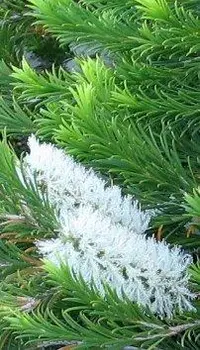
Bracelet honey myrtle (Melaleuca armillaris) is an evergreen shrub or small tree from the myrtle family, valued for its fine foliage and white, bottlebrush-like flowers. It naturally occurs in coastal regions of southeastern Australia, where it often grows on rocky slopes and poor, sandy soils.
Plants develop an arching, layered habit that can form dense screens or windbreaks in mild climates. Once established, it tolerates wind, salt spray, and short dry periods, which makes it relatively low-maintenance in suitable outdoor conditions.
To care for Bracelet honey myrtle, provide full sun, well-drained soil, and protection from severe frost, as prolonged cold and waterlogged ground can limit its performance and lifespan.

Care Difficulty
Easy Care

Light Preference
Full Sun

Water Requirements
Low Water

Temperature Preference
Warm Climate

Hardiness Zone
8–11

Soil Texture
Sandy, Loamy, Rocky

Soil pH
Acidic (5.5–6.5), Slightly acidic (6.5–7.0)

Soil Drainage
Well-drained

Fertilization
Minimal (feed rarely)
Scan your plant to receive care tips personalized for your specific plant
Available on iOS and Android
Melaleuca armillaris prefers bright, open conditions that mimic its native coastal habitat.
Melaleuca armillaris is drought-tolerant once established and prefers to dry slightly between deep waterings.
This shrub thrives in mild, coastal-type climates with warm summers and frost-free winters.
Humidity is a minor factor for this species and it adapts well to typical outdoor and indoor household conditions.
Soil should be lean, fast-draining, and slightly acidic to neutral to mimic coastal scrub conditions.
This species can be grown in containers, especially in mild climates or where garden space is limited.
This adaptable Australian shrub needs only modest feeding, especially when grown in the ground.
Pruning helps maintain size, density, and safe structure in Melaleuca armillaris.
This species is most often grown in the ground, where careful transplanting matters more than repotting.
Melaleuca armillaris is commonly propagated by semi-hardwood cuttings and sometimes by seed.
This coastal shrub is moderately frost tolerant but benefits from some winter protection in colder regions.

Plant Health Check
Not sure what's wrong with your plant? Check your plant's health inside the app.
This species naturally forms dense, wind-pruned thickets on exposed sea cliffs and dunes in southern Australia, tolerating strong salt-laden winds that damage many other shrubs and trees.
It produces heavy flushes of small white bottlebrush-like flowers along the slender branches, providing a concentrated nectar resource that strongly attracts bees and other pollinators in its native range.
Older stems develop thick, layered, papery bark beneath long chains of woody seed capsules, which remain attached for years and gradually release tiny seeds after heat or branch death.

In parts of southern Australia, this species has been extensively planted as a living roadside and farm windbreak, where its fast growth, dense branching, and high tolerance of pruning allow it to be maintained as a clipped hedge several meters high with minimal inputs, making it a model case for Melaleuca armillaris plant care in harsh coastal corridors.
Poor flowering often follows hard pruning at the wrong time, deep shade, or nutrient imbalance from excess nitrogen. Lightly prune only after flowering, provide full sun exposure, and use a low-phosphorus, balanced fertilizer if soil is very poor.
Keep your plants happy and healthy with plant identification, disease detection, and easy care guidance.