Host tree selection
Choose older, declining broadleaf trees (especially beech) in low-traffic areas, since this fungus is a root and butt rot pathogen and can weaken otherwise valuable landscape trees.

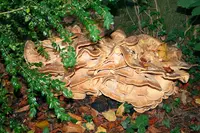
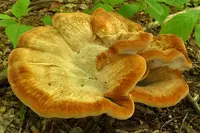
Giant polypore, Meripilus giganteus, is a large bracket fungus rather than a traditional leafy plant. It forms massive, layered rosettes of overlapping, fan-shaped caps at the base of trees, especially beech. The surface is usually brown to tan, darkening when bruised, with pale pore surfaces underneath.
This species occurs mainly in Europe and North America, growing on living or dead hardwood roots and lower trunks. It is valued more for its ecological role in wood decay than for culinary use.
For those who want to care for Giant Polypore in a managed landscape, it is important to remember it favors moist, shaded, well-aerated sites with decaying wood as its main resource.

Care Difficulty
Moderate Care

Light Preference
Partial Shade

Water Requirements
Keep Soil Moist

Temperature Preference
Cool Climate

Hardiness Zone
4–9

Soil Texture
Loamy, Clay, Organic-rich

Soil pH
Acidic (5.5–6.5), Slightly acidic (6.5–7.0)

Soil Drainage
Moist but well-drained

Fertilization
Minimal (feed rarely)
Scan your plant to receive care tips personalized for your specific plant
Available on iOS and Android
This wood-decay fungus prefers shaded woodland conditions with limited direct sun exposure.
This fungus depends on consistently moist wood and soil rather than direct watering of the fruiting bodies.
This species is adapted to temperate climates with cool to mild growing seasons.
Humidity is not a major control factor for Meripilus giganteus compared with moisture and substrate conditions.
Meripilus giganteus requires persistently moist, organic-rich substrate rather than typical garden mineral soil.
This species is generally unsuitable for container growing because it naturally colonizes large stumps or roots in the ground, making confinement impractical and unstable long term.
This wood-decay fungus grows on tree roots and typically does not benefit from supplemental fertilization.
Pruning for Meripilus giganteus is limited to hygienic removal of old fruiting bodies rather than shaping growth.
Meripilus giganteus is a root-decay fungus of trees, so transplanting focuses on site ethics rather than plant health.
Propagation of Meripilus giganteus is generally left to natural spore dispersal and is not recommended for home cultivation.
This fungus is naturally cold hardy in temperate climates and does not need active winter care.

Plant Health Check
Not sure what's wrong with your plant? Check your plant's health inside the app.
This fungus forms very large, multi-layered rosettes of overlapping caps that can weigh several kilograms and reappear from the same root zone year after year.
It is a parasitic and saprotrophic fungus that attacks the structural roots and lower trunk (butt) of broadleaf trees, especially beech, often causing serious decay and instability while continuing to live on dead wood.
When bruised, handled, or drying, its pale surfaces slowly turn dark brown to black, a striking color change that helps distinguish it from similar bracket fungi.

Genetic studies have shown that what was once treated as a single, widespread species under this name actually represents a complex of closely related Meripilus lineages, with European material now restricted to Meripilus giganteus in a stricter sense.
This fungus can develop large fruiting bodies within 1–3 months once established on suitable wood, often appearing rapidly in late summer. Growth rate depends on log size, moisture, and temperature, rather than traditional plant growth factors.
Keep your plants happy and healthy with plant identification, disease detection, and easy care guidance.