

Salt-tolerant siting
Use this plant in coastal or roadside spots with slightly saline or poor sandy soils where more sensitive species struggle, but still avoid areas with standing water or heavy clay that stays wet after rain.

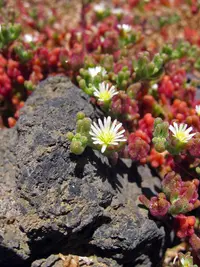
Slenderleaf iceplant, Mesembryanthemum nodiflorum, is a small, low-growing succulent often forming loose mats of fleshy, narrow leaves. The foliage and stems are covered with tiny, glistening bladder cells that look like ice crystals. This species occurs naturally in coastal and saline habitats, especially around the Mediterranean region and in other mild, dry climates where it can naturalize. It grows quickly, sets many small flowers and seeds, and can behave as an annual in cooler areas. Its tolerance of drought, poor soils, and salt spray makes it relatively easy to grow, though it may spread where conditions suit it. To care for slenderleaf iceplant, provide strong light, fast-draining soil, and only occasional watering.

Care Difficulty
Easy Care

Light Preference
Full Sun

Water Requirements
Low Water

Temperature Preference
Tropical / Frost Sensitive

Hardiness Zone
9–11

Soil Texture
Sandy, Loamy, Rocky

Soil pH
Slightly alkaline (7.0–7.5), Alkaline (7.5–8.5)

Soil Drainage
Well-drained

Fertilization
Minimal (feed rarely)
Scan your plant to receive care tips personalized for your specific plant
Available on iOS and Android
Mesembryanthemum nodiflorum thrives in strong, direct light typical of open, coastal or dry sites.
This coastal succulent needs infrequent, light watering and dries quickly between soakings.
This species prefers warm, dry conditions and copes well with heat but has limited frost tolerance.
This coastal succulent tolerates very dry air and rarely needs humidity adjustment indoors.
This species needs very fast-draining, mineral-rich soil to prevent root rot.
This succulent is well suited to container growing outdoors in sunny, dry locations.
Mesembryanthemum nodiflorum is adapted to poor, sandy soils and needs only light feeding under cultivation.
Pruning Mesembryanthemum nodiflorum is simple and mainly keeps the mat compact and tidy.
This shallow-rooted succulent is often grown in the ground, but container plants may need occasional transplanting.
Mesembryanthemum nodiflorum is commonly propagated from both seeds and short stem cuttings.
This species prefers mild, dry winters and has limited tolerance to prolonged hard frost.

Plant Health Check
Not sure what's wrong with your plant? Check your plant's health inside the app.
This annual succulent is naturally adapted to saline coastal habitats such as salt marshes and sandy shores, where many other species cannot survive, and often forms low, dense mats close to the ground.
Its fleshy leaves can excrete excess salt through specialized cells, leaving visible salt crystals on the surface, an adaptation that allows the plant to thrive in high-salinity soils.
Outside its native range in southern Africa, it behaves as a pioneer and sometimes invasive species along disturbed coasts of the Mediterranean, California, and parts of Australia, where it can quickly colonize bare, salty substrates.

This species plays a role in coastal soil stabilization by binding loose, saline sand with its shallow but spreading root system and low mat-forming growth, which helps reduce erosion in exposed shorelines and salt marsh edges.
This species grows quickly in warm, bright, dry conditions, often filling small gaps in 1–2 seasons. Growth slows in cool weather, nutrient-poor substrates, or with frequent disturbance such as foot traffic or repeated trimming.
Keep your plants happy and healthy with plant identification, disease detection, and easy care guidance.

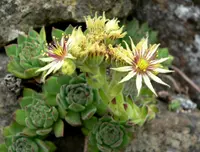
yellow-flowered houseleek
Sempervivum grandiflorum

Greater Plantain
Plantago major
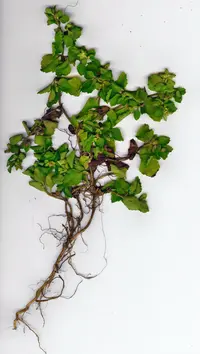
Paraguayan starbur
Acanthospermum australe
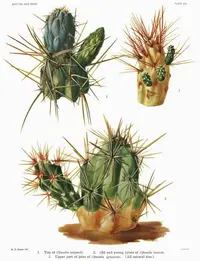
Miqueliopuntia
Miqueliopuntia miquelii
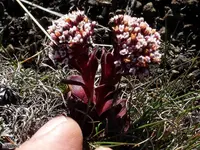
Crassula natalensis
Crassula natalensis
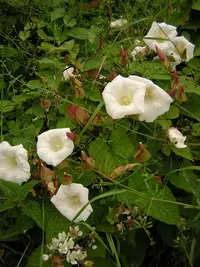
Large Bindweed
Calystegia silvatica
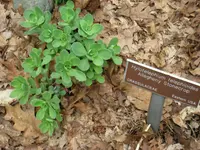
Allegheny stonecrop
Hylotelephium telephioides
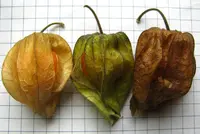
clammy groundcherry
Physalis heterophylla