Wind-hardening young plants
Expose young trees to increasing wind over several weeks or stake them loosely so trunks flex, which encourages stronger wood and better long-term storm resistance when growing ohi'a lehua outdoors.

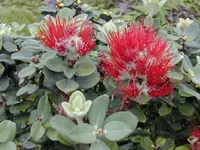
Ohi'a lehua, Metrosideros polymorpha, is an evergreen tree or large shrub native to Hawaiʻi, where it dominates many native forests from coast to high elevation. It has leathery, often small leaves and showy, brush-like flower clusters that range from bright red to orange, yellow, or rarely pink.
This species is highly adaptable in the wild, tolerating wind, poor lava soils, and varying moisture, but it can be slow-growing and sensitive when young in cultivation. Understanding how to care for ohi'a lehua means respecting its need for sun, excellent drainage, and steady but not excessive moisture.

Care Difficulty
Hard Care

Light Preference
Full Sun

Water Requirements
Moderate Water

Temperature Preference
Tropical / Frost Sensitive

Hardiness Zone
10–12

Soil Texture
Sandy, Loamy, Rocky

Soil pH
Strongly acidic (4.5–5.5), Acidic (5.5–6.5)

Soil Drainage
Well-drained

Fertilization
Minimal (feed rarely)
Scan your plant to receive care tips personalized for your specific plant
Available on iOS and Android
This species thrives in strong light and is adapted to open, exposed sites.
This species prefers evenly moist, fast-draining soil and is adapted to periodic drying.
This plant is adapted to mild, frost-free climates with moderate temperature swings.
This species handles a range of humidity but grows best with moderately moist air.
Soil should be fast-draining yet moisture-retentive enough to support steady growth.
This species can be grown in containers if the pot is chosen and managed carefully.
Metrosideros polymorpha is adapted to low-nutrient conditions, so use fertilizer sparingly, especially for in-ground plants.
Pruning Metrosideros polymorpha focuses on safety, structure, and light management rather than frequent shaping.
Metrosideros polymorpha is usually grown in the ground, so transplanting young plants correctly is more important than frequent repotting.
Propagation of Metrosideros polymorpha is possible but moderately challenging and often slow.
This species comes from mild, frost-free climates and needs protection in regions with cold winters, especially in containers.

Plant Health Check
Not sure what's wrong with your plant? Check your plant's health inside the app.
This species grows from near sea level to over 2,000 m on Hawaiian volcanoes, tolerating everything from wet rainforests to dry lava flows and even cold, high-elevation cloud forests.
It is one of the first woody plants to establish on fresh lava, where its roots penetrate cracks, trap organic matter, and help create the first true soil on new volcanic landscapes.
Different populations show striking variation in leaf size, thickness, and hairiness, with some forms adapted to intense sun and drought and others to cool, cloudy, high-rainfall environments.

In native Hawaiian forests, this species is a keystone nectar source for endemic honeycreepers such as the ʻapapane and ʻiʻiwi, which have evolved curved bills that closely match the shape and positioning of its flowers.
This species can be grown in large, deep containers with excellent drainage and a coarse, low-phosphorus mix. Container culture helps control size and soil conditions but requires consistent monitoring of moisture, root health, and nutrient levels.
Keep your plants happy and healthy with plant identification, disease detection, and easy care guidance.