Use Branch Mounts
Mount rhizomes on a piece of cork or hardwood bark with sphagnum only under the roots, leaving the top of the rhizome exposed so new fronds can creep and attach naturally.

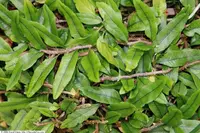
Clubmoss snakefern, Microgramma lycopodioides, is an epiphytic fern often found growing on tree trunks, rocks, or old wood in tropical and subtropical regions of the Americas. It forms slender, creeping rhizomes with small, narrow fronds that can create a delicate, trailing mat over time.
In nature it prefers shaded, humid forest environments with good air movement and consistently moist, but not waterlogged, surfaces. Indoors it is moderately easy if its need for steady moisture and higher humidity is respected. For anyone learning how to care for clubmoss snakefern, the key traits to understand are its shallow, spreading roots and sensitivity to drying out completely.

Care Difficulty
Moderate Care

Light Preference
Partial Shade

Water Requirements
Keep Soil Moist

Temperature Preference
Tropical / Frost Sensitive

Hardiness Zone
10–12

Soil Texture
Loamy, Peaty, Organic-rich

Soil pH
Acidic (5.5–6.5), Slightly acidic (6.5–7.0)

Soil Drainage
Moist but well-drained

Fertilization
Light (every 4–6 weeks)
Scan your plant to receive care tips personalized for your specific plant
Available on iOS and Android
This epiphytic fern prefers bright, filtered light similar to a forest understory.
This fern prefers evenly moist conditions without staying waterlogged.
This species favors warm, stable temperatures similar to a tropical forest environment.
This epiphytic fern prefers consistently moist air and reacts quickly to dry indoor conditions.
Microgramma lycopodioides benefits from a loose, airy, and fast-draining mix that mimics its natural epiphytic habit on trees or rocks.
This species adapts very well to container culture when its shallow, creeping rhizomes are considered in pot choice.
This epiphytic fern prefers light feeding, as roots are adapted to low-nutrient habitats.
Pruning needs for Microgramma lycopodioides are light and mainly hygienic.
This fern prefers stable conditions and only occasional repotting or remounting.
Propagation is most reliable by division of rhizomes rather than from spores for home growers.
This subtropical fern is not frost hardy and needs protection in regions with cold winters.

Plant Health Check
Not sure what's wrong with your plant? Check your plant's health inside the app.
This species naturally grows as a creeping epiphyte on tree trunks and branches in tropical forests, rooting along its thin rhizomes rather than in deep soil. Its small, spaced leaves follow the line of the host branch, forming narrow, trailing mats instead of dense rosettes or clumps.
The narrow, cylindrical rhizomes and small, overlapping leaves give this fern a superficial resemblance to true clubmosses in the genus Lycopodium, which is reflected in the species name lycopodioides. Despite the similarity, it is a true fern and produces spores on the undersides of its leaves rather than cones.
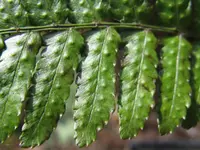
The round sori, which are the spore-bearing structures, appear as distinct button-like dots on the undersides of the mature leaves. Their regular spacing and clear outline make this fern relatively easy to distinguish from many other fine-leaved epiphytic ferns.

This species is native to lowland and montane forests of the Neotropics, where it often forms part of complex epiphytic communities on branches already covered by mosses, lichens, and other small ferns, contributing to the multi-layered microhabitats that support invertebrates and tiny amphibians.
This species grows from creeping rhizomes that slowly spread across the surface of soil, moss, or bark. Fronds arch or trail rather than climb, so it functions more as a small-scale ground cover or cascading plant.
Keep your plants happy and healthy with plant identification, disease detection, and easy care guidance.