Indian Cork Tree Care (Millingtonia hortensis)

Indian Cork Tree

About Indian Cork Tree

Indian cork tree, Millingtonia hortensis, is a fast-growing, semi-evergreen tree valued for its tall, narrow form and fragrant white tubular flowers. It is commonly used as an ornamental avenue or garden tree in warm climates.

This species is native to South and Southeast Asia, where it grows in tropical and subtropical regions. In suitable conditions it develops a straight trunk, light feathery foliage, and a softly textured canopy.

It prefers full sun, well-drained soil, and moderate moisture, and it responds well to regular light pruning when young. These traits make it relatively manageable for experienced gardeners who want to learn how to care for Indian Cork Tree in larger outdoor spaces.

Main Plant Requirements

Care Difficulty

Moderate Care

Light Preference

Full Sun

Water Requirements

Moderate Water

Temperature Preference

Tropical / Frost Sensitive

Hardiness Zone

10–11

Soil Texture

Loamy, Sandy, Organic-rich

Soil pH

Acidic (5.5–6.5), Slightly acidic (6.5–7.0)

Soil Drainage

Well-drained

Fertilization

Minimal (feed rarely)

Get Personalized Care Plan

Scan your plant to receive care tips personalized for your specific plant

Available on iOS and Android

How to Care for the Indian Cork Tree

This fast-growing tropical tree needs abundant light for strong flowering and upright growth.

  • Provide 6–8 hours of direct sun daily, ideally with gentle morning sun and some light afternoon shade in very hot climates.
  • Young trees tolerate partial shade but may flower less; aim for at least 4 hours of unshaded light once established for Indian Cork Tree.
  • Avoid harsh, all-day overhead summer sun that can scorch new leaves; in winter, ensure unobstructed exposure to prevent thin, leggy growth.

This tree prefers evenly moist but not saturated soil, especially during active growth and flowering.

  • Before watering, let the top 3–5 cm of soil dry; in hot seasons this may mean deep watering 1–2 times per week in well-drained ground.
  • Reduce watering frequency in cooler months, allowing the soil to dry slightly deeper while avoiding complete, prolonged dryness around the root zone.
  • Watch for yellowing, soft leaves as a sign of overwatering and very dry, curled leaves or twig dieback as a sign Millingtonia hortensis is staying too dry.

This subtropical tree thrives in warm climates and is sensitive to cold and frost.

  • Optimal growth occurs around 70–90°F (21–32°C), with steady warm conditions promoting stronger shoots and better flowering.
  • The tree is frost-tender; brief drops near 32°F (0°C) can damage young growth, and sustained temperatures below 28°F (-2°C) may kill branches or young plants.
  • It tolerates dry heat up to about 100°F (38°C) if soil moisture is maintained, but hot, dry winds increase leaf scorch, especially on newly planted trees.

This species prefers moderate humidity but usually adapts to typical household air if roots are well managed.

  • Aim for 40–60% humidity; Indian Cork Tree tolerates brief dips lower if soil moisture is stable.
  • Crisping leaf margins, slowed growth, and bud drop often indicate air that is too dry or uneven watering.
  • Increase humidity locally with grouped plants, a wide pebble tray under the pot, or short, occasional use of a room humidifier.

Soil for Millingtonia hortensis should be free-draining, moderately fertile, and slightly moisture-retentive without staying wet.

  • Use a loamy mix with 40–50% organic matter, such as compost, plus coarse sand or fine grit to keep structure open.
  • Ensure fast drainage; the mix should drain within a few seconds of watering and not form sticky clods when squeezed.
  • Target a slightly acidic to neutral pH around 6.0–7.0, avoiding very alkaline soils that can limit nutrient availability.
  • In heavy or compacted ground, incorporate coarse sand or perlite through the top 20–30 cm to improve aeration and root penetration.

This tree can be grown in containers for some years, especially in warm climates or where winter protection is needed.

  • Choose a deep, heavy container that resists tipping, as tall upright growth becomes top-heavy in wind or on balconies.
  • Select a pot material with moderate porosity, such as thick-walled clay, to help prevent waterlogging while avoiding rapid drying.
  • Leave a generous unfilled rim space at the top of the pot so thorough watering does not overflow and erode the mix surface.

Millingtonia hortensis responds well to modest feeding in containers or poor soils, but established trees in fertile ground need very little.

  • Use a balanced NPK granular or slow-release fertilizer at half strength for young or potted plants at the start of spring.
  • Feed every 6–8 weeks through the warm growing season if growth appears weak or leaves pale.
  • Incorporate compost or well-rotted manure as a light top-dress to improve soil structure and biology.
  • Stop fertilizing in late fall and during winter dormancy to avoid soft, frost-sensitive growth.

Pruning Millingtonia hortensis is mainly used to manage height, structure, and safe clearance.

  • Carry out structural pruning in late winter or very early spring before vigorous new growth starts.
  • Remove dead, diseased, storm-damaged, or crossing branches with sharp, clean bypass pruners or a pruning saw.
  • Thin congested inner branches to improve airflow and light penetration, which supports healthier foliage and flowering.
  • Limit heading cuts on main leaders; instead, shorten or remove selected laterals to control size while keeping a natural crown.

This species is usually grown in the ground, so focus on careful transplanting of young Millingtonia hortensis rather than frequent repotting.

  • Transplant in late spring or early summer once frost risk has passed and soil is warm.
  • Look for roots circling the pot, water running straight through, or slowed growth as signs a container seedling needs a larger space.
  • Handle the root ball gently, loosening only lightly to reduce root stress and avoid major disturbance.
  • Plant into a larger hole with free-draining soil, backfill firmly, water deeply, then shade and keep evenly moist for several weeks.

Propagation of Millingtonia hortensis is most practical from seed, with some growers also using semi-ripe cuttings.

  • Collect ripe seeds and sow them fresh in late spring in a free-draining, sterile seed mix kept at 70–80°F.
  • Barely cover seeds, maintain consistent moisture, and provide bright, indirect light to support even germination.
  • Take semi-ripe cuttings in early summer, use rooting hormone, and place in a humid, warm environment with good airflow.
  • Label young plants clearly and pot on gradually as roots fill containers, avoiding sudden shifts in light or moisture.

In warm climates Indian Cork Tree needs minimal winter care, but it is sensitive to frost and prolonged cold.

  • In regions below about 30–32°F, grow Millingtonia hortensis in a large container that can be moved to a bright, frost-free space for winter.
  • Mulch the root zone with 5–8 cm of organic material in fall to buffer soil temperature and conserve moisture.
  • Avoid heavy pruning or nitrogen-rich feeding in late fall, which can trigger tender growth more vulnerable to freezing damage.

Care Tips

Establish strong leader

Select one central trunk while the tree is young, remove competing upright shoots, and lightly stake it for 1–2 years so the canopy forms high enough for good airflow and easier access under the tree later.

Encourage flowering flush

In warm climates, lightly tip-prune only the outer 10–15 cm of vigorous shoots at the end of the cool dry season to stimulate new flowering wood without removing too many potential flower buds.

Protect shallow roots

Avoid deep cultivation or heavy foot traffic within the drip line, and use a 5–8 cm organic mulch layer instead of lawn right against the trunk, because the root system is relatively shallow and easily damaged.

Plan for leaf litter

Site the tree where falling leaves and flowers can remain as a natural mulch or be easily raked, because the steady litter under a mature specimen can stain hardscape and clog drains if not managed.

Monitor for borers

Inspect the trunk and main branches 2–3 times per year for small exit holes, frass (sawdust-like material), or dieback, and remove affected branches promptly while improving tree vigor, as early borer detection is critical when caring for Indian Cork Tree.

Common Pests and Diseases

Leaf webworm

This pest is the larval stage of a moth that feeds on foliage and stitches leaves together with silk, often leading to defoliation on young trees. Symptoms include rolled or webbed leaves, skeletonized leaf surfaces, and visible greenish caterpillars inside the webs.

Solution

Prune and destroy webbed or heavily infested shoots, then manually remove remaining caterpillars where reachable. For larger infestations, use a targeted biological insecticide containing Bacillus thuringiensis (Bt) on young larvae and encourage natural predators by avoiding broad-spectrum insecticides.

Bark-boring beetles

These insects tunnel into twigs and stems, disrupting the flow of water and nutrients and weakening the tree. Symptoms include small round exit holes, sawdust-like frass on the bark or at the base, and dieback of affected branches.

Solution

Cut and dispose of infested branches as soon as dieback and boring dust are noticed, then keep the tree well watered and unstressed so it can resist further attack. In areas with repeated problems, use trunk or branch sprays with a registered systemic insecticide timed to adult beetle activity, following local label directions.

Scale insects

These insects attach along stems and leaf veins, sucking sap and excreting honeydew that can lead to sooty mold on foliage. Symptoms include small brown or gray bumps on twigs, sticky leaves, and a general loss of vigor.

Solution

Wipe or gently scrub infested stems with a soft cloth or brush dipped in mild soapy water or horticultural oil, then repeat every 7–14 days until numbers drop. For heavier infestations, apply a horticultural oil spray that thoroughly coats stems and the undersides of leaves, and prune out badly affected twigs.

Sooty mold

This disease is a group of superficial fungi that grow on the sugary honeydew left by sap-sucking insects like scales or aphids. Symptoms include black, soot-like coating on leaves and twigs that can reduce photosynthesis and make foliage look dull and dirty.

Solution

Control the underlying honeydew-producing insects first, then gently wash leaves with water or mild soapy water to remove the fungal film. Improve light penetration and airflow through selective pruning so new leaves remain drier and less prone to recurring growth.

Leaf spot

This disease causes small brown or black spots on leaves that may enlarge, sometimes with a yellow halo and early leaf drop in humid or rainy conditions. Symptoms include scattered lesions, more prominent on older leaves, and thinning foliage on stressed trees.

Solution

Remove and discard fallen and heavily spotted leaves, then water at the base rather than overhead to keep foliage dry. In areas with persistent wet weather or recurring issues, improve spacing and air circulation, and use a copper-based or other labeled fungicide during periods of high humidity according to product directions for Millingtonia hortensis care instructions.

Interesting Facts

Night-scented blossoms

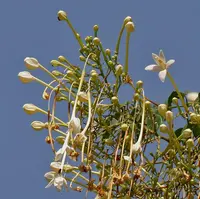
The flowers open mainly in the evening and release a strong, sweet fragrance at night, which helps attract nocturnal pollinators such as moths. By morning many flowers drop, forming a white carpet beneath the tree.

Tubular corolla design

Each flower has a narrow, tube-like corolla up to several centimeters long that flares into 4 star-like lobes, an adaptation that guides long-tongued pollinators toward the nectar and reproductive parts of the flower.

Light-demanding canopy tree

In its native range the species typically grows as an emergent or upper-canopy tree in warm regions, performing best in full sun and open sites rather than shaded forest understory.

Botan icon

Did you know?

The species produces long, pod-like capsules packed with many flat, winged seeds that are adapted for wind dispersal, allowing the tree to colonize open, sunny areas quite efficiently when conditions are suitable.

FAQs about Indian Cork Tree

Lack of flowering usually relates to plant immaturity, insufficient light, or heavy pruning at the wrong time, which removes flower buds. Nutrient imbalance with excess nitrogen can also reduce blooms. Stable warmth and moderate feeding support reliable flowering.

Grow Healthy Plants with Botan Care

Keep your plants happy and healthy with plant identification, disease detection, and easy care guidance.

Botan plant care app — identify plants on mobile

Explore More Plants