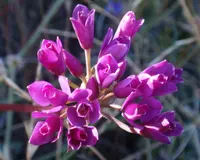
Night-scent placement
Site plants where evening air circulates past patios, open windows, or seating areas so the long, tubular flowers can release their strongest fragrance without being blocked by tall shrubs or solid fences.


Sweet four o'clock (Mirabilis longiflora) is a fragrant, night-blooming perennial often grown as an annual in cooler climates. It belongs to the same group as the common four o'clock but has longer, tubular flowers.
Plants typically form low, branching clumps with narrow leaves and clusters of slender white to pale pink blooms that open in the evening. The strong, sweet scent attracts moths and other night pollinators.
In the wild, Mirabilis longiflora is native to arid and semi-arid regions of the southwestern United States and northern Mexico. Its drought tolerance and tuberous roots make it fairly forgiving, so learning how to care for sweet four o'clock is manageable for most gardeners.
It generally prefers full sun, well-drained soil, and moderate watering once established.

Care Difficulty
Easy Care

Light Preference
Full Sun

Water Requirements
Moderate Water

Temperature Preference
Tropical / Frost Sensitive

Hardiness Zone
8–10

Soil Texture
Sandy, Loamy, Rocky

Soil pH
Slightly acidic (6.5–7.0), Neutral (7.0)

Soil Drainage
Well-drained

Fertilization
Minimal (feed rarely)
Scan your plant to receive care tips personalized for your specific plant
Available on iOS and Android
This night-blooming perennial prefers bright, direct light but benefits from some shade in hot climates.
This drought-tolerant species prefers deep, infrequent watering once established.
This plant thrives in warm conditions and performs best in climates with mild winters.
Mirabilis longiflora handles 30–50% humidity well and rarely needs special humidity management.
Mirabilis longiflora prefers loose, well-drained, slightly fertile soil that does not stay wet.
This species is suitable for container growing outdoors when the pot allows deep root development and free drainage.
This species benefits from light, balanced feeding during active growth but does not need heavy fertilization.
Pruning Mirabilis longiflora is mainly done to keep plants tidy and encourage repeat flowering.
This plant forms a deep tuber and is usually better suited to in-ground planting than long-term container culture.
Mirabilis longiflora is most often propagated from seeds, with tuber division used more cautiously.
This tuberous perennial has moderate frost tolerance but benefits from some winter protection in colder regions.

Plant Health Check
Not sure what's wrong with your plant? Check your plant's health inside the app.
This species opens its long, tubular flowers in the evening and releases a strong sweet fragrance at night, then closes them again by mid-morning.
The very long floral tubes match the proboscis length of nocturnal hawkmoths, which are its primary pollinators and can reach the nectar deep inside the flowers.
It is native to arid and semi-arid regions of the southwestern United States and northern Mexico, where it grows in dry, rocky soils and scrub habitats.

The species forms a deep, tuberous root system that allows it to survive extended dry periods and resprout after drought, an adaptation that supports long-term persistence in harsh desert climates.
Lack of flowers usually comes from insufficient light, overfertilizing with high-nitrogen products, or plants that are still immature. Ensure strong sun, avoid heavy feeding, and do not disturb tuberous roots during the growing season.
Keep your plants happy and healthy with plant identification, disease detection, and easy care guidance.