

Mulch For Coolness
Apply a 3–5 cm layer of fine bark or leaf mold around the clump each spring to keep roots cool, conserve moisture, and reduce weed competition without burying the crown.

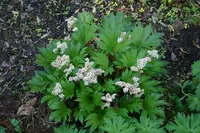
Mukdenia rossii is a hardy, herbaceous perennial grown mainly for its striking foliage and early spring flowers. It forms low clumps, sending up scalloped, maple-like leaves that often develop red or bronze tints in cool weather. In early spring, it produces airy stems of small white flowers before the foliage reaches full size.
This species is native to rocky, woodland slopes in East Asia, especially Korea and China. It prefers partial shade, consistently moist but well-drained soil, and cool conditions. Once established, it is relatively low-maintenance, which makes it straightforward to care for Mukdenia rossii in suitable climates.

Care Difficulty
Moderate Care

Light Preference
Partial Shade

Water Requirements
Regular Water

Temperature Preference
Cold Hardy

Hardiness Zone
4–8

Soil Texture
Loamy, Silty, Organic-rich

Soil pH
Acidic (5.5–6.5), Slightly acidic (6.5–7.0)

Soil Drainage
Moist but well-drained

Fertilization
Minimal (feed rarely)
Scan your plant to receive care tips personalized for your specific plant
Available on iOS and Android
This woodland perennial prefers bright, gentle light that mimics dappled forest conditions.
This plant favors consistently moist, cool soil without becoming waterlogged.
This hardy perennial is adapted to cool to mild climates with pronounced seasonal change.
This woodland perennial prefers moderately moist air but usually adapts to typical outdoor humidity levels.
Mukdenia rossii grows best in loose, humus-rich soil that stays evenly moist yet drains freely.
This species is suitable for containers when moisture and shade needs can be managed consistently.
This woodland perennial benefits from light feeding but grows acceptably in fertile, organic soil without extra inputs.
Pruning needs for Mukdenia rossii are minimal and focus on cleanliness rather than reshaping.
This species is usually grown in the ground and only occasionally kept in containers for display.
New plants are most reliably produced by division rather than seed.
This hardy perennial tolerates typical temperate winters with limited intervention once established.

Plant Health Check
Not sure what's wrong with your plant? Check your plant's health inside the app.
The emerging leaves often start bronze or reddish in early spring and gradually turn bright green, creating a strong seasonal color contrast before any flowers appear.
In its native range in Korea and parts of northeastern China, this species is frequently found on cool, rocky slopes and basalt cliffs, indicating a natural adaptation to thin, fast-draining soils.
Its small white star-shaped flowers open in early to mid spring, providing nectar and pollen for early-season pollinators when few other perennials are in bloom.

This species has been used in breeding compact ornamental cultivars such as Mukdenia rossii 'Crimson Fans', which combine the parent’s shade tolerance with stronger red leaf coloration for use in temperate gardens.
This species spreads slowly by short rhizomes, forming small clumps rather than running widely. It can gradually widen over several years but is not considered aggressive and usually stays within its planted area.
Keep your plants happy and healthy with plant identification, disease detection, and easy care guidance.

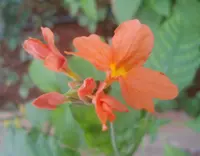
Firecracker flower
Crossandra infundibuliformis
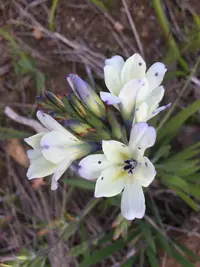
Strict Bobbejaantjie
Babiana nervosa
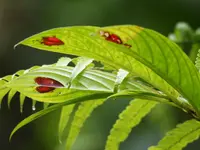
Blood of Christ
Columnea consanguinea
Anacyclus × valentinus
Anacyclus × valentinus
fierce Spaniard
Aciphylla ferox
Gireoud's brassia
Brassia gireoudiana
Short-flower Deervetch
Acmispon parviflorus
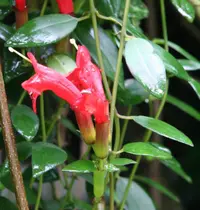
Lipstick plant
Aeschynanthus radicans