Dwarf Banana Care (Musa acuminata 'Super Dwarf Cavendish')

Also known as: Banana
Dwarf Banana

About Dwarf Banana

Musa acuminata 'Super Dwarf Cavendish' is a compact banana cultivar grown mainly as an ornamental and indoor fruiting plant. It stays much shorter than standard banana varieties, which makes it suitable for containers and small spaces.

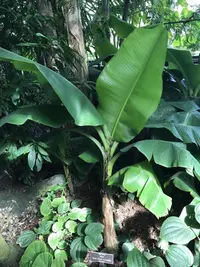
The plant forms a tight clump of broad, paddle-shaped leaves with a tropical look. In good conditions it can produce small edible bananas similar to regular dessert bananas.

This cultivar originates from tropical ancestors found in Southeast Asia but is now cultivated worldwide. Its fast growth and need for warmth, bright light, and consistent moisture influence how to care for Dwarf Banana and keep it healthy indoors.

Main Plant Requirements

Care Difficulty

Moderate Care

Light Preference

Partial Sun

Water Requirements

Keep Soil Moist

Temperature Preference

Tropical / Frost Sensitive

Hardiness Zone

9–11

Soil Texture

Loamy, Sandy, Organic-rich

Soil pH

Acidic (5.5–6.5), Slightly acidic (6.5–7.0)

Soil Drainage

Moist but well-drained

Fertilization

Heavy (weekly, diluted)

Get Personalized Care Plan

Scan your plant to receive care tips personalized for your specific plant

Available on iOS and Android

How to Care for the Dwarf Banana

This compact banana thrives with bright light that balances strong growth and leaf protection.

  • Provide 6–8 hours of light daily, with morning sun and afternoon filtered light or light shade to prevent leaf scorch.
  • Outdoors, give Musa acuminata 'Super Dwarf Cavendish' dappled sun under taller plants in hot climates; in cooler areas it tolerates more direct sun.
  • Watch leaves: pale, stretched growth indicates too little light, while crisp brown patches or curled edges signal excessive intense sun exposure.

This banana prefers consistently moist but not waterlogged soil to support fast foliage growth.

  • Water when the top 3–5 cm of soil feels dry, soaking thoroughly so excess drains away, then let the surface dry again.
  • In warm growing seasons, expect more frequent watering; in cooler months or slower growth, extend intervals and rely on soil feel, not a fixed schedule.
  • Yellowing lower leaves, soft pseudostems, or sour odor suggest overwatering, while drooping, curling, or brittle leaves indicate the plant needs moisture.

Stable warm temperatures are important for steady growth and leaf production.

  • Aim for 70–85°F (21–29°C) for active growth, as this range supports rapid leaf and root development.
  • Protect the plant when temperatures fall near 55°F (13°C); growth slows below this and tissue damage occurs near 40°F (4°C) or with any frost.
  • In hot spells above 95°F (35°C), increase shade and airflow, and avoid dark, heat-reflecting surfaces around the plant to reduce stress.

This compact banana benefits from elevated humidity but adapts to typical indoor levels if other care is stable.

  • Aim for 50–70% humidity to support steady growth and reduce leaf edge browning.
  • Tolerates short periods around 30–40% but extended dry air causes crispy margins, curled leaves, and stalled new growth.
  • Increase humidity with a nearby humidifier or grouped plants; avoid misting leaves heavily to reduce risk of fungal spotting on Dwarf Banana.

This banana prefers a deep, loose, organic-rich, and fast-draining substrate that still holds consistent moisture.

  • Use a mix of roughly 50% peat or coco coir, 30% compost, and 20% perlite or pumice for moisture retention with strong drainage.
  • Aim for slightly acidic to neutral pH around 6.0–7.0, which supports nutrient uptake for Musa acuminata 'Super Dwarf Cavendish'.
  • Incorporate chunky materials like bark fines to increase aeration and prevent compaction around thick, fibrous roots.
  • Avoid heavy clay, poorly draining mixes, or constantly waterlogged conditions, which promote root rot and weak growth.

This dwarf banana is well suited to container culture when the pot supports its fast root growth and top-heavy form.

  • Choose a wide, heavy container to counterbalance tall foliage and reduce the risk of tipping in wind or from accidental knocks.
  • Select slightly porous materials like thick terracotta only if frequent watering is manageable, as they allow faster evaporation and cooler root zones.
  • Ensure a deep substrate column so roots can anchor firmly, which improves plant stability and reduces mechanical stress on the pseudostem.

This compact banana benefits from steady nutrition during its active growing season for strong foliage and possible fruiting.

  • Use a balanced liquid fertilizer (around 10-10-10 or 20-20-20) diluted to 1/2 strength every 2–3 weeks in spring and summer.
  • Alternatively, apply a slow-release balanced fertilizer at the start of the growing season, following label rates.
  • Supplement with a thin layer of well-rotted compost on the soil surface to improve structure and micronutrients.
  • In fall and winter, when growth slows, reduce feeding to monthly at 1/4 strength or pause if light and temperatures are low.

Pruning Musa acuminata 'Super Dwarf Cavendish' focuses on removing old or weak growth to keep the clump healthy and compact.

  • Best time is late spring to early summer, once the risk of frost has passed and new growth is active.
  • Cut dead, yellowing, or damaged leaves at the base with clean, sharp pruners to reduce disease risk.
  • Remove crowded or weak suckers, keeping only the strongest stems to maintain shape and direct energy to fruiting.
  • After a stem has fruited and the bunch is harvested, cut that stem down to soil level to encourage new shoots.

Container-grown plants appreciate periodic repotting to support vigorous growth and stable moisture.

  • Check for roots circling the pot, bulging sides, frequent wilting, or stalled growth as signs it needs a larger container.
  • Plan to repot every 1–2 years in early spring, moving up 5–7 cm in pot diameter with free-draining, rich potting mix.
  • Water thoroughly the day before, then gently loosen and transfer the root ball, keeping roots as intact as possible.
  • After repotting, water deeply once, keep in bright indirect light for 3–5 days, and avoid fertilizing for about 2 weeks to limit stress.

New plants are typically produced by dividing basal suckers rather than from seed for Musa acuminata 'Super Dwarf Cavendish'.

  • Best season is late spring to early summer, when temperatures are warm and the parent plant is actively growing.
  • Select suckers 30–60 cm tall with several leaves and a clear connection to the corm, the swollen underground stem.
  • Use a clean, sharp knife or spade to separate the sucker with a portion of roots, minimizing damage to the parent clump.
  • Plant divisions into a well-drained, moist mix, keep at 70–80°F in bright, filtered light, and maintain high humidity until established.

This banana is frost-tender and needs protection in regions with cool or freezing winters, especially when grown in containers.

  • Move potted plants indoors before temperatures drop below 50°F, providing bright light and reduced watering.
  • In mild climates, apply a 5–10 cm mulch layer over the root zone to moderate soil temperature and moisture.
  • If light frosts threaten, wrap the pseudostem loosely with breathable frost cloth or burlap to limit tissue damage.

Care Tips

Pot weight check

Lift the pot slightly from the side every few days and learn its feel when the root ball is just moist; use this weight check to time irrigation more accurately than by surface soil appearance alone when growing Dwarf Banana.

Sturdy support stake

Install a single, smooth bamboo or plastic stake near the pseudostem and loosely tie the stem with soft ties in a figure‑8 pattern to prevent wind rock and stem kinking as the plant gets top‑heavy.

Leaf management

Remove only the lowest, completely brown leaves by cutting them close to the pseudostem with a clean blade, leaving any green or partially green leaves to keep photosynthesis and plant vigor high.

Controlled pup selection

When multiple pups appear, keep 1–2 well‑placed, sturdy offsets and remove crowded or weak ones by slicing them away cleanly at the base so the main plant does not waste energy on poorly positioned shoots.

Gradual relocation

When moving the plant between indoors and outdoors or to a brighter window, shift its position over 7–10 days and use a sheer curtain or temporary shade to prevent leaf scorch and stress from sudden light change.

Common Pests and Diseases

Banana aphids

These insects cluster on young leaves and pseudostems, sucking sap and causing curling, yellowing, and distorted new growth. This pest also produces sticky honeydew that can lead to sooty mold on leaves.

Solution

Rinse colonies off with a firm stream of water, then spot-treat remaining clusters with insecticidal soap or a neem oil spray, covering leaf undersides and folds. Isolate the plant, remove heavily infested leaves, and repeat treatment every 5–7 days until no new aphids appear.

Banana spider mites

These pests are tiny and often go unnoticed until fine webbing, stippling, and bronzing appear on leaves, especially in warm, dry indoor air. This pest weakens the plant and can cause premature leaf drop.

Solution

Increase humidity around the plant, then hose or shower leaves thoroughly to remove mites and webs. Follow with a miticide-labeled product or neem oil on both leaf surfaces every 5–7 days for several cycles, and keep the plant away from heat vents and very dry drafts to support Dwarf Banana indoor care.

Panama disease (Fusarium wilt)

This disease is caused by a soil-borne fungus that blocks water flow inside the plant, leading to yellowing, wilting, and collapse of older leaves while newer leaves may remain green for some time. Symptoms include brown streaks in the pseudostem if it is cut open.

Solution

Remove and discard the entire plant, potting mix, and any roots at the first clear sign, and do not reuse contaminated soil or pots without disinfecting them with a 10% bleach solution. Avoid buying or sharing suckers or divisions from unknown sources, and if growing outdoors in the ground, avoid replanting bananas in the same spot for several years.

Sigatoka leaf spot

This disease produces small yellow spots that enlarge into brown lesions with darker centers, often aligned along the leaf veins, reducing photosynthesis and overall vigor. Symptoms include premature browning and tattering of older leaves.

Solution

Promptly remove and discard affected leaves in household trash to reduce spore spread, and keep foliage as dry as possible by watering at the soil level and improving airflow around the plant. In humid outdoor conditions, a labeled copper-based fungicide can be used preventively at the first sign of spotting, applied according to product directions.

Banana weevils

These insects bore into the base of the pseudostem and rhizome, causing weakened growth, stunting, and sometimes plant collapse, more common in container plants kept outside in warm regions. Symptoms include small entry holes near the base and blackened, damaged tissue inside the corm if split open.

Solution

Inspect the base regularly and discard heavily infested plants, including soil and pot, to prevent spread. Use clean, pest-free planting material, elevate containers off bare soil, and where outdoor pressure is high, set simple pitfall traps or corrugated cardboard wraps at the base to intercept adults and remove them regularly.

Interesting Facts

True edible bananas

This cultivar produces small, fully edible dessert bananas that are genetically similar to commercial Cavendish types, rather than ornamental or seeded fruit.

Extreme plant dwarfism

It results from selection within Cavendish bananas for very compact internodes, so the entire plant often stays under 1.2–1.5 m while still going through the same developmental stages as full-size banana plants.

Parthenocarpic fruiting

Its fruits develop without pollination through parthenocarpy, which is why the bananas are seedless and suitable for Dwarf Banana indoor care in spaces where pollinators are absent.

Botan icon

Did you know?

Although it stays very short, this cultivar is typically triploid (having three sets of chromosomes), like most commercial dessert bananas, which contributes to its seedless fruit and means it is propagated almost entirely through tissue culture and vegetative offsets rather than true seeds.

FAQs about Dwarf Banana

Lack of flowering usually comes from immaturity, inconsistent warmth, or low nutrition. This species typically needs 12–18 months of stable, warm conditions and regular feeding before forming a flower stalk and later fruit.

Grow Healthy Plants with Botan Care

Keep your plants happy and healthy with plant identification, disease detection, and easy care guidance.

Botan plant care app — identify plants on mobile

Explore More Plants