Vriesea rodigasiana Care

Vriesea rodigasiana

About Vriesea rodigasiana

Vriesea rodigasiana is an epiphytic bromeliad, often grown as a compact ornamental houseplant for its bold rosette of arching leaves and striking central flower spike. The foliage typically forms a funnel-shaped tank that can hold water, a common adaptation in many bromeliads.

This species is native to tropical regions of South America, where it usually grows attached to trees rather than in soil. Its slow growth, moderate light needs, and tolerance of indoor conditions make it relatively manageable once its watering style is understood.

In general, it prefers bright, filtered light, consistently moist but not waterlogged conditions, and airy, fast-draining media. Learning how to care for Vriesea rodigasiana mainly involves balancing humidity, light, and careful watering into the central cup.

Main Plant Requirements

Care Difficulty

Moderate Care

Light Preference

Bright Indirect Light

Water Requirements

Moderate Water

Temperature Preference

Tropical / Frost Sensitive

Hardiness Zone

11–12

Soil Texture

Sandy, Loamy, Organic-rich

Soil pH

Acidic (5.5–6.5)

Soil Drainage

Well-drained

Fertilization

Light (every 4–6 weeks)

Get Personalized Care Plan

Scan your plant to receive care tips personalized for your specific plant

Available on iOS and Android

How to Care for the Vriesea rodigasiana

This bromeliad prefers bright, filtered light that mimics dappled forest conditions.

  • Provide 4–6 hours of bright, indirect light daily, such as near an east window or under light shade outdoors.
  • Allow only gentle morning sun; protect from strong midday and afternoon sun, which can scorch leaves and fade the rosette colors.
  • In winter, move Vriesea rodigasiana to the brightest frost-free spot available to compensate for shorter days, but still avoid direct harsh rays.

Watering should keep the central cup filled and the potting mix lightly moist but never waterlogged.

  • Keep the leaf cup 1/2–3/4 full with fresh water and flush it every 1–2 weeks to prevent stagnation and mineral buildup.
  • Water the potting mix when the top 2–3 cm feel dry, then let excess drain completely to avoid root rot and sour odors.
  • In cooler months reduce watering frequency, allowing the mix to dry a bit deeper and watching for curling, dull leaves as a sign of underwatering.

This species thrives in consistently warm, frost-free conditions.

  • Aim for 65–80°F (18–27°C) for active growth, which suits typical subtropical or indoor environments.
  • Avoid temperatures below 55°F (13°C); brief drops toward 40°F (4°C) can cause leaf spotting, tissue damage, or death.
  • In hot spells above 90°F (32°C), increase air movement and shade, since combined heat and direct sun can overheat the plant and dry the cup quickly.

This species benefits from moderate to high humidity to keep foliage and rosettes healthy.

  • Aim for 50–70% humidity; it tolerates brief dips lower but prolonged very dry air leads to brown leaf tips.
  • Watch for curling leaves, crispy margins, and slow growth as signs humidity is too low.
  • Increase humidity with a pebble tray under the pot, grouping plants, or a fine cool-mist humidifier placed nearby.

Vriesea rodigasiana grows best in a loose, airy, organic-rich mix that drains rapidly yet retains slight moisture.

  • Use a mix of roughly 40% fine orchid bark, 30% peat or coco coir, and 30% perlite or pumice for structure and aeration.
  • Ensure water runs through in seconds and the mix never stays waterlogged, since the roots need consistent oxygen.
  • Aim for slightly acidic to neutral pH around 5.5–7.0, which supports nutrient uptake and healthy root function.
  • Avoid dense garden soil, heavy clay, or mixes with a high proportion of fine peat that compacts and suffocates roots.

This species is well suited to container growing due to its compact root system and rosette form.

  • Choose a pot only 2–4 in wider than the rosette base to prevent excess unused mix staying wet around the roots.
  • Use a stable, heavier container or add top dressing gravel if the rosette becomes top-heavy and prone to tipping.
  • Select a pot material that matches your environment, such as terracotta to slightly increase evaporation in humid rooms.

Light, dilute feeding supports foliage color and bloom in Vriesea rodigasiana without stressing its roots.

  • Use a balanced, water-soluble fertilizer at 1/4 strength or a very light slow-release blend formulated for bromeliads.
  • Feed every 4–6 weeks during spring and summer, applying to the potting mix, not into the central cup.
  • Avoid organic composts that stay wet and heavy, which can rot the roots and crown.
  • Stop feeding in fall and winter, when growth slows, to prevent salt buildup and weak, elongated growth.

Pruning Vriesea rodigasiana focuses on hygiene and guiding offsets rather than reshaping the plant.

  • In any season, remove dead or damaged leaves at the base using clean, sharp scissors or pruning shears.
  • After the flower spike fades and turns brown, cut it off close to its base to direct energy into offsets.
  • Thin out crowded or shading leaves only if they trap moisture and encourage rot, keeping the rosette form intact.
  • Disinfect tools before and after use to reduce the risk of spreading fungal or bacterial problems.

Repotting is infrequent, mainly done to refresh mix or give offsets of Vriesea rodigasiana their own space.

  • Plan to repot every 2–3 years, or when roots circle the pot, growth slows, or the plant becomes unstable from multiple offsets.
  • Choose late spring or early summer so the plant can recover quickly in warm, bright conditions.
  • Use a shallow, slightly wider pot with a very free-draining bromeliad or orchid-type mix to limit root stress.
  • Gently tease apart offsets, disturb roots as little as possible, water lightly afterward, and keep humidity moderate while new roots establish.

Propagation of Vriesea rodigasiana is most reliable through offsets rather than seed.

  • Detach offsets in late spring or early summer when they reach about 1/3–1/2 the size of the mother plant.
  • Use a sterile, sharp knife to separate each pup with a small portion of stem and root attached.
  • Plant pups in a fine, free-draining bromeliad mix, keeping them just stable rather than deeply buried.
  • Maintain bright, indirect light, 70–80°F warmth, and slightly moist mix until firm new growth indicates successful rooting.

This tropical bromeliad is frost-sensitive and needs indoor-style winter care in cold climates.

  • Keep plants above 55°F, ideally 65–75°F, as freezing temperatures can kill foliage and the central rosette.
  • Move container plants indoors before night temperatures drop below 50°F, placing them in bright, indirect light.
  • Water less in winter, letting the mix dry slightly while keeping the central cup only lightly filled and refreshed often.
  • Avoid cold drafts and unheated windowsills, which can chill the leaves and slow recovery in spring.

Care Tips

Tank water hygiene

Empty the central cup every 1–2 weeks, rinse with room‑temperature water, and refill to prevent bacterial buildup and mosquito larvae in this bromeliad’s water reservoir.

Offset management

Once pups reach about 1/3–1/2 the height of the mother rosette, cut them away with a sterile knife and pot individually to maintain a tidy clump and renew the display.

Air circulation setup

Position a small fan on a low setting to move air gently around the foliage, which reduces the risk of rot in the leaf axils and helps the plant handle higher humidity indoors.

Support during bloom

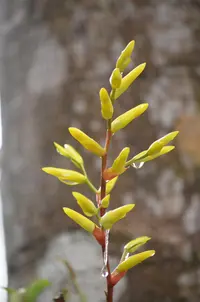
If the flowering spike leans, insert a thin stake into the potting mix and loosely tie the stem with soft plant ties to keep the inflorescence upright without damaging the tissues.

Light acclimation routine

When moving the plant to a brighter spot, shift it over 7–10 days, increasing light in small steps to avoid bleaching of the leaf blades and to keep growing Vriesea rodigasiana stable.

Common Pests and Diseases

Tank bromeliad scale

This pest forms small, flat, brown to black armored spots on leaves and often hides deep in the central water tank and leaf axils, where it feeds on plant sap and causes yellowing or weakening of the rosette.

Solution

Flush the leaf tank thoroughly with clean, lukewarm water, then wipe leaves and leaf bases with a cotton pad dipped in diluted insecticidal soap or a light horticultural oil, repeating every 7–10 days until no new scale appears; isolate the plant and avoid overfertilizing, which encourages scale buildup when growing Vriesea rodigasiana.

Mealybugs

These insects appear as white, cottony clusters in leaf bases and around the central rosette, sucking sap and excreting sticky honeydew that can lead to sooty mold.

Solution

Remove visible insects with a cotton swab dipped in isopropyl alcohol, then treat leaf axils and the rosette with a mild insecticidal soap spray and improve air circulation; repeat treatments weekly until all life stages are gone and avoid letting water sit stagnant in trays or saucers.

Bacterial leaf spot

This disease causes water-soaked, translucent spots that later turn brown and may have a yellow halo, often starting near the leaf base where water lingers in the rosette.

Solution

Remove and discard affected leaves with sterilized tools, keep the central cup water clean and not overfilled, avoid overhead misting that keeps foliage wet for long periods, and increase airflow; in persistent cases, discard severely affected plants to protect nearby bromeliads.

Phytophthora crown rot

Symptoms include a soft, collapsing center rosette with brown, foul-smelling tissue at the leaf bases, often after prolonged waterlogging or cold, wet conditions.

Solution

At the first signs, empty the water tank, remove and discard the affected plant and surrounding wet mix, and improve drainage and watering practices for remaining plants; keep the leaf tank water fresh and avoid letting the potting medium stay saturated, especially in cool temperatures.

Interesting Facts

Natural habitat origin

This bromeliad is native to southeastern Brazil, where it grows as an epiphyte on trees in warm, humid Atlantic Forest remnants rather than in soil on the forest floor.

Distinctive banded foliage

The leaves form a flattened rosette with characteristic transverse banding in shades of green and darker markings that stay attractive even when the inflorescence is not present.

Epiphytic water reservoir

Its tightly overlapping leaves create a central tank that collects rainwater, leaf litter, and small organic debris, providing both moisture and dissolved nutrients to the plant in its tree-dwelling habitat.

FAQs about Vriesea rodigasiana

This bromeliad usually blooms only once when mature, then slowly declines while producing offsets. Lack of bloom is often due to immaturity, low light, or big temperature swings. Stable conditions and patience usually solve it.

Grow Healthy Plants with Botan Care

Keep your plants happy and healthy with plant identification, disease detection, and easy care guidance.

Botan plant care app — identify plants on mobile

Explore More Plants