

Use clean substrate
Prepare a low-nutrient, fine-textured substrate such as sterilized leaf litter mixed with well-decayed wood chips to reduce competing fungi and give this species a better chance to establish.

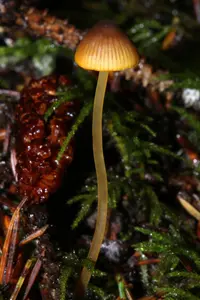
Goldenedge bonnet, Mycena aurantiomarginata, is a small woodland mushroom known for its dark cap edged with a distinct yellow to orange margin. It typically appears in clusters on mossy logs, stumps, or soil rich in decaying wood.
This species occurs mainly in temperate forests of Europe and North America, favoring cool, moist, shaded habitats. It is a saprotrophic fungus, meaning it feeds on dead organic matter and helps decompose forest debris.
In cultivation, it is rarely grown intentionally, and how to care for Goldenedge bonnet is not well established for home settings. It generally needs consistently damp conditions, moderate shade, and a substrate with plenty of rotting wood to mimic its natural environment.

Care Difficulty
Hard Care

Light Preference
Shade

Water Requirements
Keep Soil Moist

Temperature Preference
Cool Climate

Hardiness Zone
Unknown

Soil Texture
Loamy, Peaty, Organic-rich

Soil pH
Strongly acidic (4.5–5.5), Acidic (5.5–6.5)

Soil Drainage
Moist but well-drained

Fertilization
Minimal (feed rarely)
Scan your plant to receive care tips personalized for your specific plant
Available on iOS and Android
Mycena aurantiomarginata thrives in cool, shaded woodland-type light rather than direct sun exposure.
This woodland fungus requires consistently moist, not waterlogged, substrate to fruit and persist.
This species prefers cool to mild conditions that resemble a shaded forest floor in temperate climates.
This woodland fungus needs constantly moist, humid conditions to fruit well in cultivation.
This species fruits best from a loose, organic, wood-based substrate rather than typical garden soil.
This fungus can be grown in containers if they are treated as moist microhabitats for decomposing wood and leaf litter.
This woodland fungus typically needs no fertilization when growing in natural, decaying leaf litter or wood.
Mycena aurantiomarginata does not require intentional pruning, since individual mushrooms are short-lived and self-renewing from the mycelium in the substrate.
This species is not usually grown in pots; any handling focuses on transplanting its colonized substrate rather than the mushrooms themselves.
Propagation of this wild fungus is specialized and not usually attempted by casual growers, so practical home methods are limited.
In climates where it is native, this fungus is cold hardy and usually needs no deliberate winter care beyond natural leaf litter cover.

Plant Health Check
Not sure what's wrong with your plant? Check your plant's health inside the app.
This species is easily recognized by its distinctly orange to yellow-orange gill edges, which sharply contrast with the darker gill faces and help field mycologists separate it from similar small brown Mycena species.
It commonly fruits among mosses on conifer litter, rotting wood, or soil in cool, moist forests, particularly under spruce and other conifers in temperate regions of Europe and North America.
Despite its tiny, delicate fruitbodies, it has a broad distribution across the Northern Hemisphere, where it appears in autumn and sometimes late summer in suitable damp, shaded habitats.

Microscopic examination shows that this species has cheilocystidia (specialized cells on the gill edge) whose contents and wall pigmentation contribute to the striking orange margin that inspired both its common name Goldenedge bonnet and its Latin epithet aurantiomarginata.
This small mushroom is not considered edible. It is regarded as inedible due to its tiny size, insubstantial flesh, and lack of culinary value. It should not be collected for food or tasting experiments.
Keep your plants happy and healthy with plant identification, disease detection, and easy care guidance.

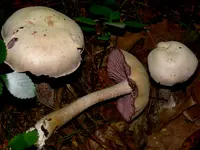
Purple-and-White Deceiver
Laccaria ochropurpurea
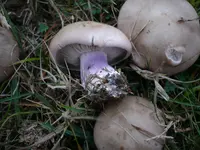
Field Blewit
Lepista saeva
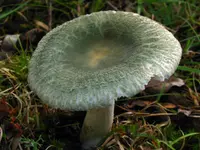
Blue-green Cracking Russula
Russula parvovirescens
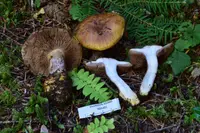
Calonarius cupreorufus
Calonarius cupreorufus
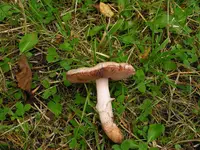
Scaly Wood Mushroom
Agaricus langei
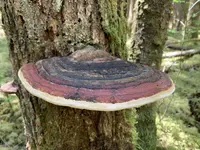
Northern Red Belt
Fomitopsis mounceae
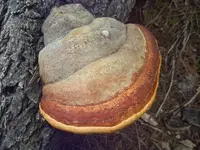
Red Belt Conk
Fomitopsis schrenkii
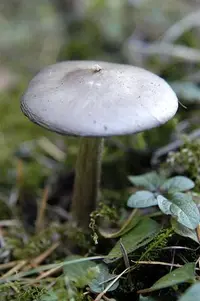
Melanoleuca strictipes
Melanoleuca strictipes