Use hardwood blocks
In controlled culture, inoculate small, well-soaked blocks of non-resinous hardwood (such as beech or oak) instead of loose chips to keep moisture more stable and support denser fruiting clusters.

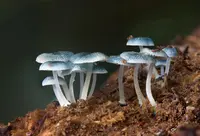
Pixie's parasol, Mycena interrupta, is a small saprotrophic fungus that grows on decaying wood, not a typical houseplant. It is best known for its striking, glossy blue caps and delicate, slender stems that appear in small clusters after rain. In nature it occurs in cool, moist forests of Australia, New Zealand, Chile, and a few parts of Asia, where humidity and shaded conditions stay high. The species is challenging to cultivate because it depends on rotting wood, stable moisture, and cool, clean air. Many growers treat it as an observational species rather than a long-term indoor specimen, although enthusiasts still explore how to care for Pixie's Parasol under controlled conditions.

Care Difficulty
Hard Care

Light Preference
Shade

Water Requirements
Keep Soil Moist

Temperature Preference
Cool Climate

Hardiness Zone
Unknown

Soil Texture
Peaty, Organic-rich

Soil pH
Strongly acidic (4.5–5.5)

Soil Drainage
Moist but well-drained

Fertilization
Minimal (feed rarely)
Scan your plant to receive care tips personalized for your specific plant
Available on iOS and Android
This forest fungus prefers dim, consistently shaded conditions that mimic damp, cool woodland understory.
This species depends on consistently moist, not waterlogged, decaying wood or organic debris.
This fungus grows best in cool, consistently mild conditions typical of shaded, moist forests.
This fungus needs very damp air, similar to a shaded forest floor, to form and maintain fruiting bodies.
Mycena interrupta requires a moist, highly organic substrate rather than standard potting soil.
This species is only marginally suitable for container culture and is best treated as an experimental terrarium organism.
Mycena interrupta usually grows on decaying wood and gains nutrients from the substrate, so added fertilizer is rarely needed for healthy growth.
Mycena interrupta does not benefit from conventional pruning, as each tiny mushroom is short-lived and naturally replaced by new fruiting bodies.
This species is a wood-decaying fungus, so care focuses on suitable substrate placement rather than true repotting or transplanting.
Reproducing Mycena interrupta at home is challenging, since it depends on specific wood types, moisture, and microbial communities.
In mild, cool climates this fungus usually needs no special winter care, as it is adapted to damp forest conditions.

Plant Health Check
Not sure what's wrong with your plant? Check your plant's health inside the app.
The intense blue color of this fungus comes from a unique mix of fungal pigments rather than bioluminescence, so the fruiting bodies look strikingly blue in daylight but do not glow in the dark.
This species is naturally found in cool, moist forests of the southern hemisphere, especially in Australia, New Zealand, New Caledonia, and parts of southern South America, where it grows on rotting wood in shaded, humid habitats.
The caps are usually only a few millimeters to about 1 cm wide, yet they still show clear radial grooves and a slimy surface layer that helps retain moisture on exposed decaying logs.

Mycena interrupta has become an informal flagship species for temperate rainforests in Australia and New Zealand, often used in conservation messaging and ecotourism materials because its unusual blue color makes forest fungal diversity visually memorable to the public.
This species grows best outdoors in cool, damp, shaded woodland settings on decaying wood. Indoors, conditions are usually too dry, bright, and sterile for reliable fruiting, so long‑term cultivation inside a home is generally unsuccessful.
Keep your plants happy and healthy with plant identification, disease detection, and easy care guidance.