Use clean substrates
Prepare a low-nutrient substrate from well-soaked, pressure-sterilized hardwood sawdust or wood shavings to limit competing fungi and bacteria during colonization.

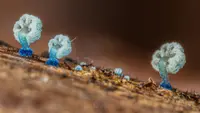
Tiny blue lights is a small bioluminescent mushroom, not a leafy houseplant. It forms delicate, thin-stemmed caps that glow soft blue in the dark under the right conditions. In nature, Mycena lazulina grows on decaying wood in humid, forested areas, where it helps break down dead plant material.
The species is visually striking but sensitive, so it is not an easy option for beginners. It generally prefers cool, stable conditions with constant moisture, gentle air flow, and clean, wood-based substrates. Many growers experiment and share methods to learn how to care for tiny blue lights successfully indoors.

Care Difficulty
Hard Care

Light Preference
Shade

Water Requirements
Keep Soil Moist

Temperature Preference
Warm Climate

Hardiness Zone
Unknown

Soil Texture
Organic-rich, Peaty

Soil pH
Strongly acidic (4.5–5.5)

Soil Drainage
Moist but well-drained

Fertilization
Minimal (feed rarely)
Scan your plant to receive care tips personalized for your specific plant
Available on iOS and Android
This small bioluminescent mushroom naturally grows in dim forest conditions with very low light.
This fungus needs consistently moist, not waterlogged, conditions to fruit well.
This species prefers mild, cool to moderately warm conditions rather than temperature extremes.
This fungus requires very high humidity to form stable fruiting bodies.
Substrate for Mycena lazulina must be moist, airy, and rich in decomposing organic matter.
This species can be grown in containers if a stable, humid microclimate is maintained.
Mycena lazulina is a saprophytic fungus that usually needs little or no fertilizer when grown on a nutrient-rich substrate.
Pruning is not part of normal Mycena lazulina care because the fungus fruits and decomposes naturally.
Transplanting focuses on refreshing the decaying substrate rather than moving individual Mycena lazulina fruiting bodies.
Multiplying Mycena lazulina involves extending its mycelium rather than traditional plant-style propagation.
Outdoor Mycena lazulina in temperate regions usually needs minimal winter care beyond maintaining suitable microhabitat conditions.

Plant Health Check
Not sure what's wrong with your plant? Check your plant's health inside the app.
This mushroom emits a blue to bluish-green light from both its cap and stem, likely due to a luciferin–luciferase chemical system similar to that studied in other glowing fungi. The light is visible in complete darkness once eyes adjust, especially in humid forest conditions.
Mycena lazulina was formally described in scientific literature only in the 2010s from specimens collected in Japan. It expanded the known diversity of bioluminescent Mycena mushrooms and helped clarify relationships within the genus.
This species has been documented from specific forest habitats in Japan, where it grows on decaying wood and leaf litter. Its restricted and patchy distribution makes it of particular interest for studies on fungal endemism and habitat specificity.
This fungus is not considered edible and should be treated as inedible. It is very small, insubstantial, and not studied as a food source. For safety, avoid tasting or using it in any culinary way.
Keep your plants happy and healthy with plant identification, disease detection, and easy care guidance.