Edge Containment
Install a shallow root barrier or steel/aluminum edging before planting to keep this vigorous groundcover from creeping into lawn, paths, or beds where it is not wanted.

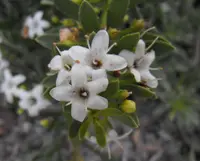
Slender myoporum (Myoporum parvifolium) is a low, spreading evergreen groundcover shrub valued for quick coverage of slopes, borders, and difficult sites. It forms dense mats of fine, narrow leaves with small white to pale pink star-shaped flowers scattered along the stems.
This species is native to Australia, where it grows in coastal and inland areas, often in poor, sandy, or rocky soils. It is generally easy to grow because it tolerates heat, drought, and light frost once established, but it dislikes poorly drained, waterlogged ground.
A sunny position and well-drained soil support healthy growth, and understanding how to care for slender myoporum helps prevent problems with rot or thinning foliage over time.

Care Difficulty
Easy Care

Light Preference
Full Sun

Water Requirements
Low Water

Temperature Preference
Warm Climate

Hardiness Zone
8–10

Soil Texture
Sandy, Loamy

Soil pH
Slightly acidic (6.5–7.0), Slightly alkaline (7.0–7.5)

Soil Drainage
Well-drained

Fertilization
Minimal (feed rarely)
Scan your plant to receive care tips personalized for your specific plant
Available on iOS and Android
This low, spreading groundcover thrives in bright, open conditions with strong sun exposure.
This drought-tolerant groundcover prefers deep, infrequent watering once established.
This species performs best in mild, warm climates with low to moderate frost exposure.
Myoporum parvifolium tolerates a wide humidity range and usually does not need special humidity management.
Myoporum parvifolium prefers light, fast-draining soil that does not stay wet for long.
This species can be grown in containers if the pot setup supports its spreading habit and rapid drainage.
Myoporum parvifolium grows well in lean soils but benefits from light feeding in poor or very sandy sites.
Myoporum parvifolium responds well to light pruning that maintains a dense, ground-hugging form.
This plant is most often used as a groundcover in the landscape, so transplanting in-ground plants is more common than repotting.
Myoporum parvifolium is commonly propagated from cuttings, which root reliably under the right conditions.
Established Myoporum parvifolium in the ground is moderately frost tolerant and usually needs minimal winter care in mild climates.

Plant Health Check
Not sure what's wrong with your plant? Check your plant's health inside the app.
This low, mat-forming shrub is naturally found on sandy coastal dunes in southern Australia, where its dense root and stem network helps bind loose sand and reduce erosion.
It produces shallow, spreading roots and can root at stem nodes that touch the soil, allowing it to rapidly knit together into a continuous ground layer in suitable conditions.
The foliage contains furanosesquiterpenes, compounds known to cause liver damage and photosensitization in grazing animals such as sheep if eaten in significant amounts.

In its native range, this species is often used in large-scale roadside and embankment plantings because it tolerates reflected heat, wind, and coastal salt spray, yet still forms a low, dense carpet that suppresses many competing weeds without growing tall enough to obstruct visibility.
This species is a fast, low, mat-forming ground cover that spreads widely through prostrate stems. In suitable climates it can cover large areas quickly and may edge into unwanted spaces if not contained or occasionally pruned.
Keep your plants happy and healthy with plant identification, disease detection, and easy care guidance.