Early framework training
Select 3–5 strong, well-spaced shoots in the first 2–3 years and lightly stake or tie them to form a stable framework that will better support the plant’s heavy leaves and fruit clusters later on.

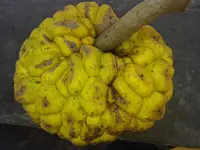
Giant yellow mulberry (Myrianthus arboreus) is a fast-growing tropical tree or large shrub native to West and Central Africa. It is valued locally for its edible fruits and leaves. The plant has large, deeply lobed leaves that create a bold, architectural look, and it can form a dense, spreading canopy in warm, frost-free climates. Its bright yellow, mulberry-like fruits are an eye-catching feature. This species prefers consistently moist, well-drained soil and benefits from high light in humid conditions. In cooler or drier regions, it can be more challenging to care for Giant Yellow Mulberry, as it resents cold, drought, and poor soil structure.

Care Difficulty
Moderate Care

Light Preference
Partial Shade

Water Requirements
Regular Water

Temperature Preference
Tropical / Frost Sensitive

Hardiness Zone
10–12

Soil Texture
Loamy, Silty, Organic-rich

Soil pH
Acidic (5.5–6.5), Slightly acidic (6.5–7.0)

Soil Drainage
Moist but well-drained

Fertilization
Minimal (feed rarely)
Scan your plant to receive care tips personalized for your specific plant
Available on iOS and Android
This fast-growing African tree prefers bright, indirect light similar to an open forest edge.
This species prefers evenly moist but not waterlogged soil in its native humid habitats.
This tropical tree thrives in consistently warm, frost-free conditions.
This species prefers moderately humid air but tolerates brief drier periods if soil moisture is stable.
Myrianthus arboreus grows best in deep, loose, organic-rich soil that drains freely yet holds some moisture.
This species can be grown in large containers for early years or patio use, but its eventual size limits long-term pot culture.
Myrianthus arboreus benefits from light, thoughtful feeding rather than heavy fertilization.
Pruning Myrianthus arboreus is mainly used to manage size, structure, and plant health.
This species is usually grown in the ground, so focus on careful transplanting of young Myrianthus arboreus plants.
Myrianthus arboreus is usually propagated from seeds, with vegetative methods used less often.
This tropical tree is not frost hardy and needs protection in regions with cool or freezing winters.

Plant Health Check
Not sure what's wrong with your plant? Check your plant's health inside the app.
The tree produces large, knobbly yellow fruits whose fibrous, sweetish pulp is traditionally eaten in parts of West and Central Africa, often fresh or mixed into porridge-like preparations.
Its leaves are strikingly large and palmately lobed, often with 7–15 finger-like segments, which gives the canopy a very distinctive, almost tropical-ornamental appearance.
Young leaves and shoots are commonly used as a leafy vegetable and as livestock fodder in many rural communities, making the species an important local food resource tree.

In several West and Central African regions, the tree is deliberately spared when land is cleared for farming, so it can be managed as a semi-wild crop tree that supplies fruit, leafy vegetables, and shade within traditional agroforestry systems.
This species is a very fast-growing tropical tree, often adding 60–150 cm of height per year in warm, moist climates. Growth slows in cooler or drier conditions, in poor soil, or when rootbound in containers.
Keep your plants happy and healthy with plant identification, disease detection, and easy care guidance.