Early structural staking
Install a sturdy central stake while the plant is still young and loosely tie the main stem, as this prevents wind rock and encourages a straight, strong trunk for long-term canopy development.

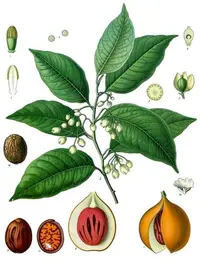
Nutmeg, Myristica fragrans, is an evergreen tropical tree grown for its aromatic seeds and fleshy arils, used as culinary nutmeg and mace. It forms a dense canopy with glossy, lance-shaped leaves and small, pale yellow flowers, followed by apricot-like fruits that split to reveal the seed. In nature it occurs in the Maluku Islands of Indonesia and other humid, lowland tropical regions. The species prefers warm, consistently moist conditions, fertile well-drained soil, and sheltered, bright light, which makes it challenging outside true tropics. Those seeking to care for nutmeg in cooler climates usually grow young plants in containers under protected indoor or greenhouse conditions.

Care Difficulty
Hard Care

Light Preference
Partial Shade

Water Requirements
Keep Soil Moist

Temperature Preference
Tropical / Frost Sensitive

Hardiness Zone
11–12

Soil Texture
Loamy, Sandy, Organic-rich

Soil pH
Acidic (5.5–6.5), Slightly acidic (6.5–7.0)

Soil Drainage
Moist but well-drained

Fertilization
Light (every 4–6 weeks)
Scan your plant to receive care tips personalized for your specific plant
Available on iOS and Android
Myristica fragrans prefers bright, warm, tropical light conditions without harsh midday exposure.
Myristica fragrans needs consistently moist but never waterlogged soil for steady growth.
This tropical tree favors warm, stable temperatures with no exposure to frost.
This species benefits from fairly high, stable humidity for healthy foliage and growth.
Myristica fragrans prefers deep, well-drained, organic-rich soil that stays moist but never waterlogged.
This tree can be grown in large containers for some years if given enough root space and careful moisture control.
Myristica fragrans responds well to moderate, balanced feeding during active growth in warm months.
Myristica fragrans benefits from light structural pruning to maintain a healthy, manageable crown.
Young plants are often container-grown first, then transplanted as Myristica fragrans develops a stronger root system.
Sexual propagation from fresh seed is the standard method for Myristica fragrans, though it can be slow.
This tropical tree is frost-sensitive and needs careful winter management in regions with cool or cold seasons.

Plant Health Check
Not sure what's wrong with your plant? Check your plant's health inside the app.
The same Myristica fragrans seed yields both nutmeg and mace: nutmeg is the dried kernel, while mace is the dried, lacy aril that surrounds it, and each has a distinct aroma and culinary use.
In its native habitat in the Maluku (Spice) Islands, the fleshy aril of the fruit attracts birds such as pigeons, which eat the aril and help disperse the seeds, shaping the tree’s natural distribution.
Nutmeg from this species contains a complex mix of volatile compounds, including myristicin, sabinene, and elemicin, which together produce its characteristic warm, sweet, and slightly resinous scent valued in cooking and perfumery.

During the 17th century, control of Myristica fragrans groves in the Maluku Islands was so economically important that European colonial powers negotiated territorial exchanges and waged conflicts largely to dominate the nutmeg trade.
This tree often needs 6–8 years to reach flowering age, sometimes longer from seed. Inadequate warmth, humidity, or nutrition reduces flower production. Stable tropical conditions and patience are essential when growing nutmeg for its fruit.
Keep your plants happy and healthy with plant identification, disease detection, and easy care guidance.