

Moisture-retentive substrate
Use a shallow tray lined with soaked, well-rinsed hardwood sawdust, fine bark, or decaying hardwood chips to mimic the constantly damp, woody surfaces this jelly fungus colonizes in nature.

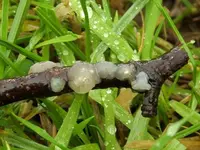
Crystal brain fungus, Myxarium nucleatum, is a jelly fungus rather than a true plant, but it often appears in garden and woodland settings. It forms small, translucent, brain-like blobs on dead or decaying wood, especially on fallen branches and damp, shaded logs.
This species is common in temperate regions and is frequently seen in moist forests, hedgerows, and shaded urban landscapes. It plays an ecological role in breaking down wood and recycling nutrients.
Because it depends on consistently damp, decaying wood, it is not a typical houseplant, and it can be challenging to maintain indoors. Gardeners who want to care for Crystal Brain Fungus usually focus on providing cool shade, high humidity, and undisturbed rotting wood outdoors.

Care Difficulty
Hard Care

Light Preference
Shade

Water Requirements
Keep Soil Moist

Temperature Preference
Cool Climate

Hardiness Zone
Unknown

Soil Texture
Loamy, Silty, Organic-rich

Soil pH
Acidic (5.5–6.5), Slightly acidic (6.5–7.0)

Soil Drainage
Waterlogged tolerant

Fertilization
Minimal (feed rarely)
Scan your plant to receive care tips personalized for your specific plant
Available on iOS and Android
Myxarium nucleatum, often seen as Crystal Brain Fungus, prefers dim woodland-style light rather than direct sun.
Myxarium nucleatum develops best on consistently moist, but not flooded, substrates like decaying wood or very humus-rich soil.
This species prefers cool to mild conditions and is most active during moist, temperate weather.
This jelly fungus needs consistently moist air and surfaces to form and persist.
This species grows on decaying wood rather than true soil, but substrate conditions still matter.
This fungus can be maintained in containers if a consistently moist woody substrate is provided.
Myxarium nucleatum is a saprophytic fungus that generally does not require intentional fertilizing in garden or woodland settings.
Pruning is not a routine practice for Myxarium nucleatum, since fruiting bodies are short-lived and arise from decaying wood or organic debris.
This fungus is not suited to normal houseplant-style repotting; focus instead on placing or adjusting its woody substrate.
Propagation of Myxarium nucleatum is specialized and usually left to experienced mycologists or natural spread in the landscape.
In most temperate climates this wood-inhabiting fungus needs no special winter care and tolerates normal seasonal temperature shifts.

Plant Health Check
Not sure what's wrong with your plant? Check your plant's health inside the app.
This species forms translucent, gelatinous, brain-like clusters on decaying wood, which are actually masses of fused basidiocarps (reproductive structures of basidiomycete fungi). The individual lobes are small and irregular, often merging into larger cushions in wet weather.
The fruiting bodies swell and become soft and shiny when wet, then shrink and turn more opaque and firm as they dry. This reversible change is due to the high water content of the gelatinous matrix, which allows the tissue to rehydrate and resume activity after desiccation.
Myxarium nucleatum lives as a saprobe, breaking down dead hardwood branches and twigs, especially in damp woodland habitats. By decomposing lignin and cellulose, it helps recycle nutrients back into forest soils.

Microscopic study shows that the spores of Myxarium nucleatum are produced on unusually long, thread-like basidia (spore-bearing cells), a feature that helps distinguish this species from other similar-looking jelly fungi under the microscope.
Growth is relatively slow and strongly linked to moisture and decaying wood quality. After spores establish, small gelatinous clusters can appear within weeks during wet conditions, but they usually expand only modestly over each cool, damp season.
Keep your plants happy and healthy with plant identification, disease detection, and easy care guidance.

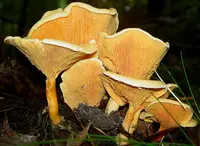
False Chanterelle
Hygrophoropsis aurantiaca
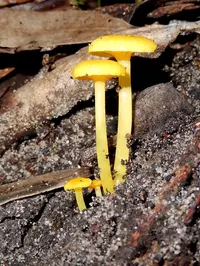
Hygrocybe chromolimonea
Hygrocybe chromolimonea
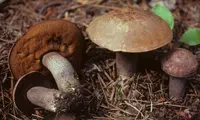
Lilac-brown bolete
Sutorius eximius
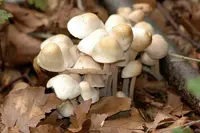
clustered toughshank
Collybiopsis confluens
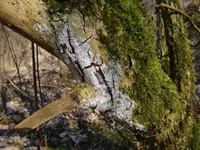
Dendrothele acerina
Dendrothele acerina
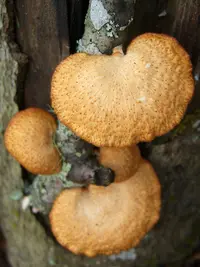
hexagonal-pored polypore
Neofavolus alveolaris
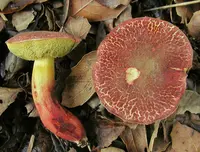
Vejvarut Paphiopedilum
Xerocomellus dryophilus
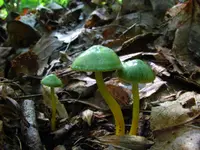
Parrot Mushroom
Gliophorus psittacinus