rushleaf jonquil Care (Narcissus assoanus)

rushleaf jonquil

About rushleaf jonquil

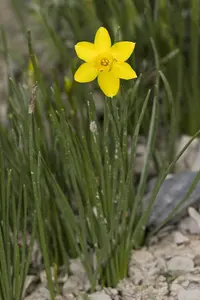
Rushleaf jonquil, Narcissus assoanus, is a small bulb-forming spring flower in the daffodil group. It has narrow, rush-like leaves and clusters of small, fragrant yellow blooms.

This species occurs naturally in parts of southwestern Europe, often in open grasslands and rocky slopes with good drainage. It tends to stay compact and forms clumps over time rather than spreading aggressively.

Consistent sun, moderately moist but free-draining soil, and a dry rest after flowering usually make it straightforward for gardeners who want to learn how to care for rushleaf jonquil.

Main Plant Requirements

Care Difficulty

Easy Care

Light Preference

Full Sun

Water Requirements

Moderate Water

Temperature Preference

Cool Climate

Hardiness Zone

6–9

Soil Texture

Sandy, Loamy, Rocky

Soil pH

Acidic (5.5–6.5), Slightly acidic (6.5–7.0)

Soil Drainage

Well-drained

Fertilization

Minimal (feed rarely)

Get Personalized Care Plan

Scan your plant to receive care tips personalized for your specific plant

Available on iOS and Android

How to Care for the rushleaf jonquil

This small spring-blooming bulb thrives in bright, open conditions with plenty of direct sun.

  • Provide 6–8 hours of direct sun daily; full sun is ideal, especially in cool to mild climates where leaves can photosynthesize efficiently.
  • Allow light partial shade in hot regions, with morning sun and light afternoon shade to prevent leaf scorch and premature flower fade on rushleaf jonquil.
  • Plant in an open site with minimal shade from shrubs or buildings so winter–spring sun reaches the bulbs before nearby plants leaf out.

This bulb prefers moderate moisture during active growth and drier conditions when dormant.

  • In spring, water only when the top 3–5 cm of soil feel dry, aiming for consistently moist but not soggy soil while leaves are green and growing.
  • Ensure sharply drained soil; standing water, foul smell, or soft bulbs indicate overwatering and heightened risk of rot in Narcissus assoanus.
  • Reduce or stop watering once foliage yellows and dies back in late spring or early summer, allowing the soil to dry more between natural rains during dormancy.

This species is adapted to mild, Mediterranean-type climates with cool winters and warm, dry summers.

  • Active growth and flowering occur best at 50–65°F (10–18°C), with cool nights that support strong stems and long-lasting blooms.
  • Dormant bulbs tolerate cold down to about 10–15°F (-12 to -9°C) if soil is well drained, though extended freezes below this can damage bulbs.
  • Heat up to 85–90°F (29–32°C) is tolerated in summer when bulbs are dormant, but prolonged high temperatures with soil moisture can increase rot risk.

Humidity is not a major factor for Narcissus assoanus, which handles typical indoor and outdoor air well.

Narcissus assoanus prefers sharply drained, light soil that does not stay wet after watering or rain.

  • Use a sandy or gritty loam with at least 40–60% mineral material such as coarse sand or fine gravel to prevent waterlogging.
  • Keep pH slightly acidic to neutral, around 6.0–7.5, and avoid strongly acidic or alkaline mixes that can limit nutrient uptake.
  • Blend in a modest amount of compost or leaf mold, about 10–20%, to add structure without making the mix heavy or water-retentive.
  • Avoid clay-heavy or compacted soils; if native soil is dense, raise the planting area and incorporate grit to maintain aeration around the bulbs.

This small jonquil is well suited to container growing outdoors.

  • Choose a pot at least 15–20 cm deep so bulbs sit twice their height below the surface while still leaving space for root growth.
  • Use a heavy, stable container material such as terracotta or ceramic to prevent tall flowering stems from tipping the pot in wind.
  • Elevate the pot on feet or spacers so drainage holes stay clear and excess water escapes quickly after rain or irrigation.

Narcissus assoanus is a small bulb that needs only light feeding to maintain reliable flowering, especially in containers or nutrient-poor soils.

  • Use a balanced, slow-release bulb fertilizer or a light top-dressing of compost in early spring as shoots emerge.
  • Apply at about half the label strength to avoid excess nitrogen, which encourages foliage over flowers.
  • Feed once after flowering if leaves stay green, then stop feeding as foliage yellows and bulbs enter dormancy.
  • In containers, caring for rushleaf jonquil benefits from slightly richer, free-draining mix rather than frequent extra fertilizer.

Narcissus assoanus needs minimal pruning, focused on cleaning up spent parts without disturbing the bulbs.

  • After flowering, deadhead spent blooms by snipping the flower stalk just above the foliage with clean scissors.
  • Leave green leaves in place for 4–6 weeks so they can photosynthesize and recharge the bulbs for next year’s flowers.
  • Once foliage has fully yellowed and dried, gently pull or cut it at the base to keep the planting tidy.
  • Remove damaged, diseased, or flattened clumps only, avoiding heavy cutting that reduces flowering in the following season.

This species is most often grown in the ground, and transplanting Narcissus assoanus is done only when clumps become crowded or flowering declines.

  • Check for tight clumps, reduced flower size, or bulbs pushing to the surface as signs that division is needed, usually every 4–6 years.
  • Lift and transplant bulbs in late summer to early fall when the plant is fully dormant and foliage has disappeared.
  • Use a fork or trowel to loosen soil, then lift bulbs gently to avoid breaking roots or basal plates.
  • Replant bulbs immediately at 2–3 times their height in well-drained soil, water once to settle, then keep soil only slightly moist.

Narcissus assoanus is commonly multiplied by bulb division, with seed used mainly for long-term or specialist work.

  • Divide offsets in late summer to early fall, when bulbs are dormant and the soil is relatively dry and workable.
  • Lift clumps carefully, separate firm, healthy offsets from the parent bulb by hand, discarding any soft or diseased bulbs.
  • Replant offsets at 2–3 times their own height in a sunny, well-drained site, spacing to allow future clump expansion.
  • For seed propagation, sow fresh seed in pots outdoors, keep evenly moist, and expect several years before flowering.

In many mild and temperate regions, Narcissus assoanus is cold hardy and needs little special winter care once established.

  • In-ground bulbs tolerate moderate frost; ensure soil drains well to avoid waterlogged conditions that cause rot.
  • Apply a light mulch layer in late fall in colder areas to moderate soil temperature and reduce freeze–thaw heaving.
  • For container-grown bulbs, move pots into a sheltered, unheated but frost-free spot if prolonged deep freezes are expected.

Care Tips

Post-bloom deadheading

Cut off each faded flower just below the ovary (the small swollen part behind the petals) but leave the green stem and leaves intact so the plant directs energy back to the bulb rather than seed production.

Timed foliage removal

Allow foliage to yellow naturally for at least 6–8 weeks after flowering, then cut it cleanly at the base; marking clumps with small stakes when in bloom helps you relocate the bulbs later when the leaves have withered.

Bulb clump renewal

Every 3–4 years, lift and divide overcrowded clumps in late summer when foliage is fully dry, replanting only the firm, undamaged bulbs at the same depth to restore flowering vigor.

Protection from rot

In heavy or seasonally wet soils, plant bulbs on a shallow bed of coarse grit or sand and slightly raised ridges to improve drainage and reduce bulb rot risk.

Monitoring naturalization spread

When growing rushleaf jonquil in lawns or naturalized areas, flag the flowering zone and delay mowing there until 6–8 weeks after bloom so that bulbs recharge and the colony spreads evenly over time.

Common Pests and Diseases

Narcissus bulb fly

This pest is a large fly whose larvae tunnel into bulbs, causing yellowing leaves, stunted growth, or total collapse of the flowering stem. Symptoms include hollow, rotting bulbs with a single fat maggot inside.

Solution

Discard any soft, infested bulbs and do not compost them. For future seasons, plant healthy, firm bulbs deeper (15–20 cm), cover planting areas with fine mesh during the main egg‑laying period in late spring, and rotate bulb locations to reduce local populations.

Basal rot

This disease is a fungal infection of the bulb base that causes a dry, brown rot, poor sprouting, and distorted or weak flowering stalks. Symptoms include a sunken, discolored basal plate and easily detached outer scales.

Solution

Remove and destroy all affected bulbs and any obviously discolored scales. Store and plant bulbs only when fully dry in well‑drained soil, avoid mechanical damage during handling, and use clean tools and containers to limit spread; in areas with a known history, consider a labeled fungicidal bulb dip before planting as part of Narcissus assoanus care instructions.

Stem and bulb nematode

These microscopic worms enter bulbs and stems, causing swollen, twisted foliage, poor flowering, and internal brown striping in scales. This pest spreads easily in shared soil, stored bulbs, and surface water.

Solution

Immediately discard symptomatic bulbs and any surrounding soil, and avoid replanting Narcissus in the same spot for several years. Buy certified nematode‑free stock, keep storage areas dry and well ventilated, and avoid overhead irrigation and waterlogging that help nematodes move between plants.

Narcissus yellow stripe virus

This disease causes pale yellow streaks or mottling on leaves and sometimes reduced flower size or number. Symptoms include distorted foliage and gradual decline in vigor over several seasons.

Solution

There is no cure, so remove and destroy infected plants as soon as symptoms are clear to prevent spread. Control sap‑sucking insects such as aphids that transmit the virus, disinfect cutting tools between plants, and only propagate from healthy, symptom‑free bulbs.

Slugs and snails

These mollusks chew young shoots and leaves, leaving ragged edges and silvery slime trails, and can disfigure emerging flower stems. Damage is most noticeable on new spring growth in damp, cool conditions.

Solution

Hand‑pick slugs and snails in the evening, use copper tape or rough barriers around valued clumps, and reduce nearby hiding places such as dense mulch and debris. In wetter gardens, place beer traps or use iron phosphate pellets according to label directions to reduce populations around emerging shoots.

Interesting Facts

Miniature jonquil flowers

This species produces very small, bright yellow, strongly fragrant flowers, typically only about 1–1.5 cm across, carried in loose clusters on each stem.

Narrow rushlike leaves

Its leaves are unusually narrow, almost rushlike, which gives the plant a fine, grassy appearance compared with many broader-leaved daffodils.

Western Mediterranean native

The species is native to rocky and grassy habitats of the western Mediterranean, including parts of Spain, France, and North Africa, where it often grows in seasonally dry, open sites.

Botan icon

Did you know?

In some modern botanical treatments, this species has been placed in a separate genus and called Jonquilla assoana, reflecting its distinct morphology and its close relationship to other jonquil-type narcissi.

FAQs about rushleaf jonquil

Lack of blooms usually comes from insufficient chilling in winter, overcrowded bulbs, or depleted nutrients. Ensure a cool dormant period, divide congested clumps every few years, and avoid heavy nitrogen fertilizers that favor leaves over flowers.

Grow Healthy Plants with Botan Care

Keep your plants happy and healthy with plant identification, disease detection, and easy care guidance.

Botan plant care app — identify plants on mobile

Explore More Plants