Site hygiene
Remove and discard old, soggy caps and any decaying plant litter around the fruiting area to reduce mold competition and keep the mycelium zone well aerated.

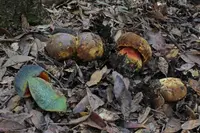
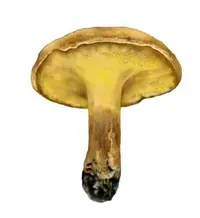
The false yellow bolete (Neoboletus xanthopus) is a mycorrhizal fungus, not a typical houseplant, forming a partnership with tree roots in forests. It produces fleshy, short-stemmed fruiting bodies with yellow pores and a brown to olive cap.
This species is usually found in warm-temperate to subtropical woodlands, especially with oaks and other broadleaf trees, often appearing in small groups on soil rather than wood. It is not a beginner-friendly species to cultivate, since it depends on living host trees and specific soil fungi to complete its life cycle. For most people, it is best to observe in nature rather than attempt to care for false yellow bolete at home.

Care Difficulty
Hard Care

Light Preference
Partial Shade

Water Requirements
Keep Soil Moist

Temperature Preference
Cool Climate

Hardiness Zone
Unknown

Soil Texture
Loamy, Silty, Organic-rich

Soil pH
Strongly acidic (4.5–5.5), Acidic (5.5–6.5)

Soil Drainage
Moist but well-drained

Fertilization
Minimal (feed rarely)
Scan your plant to receive care tips personalized for your specific plant
Available on iOS and Android
This ectomycorrhizal mushroom prefers dappled forest light rather than full exposure.
This woodland fungus depends on consistently moist, not waterlogged, soil around its host tree roots.
This species fruits best in mild to warm conditions typical of temperate woodlands.
Humidity is not a primary factor for this wild, mycorrhizal fungus, which relies more on general site moisture and suitable host trees than air humidity.
This ectomycorrhizal fungus needs undisturbed, naturally structured forest soil rather than a constructed potting mix.
This species is not suitable for standard container growing because it depends on long-term ectomycorrhizal relationships with living forest trees, which containers cannot realistically support.
Neoboletus xanthopus forms a mycorrhizal partnership with trees and generally does not need additional fertilizer in natural or garden soil.
Pruning is not a standard practice for Neoboletus xanthopus, as the visible mushroom fruiting body is short-lived and seasonal.
This species is a mycorrhizal fungus, so care focuses on placing or maintaining suitable host trees rather than classic container repotting.
Propagation of Neoboletus xanthopus by home growers is difficult and rarely reliable, as it depends on complex mycorrhizal relationships with tree roots.
This fungus is naturally cold hardy in its suitable climate range and usually needs no special winter care in the ground.

Plant Health Check
Not sure what's wrong with your plant? Check your plant's health inside the app.
The mushroom’s stem shows a striking color gradient, usually yellow at the apex and shading to orange-red or dark red toward the base, which is one of the key characters used by field mycologists to distinguish it from similar boletes.
The yellow flesh and pores often turn dark blue almost instantly when handled or damaged, due to oxidation of pigment compounds, a reaction that helps separate it from non-bruising or slowly bruising look-alike species.
This bolete forms ectomycorrhizal partnerships with the roots of broadleaf trees, especially European beech in its native range, exchanging mineral nutrients from the soil for carbohydrates produced by the tree.

Genetic and morphological studies in the last two decades led to this fungus being moved out of the large catch‑all genus Boletus and placed in the more narrowly defined genus Neoboletus, illustrating how DNA research continues to reorganize traditional mushroom classification.
This fungus is generally considered inedible or of very poor culinary value. Reports of gastrointestinal upset exist, so it should not be eaten. Correct identification is difficult, and similar boletes can be mildly to seriously toxic.
Keep your plants happy and healthy with plant identification, disease detection, and easy care guidance.