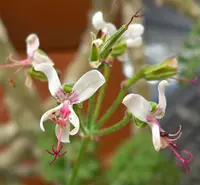
Deadhead For Rebloom
Remove spent flower clusters every few days by pinching just above a leaf node to extend the blooming period and keep plants from diverting energy into seed production.

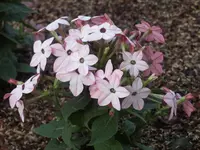
Garden tobacco, Nicotiana × sanderi, is a compact, fast-growing ornamental flowering plant often used in beds, borders, and patio containers. It is typically grown as an annual, even though it can be short-lived perennial in mild climates.
Plants form leafy clumps topped with clusters of star-shaped flowers in shades of white, pink, red, or purple, often with a light evening fragrance. They originate from horticultural breeding of Nicotiana species from South America, not from a single wild habitat.
Garden tobacco grows quickly and responds well to regular moisture, fertile, well-drained soil, and sun to light shade. Its rapid growth and generous flowering make it relatively easy to care for Garden Tobacco if basic conditions are met.

Care Difficulty
Moderate Care

Light Preference
Partial Sun

Water Requirements
Regular Water

Temperature Preference
Tropical / Frost Sensitive

Hardiness Zone
10–11

Soil Texture
Loamy, Sandy, Organic-rich

Soil pH
Acidic (5.5–6.5), Slightly acidic (6.5–7.0)

Soil Drainage
Moist but well-drained

Fertilization
Moderate (every 2–4 weeks)
Scan your plant to receive care tips personalized for your specific plant
Available on iOS and Android
Nicotiana × sanderi prefers bright, gentle light that supports steady flowering without leaf scorch.
Watering for Nicotiana × sanderi aims to keep soil consistently moist but never saturated.
This plant grows best in mild, frost-free conditions typical of many summer annuals.
This species grows best in moderate ambient humidity but usually adapts to typical household levels.
This plant prefers a loose, well-drained, organic-rich substrate that stays evenly moist but not waterlogged.
This species is well suited to container growing outdoors in patios, balconies, and entryways.
Nicotiana × sanderi responds well to modest feeding during its active growing and flowering period.
Pruning helps Nicotiana × sanderi stay compact and encourages continuous flowering.
This plant is usually grown as an annual, so transplanting young Nicotiana × sanderi seedlings is more common than long-term repotting.
Nicotiana × sanderi is most often propagated from seed, which germinates reliably under warm, bright conditions.
In most climates Nicotiana × sanderi is treated as a frost-tender annual and does not need complex winter care.

Plant Health Check
Not sure what's wrong with your plant? Check your plant's health inside the app.
This plant is a horticultural hybrid derived mainly from Nicotiana alata and Nicotiana forgetiana, bred specifically for compact size, heavy blooming, and decorative garden use rather than for nicotine production.
Many forms release a stronger, sweet fragrance in the late afternoon and evening, a trait inherited from night-scented wild relatives that are pollinated by moths.
Modern cultivars show a wide palette of flower colors, from pure white and lime-green to pink, red, and bicolored forms, resulting from intensive breeding focused on ornamental traits rather than leaf chemistry.

Although related to commercial tobacco, this hybrid produces relatively low nicotine in its foliage and is not used for smoking or industrial nicotine extraction, which is why it is grown almost exclusively as a flowering ornamental in bedding schemes and containers.
Poor flowering usually comes from too little light, excess nitrogen fertilizer, or heat stress. Deadhead faded blooms, avoid high-nitrogen feeds, and keep soil consistently moist but not soggy to support bud formation and prolonged flowering.
Keep your plants happy and healthy with plant identification, disease detection, and easy care guidance.