Staggered Deadheading
Remove spent flowers every 1–2 days but leave a few last blooms to set seed if desired, which keeps plants flowering strongly while still allowing limited self-sowing.

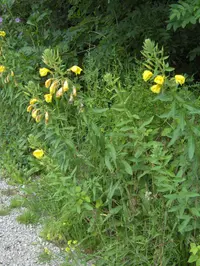
Intermediate evening-primrose (Oenothera × fallax) is a short-lived perennial or biennial herb grown mainly for its soft yellow, evening-opening flowers. It usually forms loose clumps of narrow, lance-shaped leaves and upright stems that can create a natural, slightly informal look in garden beds or wildflower-style plantings.
This hybrid is associated with European and North American cultivation rather than a single precise wild origin, often found in sunny borders, meadows, and roadsides. It tends to be fairly undemanding, which makes it easier to care for intermediate evening-primrose in typical garden conditions.
The plant prefers full sun, moderately moist but well-drained soil, and does not need rich fertility to flower reliably.

Care Difficulty
Easy Care

Light Preference
Full Sun

Water Requirements
Moderate Water

Temperature Preference
Cold Hardy

Hardiness Zone
4–8

Soil Texture
Sandy, Loamy, Rocky

Soil pH
Slightly acidic (6.5–7.0), Neutral (7.0)

Soil Drainage
Well-drained

Fertilization
Minimal (feed rarely)
Scan your plant to receive care tips personalized for your specific plant
Available on iOS and Android
This hybrid evening-primrose thrives in open, bright sites with direct sun exposure.
This plant prefers moderately dry conditions and dislikes waterlogged soil.
This perennial handles a wide temperature range but flowers best in moderate conditions.
This species handles typical outdoor humidity and does not need special humidity control.
This perennial prefers moderately fertile, well-drained soil that does not stay wet after rain.
This species can be grown in containers if drainage and root space are carefully managed.
This hybrid evening-primrose grows best in moderately fertile soil and usually needs only light feeding.
Thoughtful pruning keeps Oenothera × fallax compact, long-flowering, and tidy.
This perennial is typically grown in garden beds, so focus on careful transplanting rather than frequent repotting.
New plants of Oenothera × fallax are most reliably produced by division, with some gardeners also using cuttings.
This evening-primrose is generally cold hardy in temperate climates and needs only modest winter care outdoors.

Plant Health Check
Not sure what's wrong with your plant? Check your plant's health inside the app.
This taxon is a natural hybrid evening-primrose that arose where two related Oenothera species overlap in range, and it has become established enough to be treated as a distinct nothospecies in floras and herbarium records.
Its pale yellow flowers typically open around dusk and are mainly visited by nocturnal insects such as moths, reflecting the group’s evolutionary adaptation to nighttime pollination.
Although the parent species are native to North America, this hybrid is well documented in several European countries, where it occurs as a naturalized plant in disturbed and ruderal habitats.
This hybrid usually forms loose clumps and can seed around, but is not typically aggressive in managed beds. Deadhead spent flowers and remove unwanted seedlings to limit spread and keep planting areas controlled.
Keep your plants happy and healthy with plant identification, disease detection, and easy care guidance.