


Stake new spikes
Install thin, smooth stakes and soft clips as soon as new flower spikes reach 10–15 cm so they grow upright and avoid kinking at the base under the weight of buds.

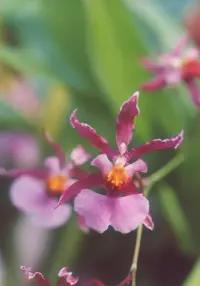
Oncidium ornithorhynchum is a compact epiphytic orchid, meaning it naturally grows attached to trees rather than in soil. It forms clumps of slim pseudobulbs with narrow, arching leaves. The plant produces many small, fragrant flowers on airy branched stems, often in shades of pink to rosy purple, creating a light, cloud-like display. It is native to higher-elevation regions of Central and South America, where conditions are bright, cool to mild, and humid. This species is considered moderately easy for growers who can provide stable temperatures, good air movement, and careful watering. Understanding how to care for Oncidium ornithorhynchum starts with offering bright filtered light and an open, fast-draining orchid mix that dries slightly between waterings.

Care Difficulty
Moderate Care

Light Preference
Bright Indirect Light

Water Requirements
Moderate Water

Temperature Preference
Tropical / Frost Sensitive

Hardiness Zone
12–13

Soil Texture
Sandy, Organic-rich

Soil pH
Acidic (5.5–6.5)

Soil Drainage
Well-drained

Fertilization
Moderate (every 2–4 weeks)
Scan your plant to receive care tips personalized for your specific plant
Available on iOS and Android
This orchid prefers bright, filtered light that mimics high, dappled forest canopy conditions.
Watering should balance consistent moisture with excellent drainage to protect the roots and pseudobulbs.
Stable, intermediate temperatures support steady growth and reliable blooming for this orchid.
This orchid prefers moderately humid air and reacts quickly to very dry conditions.
This species grows best in a very airy, fast-draining orchid medium rather than standard potting soil.
This orchid is very suitable for container growing when the pot supports its fine, air-loving roots.
This orchid benefits from light, consistent feeding during active growth for balanced flowering and leaf health.
Pruning needs are minimal and focus on hygiene and maintaining flowering performance.
Repotting helps maintain healthy roots and good aeration in this epiphytic orchid.
Propagation is mainly done by division because seed production requires sterile laboratory conditions.
This warmth-loving orchid is not frost tolerant and needs indoor conditions in cold climates.

Plant Health Check
Not sure what's wrong with your plant? Check your plant's health inside the app.
This species is known for producing clouds of small, pale pink flowers with a strong, sweet, candy-like fragrance that can fill a room when the plant is in full bloom.
It naturally comes from mid- to high-elevation habitats in Central America, where nights are cooler, which explains its preference for cooler to intermediate temperatures compared to many other commonly grown Oncidium orchids.
Under stable light and temperature conditions, this orchid can flower more than once a year on mature pseudobulbs, making it one of the more floriferous species suited to Oncidium ornithorhynchum indoor care.
Lack of blooms usually comes from insufficient light, too-warm nights, or skipping a slight winter rest. Inadequate fertilization, especially low potassium, and overcrowded, exhausted medium can also reduce flowering. Adjust these factors before expecting reliable spikes.
Keep your plants happy and healthy with plant identification, disease detection, and easy care guidance.

Green Fleshy Tree Orchid
Drymoanthus adversus
 POPULAR
Corpse Flower
Amorphophallus titanum
Bamboo-leaf orchid
Cymbidium lancifolium
Chinese Apple
Ziziphus mauritiana

Griffith Humata
Davallia griffithiana
prairie blazing star
Liatris pycnostachya
Anguloa clowesii
Anguloa clowesii
Tillandsia prodigiosa
Tillandsia prodigiosa