


Oncidium leleui Care

Oncidium leleui

About Oncidium leleui

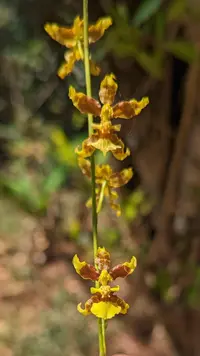
Oncidium leleui is an epiphytic orchid, meaning it often grows on trees rather than in soil, forming compact clumps with slender pseudobulbs and narrow leaves. It typically produces airy sprays of small, colorful flowers that can create a light, dancing effect on the stems.

This species is native to tropical regions of the Americas, where it experiences bright filtered light, good air movement, and regular moisture with rapid drying. Its need for stable humidity, careful watering, and adequate light makes it moderately challenging for beginners, but rewarding once conditions are understood. Learning how to care for Oncidium leleui helps prevent issues such as root rot and poor flowering.

Main Plant Requirements

Care Difficulty

Moderate Care

Light Preference

Bright Indirect Light

Water Requirements

Moderate Water

Temperature Preference

Tropical / Frost Sensitive

Hardiness Zone

Unknown

Soil Texture

Organic-rich

Soil pH

Acidic (5.5–6.5)

Soil Drainage

Well-drained

Fertilization

Light (every 4–6 weeks)

Get Personalized Care Plan

Scan your plant to receive care tips personalized for your specific plant

Available on iOS and Android

How to Care for the Oncidium leleui

This orchid prefers bright, filtered light with protection from harsh midday sun.

  • Provide 6–8 hours of bright, indirect light daily, such as dappled light under a sheer curtain or shade cloth.
  • Allow gentle morning sun and light late-afternoon sun; avoid direct midday rays that can scorch leaves or cause yellow patches.
  • In winter, move Oncidium leleui to the brightest spot available, but still filtered, to compensate for shorter days and lower light.

This species needs evenly moist but never waterlogged conditions, with slight drying between waterings.

  • Water thoroughly when the top 2–3 cm of the medium feels dry, using room-temperature water and allowing excess to drain completely.
  • Reduce watering in cooler months, letting the medium dry a bit more, and increase slightly during active growth in spring and summer.
  • Watch for wrinkled pseudobulbs as a sign of underwatering, and soft, blackened roots or a sour smell as signs of overwatering and poor drainage.

This orchid prefers intermediate to warm conditions with stable temperatures and good air movement.

  • Aim for 65–80°F (18–27°C) during the day and 55–65°F (13–18°C) at night for steady growth and flowering.
  • Protect from cold drafts and temperatures below 50°F (10°C), as prolonged exposure can damage leaves and roots and slow recovery.
  • In hot weather above 85°F (29°C), increase air circulation and humidity and shade lightly, since Oncidium leleui can overheat and dehydrate quickly in still, hot air.

This orchid prefers moderately high, stable humidity to maintain healthy pseudobulbs and foliage.

  • Aim for 50–70% humidity, as very dry indoor air causes shriveling pseudobulbs and crisp leaf tips.
  • Tolerates brief dips to 35–40%, but prolonged dryness slows growth and reduces flowering.
  • Increase humidity with a pebble tray, grouping plants, or a small humidifier, while keeping leaves well ventilated to prevent fungal issues.

This species needs a very airy, fast-draining orchid medium rather than conventional potting soil.

  • Use a chunky mix of medium bark, perlite, and a little sphagnum moss to provide both aeration and moisture retention.
  • Ensure the structure stays open; large particle size prevents compaction and protects fine roots from suffocation.
  • Aim for slightly acidic to neutral conditions, around pH 5.5–6.5, which supports nutrient uptake for Oncidium leleui.
  • Avoid dense, peat-heavy or garden soils that stay wet and clog air spaces, as these quickly lead to root rot.

This orchid is well suited to container growing when the pot supports its fine, spreading root system.

  • Choose a snug, shallow orchid pot to keep roots evenly moist without a large volume of constantly wet medium.
  • Use pots with side slits or mesh-style walls to boost air movement through the coarse orchid mix.
  • Select a heavier or wider-base pot if the plant becomes top-heavy so the container does not tip when spikes develop.

Nutrient input supports steady growth and flowering for Oncidium leleui grown in pots or mounted culture.

  • Use a balanced orchid fertilizer (around 20-20-20) diluted to 1/4–1/2 strength in low-mineral water.
  • Feed every 2–3 weeks during active growth in spring and summer, skipping applications if roots or medium look stressed.
  • In autumn and winter, reduce feeding to once every 4–6 weeks or pause if growth rests.
  • Avoid heavy compost or slow-release granules, which can burn roots in fine orchid media.

Pruning focuses on hygiene and flower-spike management rather than reshaping Oncidium leleui.

  • After blooms fade, cut spent flower spikes back to the base with sterilized scissors or pruners.
  • Remove dead, yellowed, or shriveled leaves and pseudobulbs to limit fungal problems and improve air flow.
  • Trim only clearly damaged roots when repotting, leaving firm, silvery or white roots intact.
  • Avoid cutting healthy green growth, as this reduces energy reserves and future flowering potential.

Repotting maintains healthy roots and aeration for container-grown Oncidium leleui.

  • Plan to repot every 2–3 years, or when roots circle the pot, escape drainage holes, or growth slows noticeably.
  • Choose late winter to early spring, just before new root and shoot growth, to support quick recovery.
  • Use a snug pot with fresh, free-draining orchid mix such as medium bark with perlite and a little charcoal.
  • Gently tease away old medium, trim only dead roots, and keep the plant slightly shaded and evenly moist afterward to limit stress.

Propagation of Oncidium leleui in home collections is usually done by division rather than by seed.

  • Divide mature clumps in late winter or early spring when new growths and roots are just starting.
  • Ensure each division carries at least 3–4 healthy pseudobulbs to maintain energy reserves.
  • Plant divisions in fresh orchid mix, firming gently so rhizomes sit just above the medium surface.
  • Provide bright, indirect light, high humidity, and slightly warmer temperatures to encourage rapid root establishment.

This orchid is frost-sensitive and needs controlled conditions during winter in most climates.

  • Keep plants indoors or in a heated greenhouse when outdoor temperatures drop below 55°F.
  • Maintain indoor temperatures around 60–70°F with bright, indirect light and good air movement.
  • Water less frequently in winter, allowing the medium to approach dryness while avoiding complete desiccation.
  • Avoid cold drafts and sudden temperature swings, which can stress pseudobulbs and reduce spring flowering.

Care Tips

Pseudobulb orientation

When repotting, position the newest pseudobulbs toward the pot center and leave space in front of the growth direction so the plant can produce several new leads before needing a larger pot.

Targeted air movement

Place a small fan on low, aimed past rather than directly at the plant, to keep leaves dry after watering or misting and reduce the risk of fungal spotting on the fine foliage.

Stake arching spikes

As flower spikes elongate, secure them loosely to thin stakes with soft clips or ties so the weight of the branching panicle does not snap the spike at its base.

Flush salts regularly

Every 4–6 weeks, water heavily with plain, low-mineral water until it runs freely from the drainage holes to wash out fertilizer salts that can burn the fine roots of this orchid.

Seasonal light shift

In winter, move the plant slightly closer to the light source and extend artificial lighting by 1–2 hours if possible to support continued root and pseudobulb strength when growing Oncidium leleui.

Common Pests and Diseases

Scale insects

This pest feeds on plant sap, often forming crusty, brown or whitish bumps on pseudobulbs, leaf bases, and flower spikes. Symptoms include yellowing leaves, poor flowering, and sticky honeydew that can lead to sooty mold.

Solution

Remove heavily infested leaves or sheaths and gently scrape individual scales with a cotton swab dipped in 70% isopropyl alcohol, taking care not to damage the pseudobulbs. Improve air movement, avoid excess nitrogen fertilization, and repeat alcohol swab treatments every 7–10 days until no new scale is seen as part of broader Oncidium leleui care instructions.

Spider mites

These insects are tiny sap-suckers that thrive in warm, dry, stagnant air and can be problematic on the thin leaves of this species. Symptoms include fine stippling, dull or silvery leaf surfaces, and fine webbing on the undersides of leaves or between leaf joints.

Solution

Rinse foliage thoroughly with lukewarm water, focusing on the undersides of leaves, and increase humidity to 50–70% while maintaining good air circulation. For persistent infestations, use repeated applications of an insecticidal soap or horticultural oil, applied in the evening and kept off open flowers to avoid spotting.

Mealybugs

This pest appears as white, cottony clusters in leaf axils, on pseudobulbs, and around roots in the potting mix. Symptoms include distorted new growth, sticky honeydew, and gradual weakening of the plant if populations build up.

Solution

Isolate the plant, remove visible insects with a cotton swab dipped in 70% isopropyl alcohol, and flush the crown and leaf axils with a gentle alcohol-water mix if the plant is strong. Replace or rinse the potting medium, inspect roots and rhizomes, and repeat spot treatments every 7–10 days until the plant is clean.

Bacterial brown spot

This disease causes soft, water-soaked lesions on leaves that quickly turn brown to black, sometimes with a yellow halo. Symptoms include rapid expansion of spots in warm, humid conditions and a foul smell from advanced lesions.

Solution

Remove affected leaves immediately with a sterile blade, cutting well into healthy tissue, and discard all infected material. After pruning, keep leaves dry, increase air movement, avoid overhead watering, and apply a copper-based bactericide labeled for orchids if the plant has a history of recurring issues.

Leaf spot fungus

This disease produces small, round to irregular dark spots on leaves that may merge into larger patches, particularly under cool, humid conditions or poor air circulation. Symptoms include slow expansion of lesions and cosmetic damage that can reduce photosynthesis over time.

Solution

Improve spacing and airflow around the plant, water early in the day, and avoid wetting foliage for long periods. Remove leaves with extensive spotting, then use a systemic fungicide labeled for ornamental orchids on both sides of remaining leaves according to label directions, repeating at intervals until no new spots appear.

Interesting Facts

Cloud forest specialist

This species is native to high-elevation cloud forests of Peru, where it grows as an epiphyte on trees in cool, moist, and very bright conditions with frequent mist but fast-drying roots.

Miniature growth habit

Unlike many showy Oncidium relatives, it remains quite small, forming compact clumps with relatively short pseudobulbs and fine roots, an adaptation to narrow tree branches and mossy bark in its native habitat.

Taxonomic uncertainty

The name has appeared in orchid literature mainly in older or regional sources, and its current taxonomic status is considered uncertain or unresolved in several modern orchid checklists, so it is rarely seen in mainstream cultivation or trade.

FAQs about Oncidium leleui

This species usually blooms once or twice a year, often in cooler, drier seasons after a period of steady growth. Flower spikes can be long and branched, carrying many small flowers that open over several weeks.

Grow Healthy Plants with Botan Care

Keep your plants happy and healthy with plant identification, disease detection, and easy care guidance.

Botan plant care app — identify plants on mobile









