Flowering cycle rest
After flowering finishes, reduce water slightly and keep the plant in bright, cool, very dry conditions for 4–6 weeks to encourage the next bud set rather than nonstop vegetative growth.

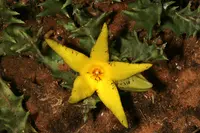
Yellow carrion flower (Orbea lutea) is a small, clumping succulent from arid regions of southern Africa. It forms low mats of green, four-angled, leafless stems. In warm seasons, it produces star-shaped yellow flowers that may have a faint carrion-like scent, which attracts pollinating flies. The blooms are striking and often patterned, making the plant popular in succulent collections. Orbea lutea stays compact, so it suits windowsills and small indoor displays. It prefers bright light, very well-drained gritty soil, and careful watering with long dry intervals. These drought-adapted traits make it relatively easy for patient growers who avoid overwatering and understand how to care for Yellow Carrion Flower.

Care Difficulty
Moderate Care

Light Preference
Partial Sun

Water Requirements
Low Water

Temperature Preference
Tropical / Frost Sensitive

Hardiness Zone
10–11

Soil Texture
Sandy, Loamy, Rocky

Soil pH
Slightly acidic (6.5–7.0), Neutral (7.0)

Soil Drainage
Well-drained

Fertilization
Minimal (feed rarely)
Scan your plant to receive care tips personalized for your specific plant
Available on iOS and Android
This succulent prefers bright, indirect light that mimics open, lightly shaded desert habitats.
This species has water-storing stems and needs infrequent but thorough watering in fast-draining soil.
This succulent thrives in warm, dry conditions with good protection from frost and extreme temperature swings.
This succulent thrives in dry indoor air and does not need elevated humidity.
Orbea lutea needs a sharply draining, airy mineral mix to prevent root and stem rot.
This species is very suitable for container growing due to its compact, clumping habit.
This succulent needs only light feeding to support compact growth and flowering without risking root damage.
Pruning Orbea lutea is mainly hygienic, helping maintain a tidy, healthy clump of stems.
This compact succulent prefers a slightly tight pot and infrequent repotting to avoid excess moisture around the roots.
Propagation of this species is commonly done from stem cuttings, with seeds used mainly by advanced growers.
This succulent is frost sensitive and needs managed conditions in winter, especially in cooler climates.

Plant Health Check
Not sure what's wrong with your plant? Check your plant's health inside the app.
In its native southern African range, the yellow carrion flower is mainly pollinated by dung beetles and other carrion-loving insects that are attracted by its faint odor and the visual mimicry of decaying organic matter.
This succulent typically grows and flowers during the warm rainy season in habitat, then slows or partially rests in the cooler, drier months, an adaptation to unpredictable semi-arid climates.
The flowers are star-shaped with 5 narrow, pointed lobes, but their size and shade of yellow can vary noticeably between populations, reflecting genetic diversity within the species.

The inner surface of the flowers often bears tiny, glossy, wart-like bumps and distinct patterning that help reflect light and enhance the illusion of moist, decomposing material, making the blooms more convincing to scavenging insect pollinators.
Lack of blooms is usually linked to insufficient light, too much water, or a pot that is overly large. Cool winter rest, strong light, and a lean, fast‑draining mix support flowering in this succulent species.
Keep your plants happy and healthy with plant identification, disease detection, and easy care guidance.