Shallow, wide pots
Use a wide, shallow clay pot with several drainage holes to let the creeping stems spread and to keep the root zone from staying wet too long.

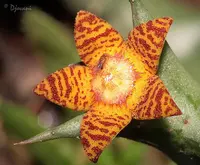
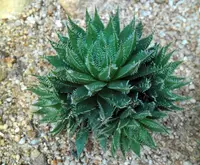
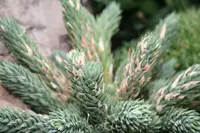
Orbea schweinfurthii is a small, clumping succulent from arid regions of East Africa. It forms low mats of green to mottled, angular stems with soft teeth along the ridges.
The plant produces striking star-shaped flowers, often patterned and sometimes faintly scented, which appear near the stem bases. Its growth habit stays compact, which suits containers and small indoor spaces.
This species comes from hot, dry habitats, so it resents excess moisture and poor drainage. Those conditions shape how to care for Orbea schweinfurthii and make it sensitive to overwatering.
Given bright light, a very well-drained gritty mix, and careful watering, it is generally not difficult to maintain for growers used to succulents.

Care Difficulty
Moderate Care

Light Preference
Partial Sun

Water Requirements
Low Water

Temperature Preference
Tropical / Frost Sensitive

Hardiness Zone
11–12

Soil Texture
Sandy, Loamy, Rocky

Soil pH
Slightly acidic (6.5–7.0), Neutral (7.0)

Soil Drainage
Well-drained

Fertilization
Minimal (feed rarely)
Scan your plant to receive care tips personalized for your specific plant
Available on iOS and Android
This succulent prefers bright conditions that mimic its sunny native habitat while avoiding harsh burn.
Watering should mimic a dry, episodic desert pattern rather than frequent small sips.
Stable warmth with brief cool periods suits this species best, while frost quickly causes tissue damage.
This species handles typical indoor humidity well and rarely needs special humidity management.
Use a coarse, fast-draining mineral-based mix that mimics arid, rocky habitats.
This succulent grows very well in containers, both indoors and outdoors in suitable climates.
This succulent benefits from modest feeding during its active season but is sensitive to excess nutrients.
Pruning needs are low and mainly focused on hygiene and maintaining a compact clump.
This species prefers slightly tight conditions and only needs infrequent repotting in a suitable gritty mix.
Propagation is commonly done from stem cuttings that root well in warm, dry conditions.
This plant is not frost tolerant and needs controlled, dry winter conditions, especially in cold climates.

Plant Health Check
Not sure what's wrong with your plant? Check your plant's health inside the app.
Its star-shaped flowers emit a rotten odor that mimics decaying organic matter, an adaptation that attracts carrion-associated flies as pollinators in its native habitats of northeastern tropical Africa.
Flower lobes often show a mix of maroon, brown, and yellowish patterns, with fine hairs along the surface, and this color and hair pattern variation is used by taxonomists to distinguish it from closely related Orbea species.
Instead of storing water in leaves, it has leafless, angular, green succulent stems that carry out most of the photosynthesis and allow the plant to withstand long dry periods in rocky, arid sites.
Blooming is often reduced by insufficient light, excess watering, or fertilizer high in nitrogen. Provide strong light, a gritty, lean mix, and a slightly cooler, drier rest period in winter to encourage flowering when caring for Orbea schweinfurthii.
Keep your plants happy and healthy with plant identification, disease detection, and easy care guidance.