


Encourage Compact Form
Pinch back soft stem tips in early spring to keep plants dense and low rather than leggy, and use the cuttings as propagation material so growing Gum Toothfig stays efficient and space-saving.

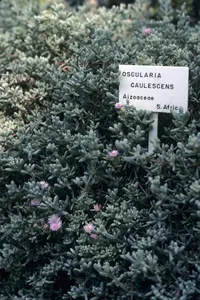
Gum toothfig, Oscularia caulescens, is a compact, mat-forming succulent from the dry coastal regions of South Africa. It is grown mainly for its sculptural foliage and bright flowers. The plant has blue-green, three-angled leaves with tiny tooth-like edges and produces abundant pink to magenta daisy-like blooms in warm seasons. Stems can trail or gently spill over pot edges, so it suits containers, rock gardens, and hanging planters. This species stays relatively small and copes well with short dry spells, which makes it manageable for beginners. To care for Gum Toothfig, provide strong light, very free-draining soil, and avoid frequent heavy watering.

Care Difficulty
Easy Care

Light Preference
Full Sun

Water Requirements
Low Water

Temperature Preference
Warm Climate

Hardiness Zone
9–11

Soil Texture
Sandy, Loamy, Rocky

Soil pH
Slightly acidic (6.5–7.0), Neutral (7.0)

Soil Drainage
Well-drained

Fertilization
Minimal (feed rarely)
Scan your plant to receive care tips personalized for your specific plant
Available on iOS and Android
This succulent prefers bright light with some direct sun but needs protection from extreme midday intensity.
This drought-tolerant succulent needs infrequent, deep watering in fast-draining soil.
This plant prefers mild, dry conditions and does not tolerate severe frost.
This succulent handles low household humidity and rarely needs special moisture management.
Oscularia caulescens needs very fast-draining, lean soil to prevent root rot.
This species is very suitable for container growing, especially in sunny patios and rock-style planters.
Oscularia caulescens is a low‑feeding succulent that benefits from light, controlled nutrition in active growth only.
Pruning Oscularia caulescens keeps the plant compact, encourages branching, and maintains good flowering.
This succulent prefers infrequent repotting and only needs a move when clearly root-bound or declining.
Oscularia caulescens is commonly propagated from stem cuttings, which root quickly in warm, dry conditions.
This succulent dislikes prolonged frost and benefits from simple winter protection in cold climates.

Plant Health Check
Not sure what's wrong with your plant? Check your plant's health inside the app.
This species naturally grows on rocky coastal slopes in the Western Cape of South Africa, where it tolerates salty sea spray and thin, fast-draining soils that many other succulents cannot handle well.
Its small pink, daisy-like flowers typically open in the afternoon and evening, releasing a light fragrance that attracts nocturnal or crepuscular pollinators when temperatures are cooler.
Stems and triangular leaves can flush red to purple in strong sun due to increased production of protective pigments called anthocyanins, which help shield tissues from intense light and UV exposure.

This plant is considered a minor yet locally distinctive component of the Cape Floristic Region, one of the world’s biodiversity hotspots, and contributes to coastal stabilization by binding shallow, sandy or rocky soils with its mat-forming, sprawling stems.
Poor flowering usually comes from insufficient light, excess nitrogen fertilizer, or using a pot that is too large and stays wet. Provide strong light, a lean, well-drained mix, and a low-nitrogen fertilizer to support bud formation.
Keep your plants happy and healthy with plant identification, disease detection, and easy care guidance.

 POPULAR
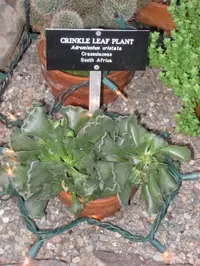
Crinkle leaf
Adromischus cristatus
Cochemiea armillata
Cochemiea armillata
Mother of Thousands
Kalanchoe laetivirens
Chandelier plant
Kalanchoe delagoensis
 POPULAR
Paddle plant
Kalanchoe luciae

Octopus Cactus
Stenocereus alamosensis
organpipe cactus
Stenocereus thurberi
Cochemiea schumannii
Cochemiea schumannii