miagos bush Care (Osmoxylon lineare)

miagos bush

About miagos bush

Miagos bush (Osmoxylon lineare) is a tropical shrub or small tree grown mainly for its narrow, finger-like leaves and tidy, upright form. It is often used as an ornamental foliage plant in warm landscapes and as a container specimen in bright indoor spaces. Native to parts of Southeast Asia, it prefers stable warmth, moderate humidity, and sheltered positions out of harsh, direct sun. Its steady growth, tolerance of pruning, and relatively low pest pressure make it manageable for most plant owners. Consistent moisture in well-drained soil and protection from cold drafts are the main points to understand when learning how to care for miagos bush.

Main Plant Requirements

Care Difficulty

Moderate Care

Light Preference

Partial Shade

Water Requirements

Moderate Water

Temperature Preference

Tropical / Frost Sensitive

Hardiness Zone

10–11

Soil Texture

Loamy, Sandy, Organic-rich

Soil pH

Acidic (5.5–6.5), Slightly acidic (6.5–7.0)

Soil Drainage

Moist but well-drained

Fertilization

Light (every 4–6 weeks)

Get Personalized Care Plan

Scan your plant to receive care tips personalized for your specific plant

Available on iOS and Android

How to Care for the miagos bush

Osmoxylon lineare prefers bright, filtered light that mimics a lightly shaded tropical understory.

  • Provide 3–5 hours of gentle morning sun with bright, dappled or filtered light for the rest of the day for healthy foliage on miagos bush.
  • Allow light to drop to bright partial shade, especially in hot climates, but avoid deep shade that causes sparse growth and elongated, weak stems.
  • Protect from intense midday and afternoon sun, which can scorch leaves; give slightly more light in winter and a bit more shade in peak summer.

Watering for Osmoxylon lineare should aim for evenly moist but never saturated soil.

  • Let the top 3–5 cm of soil dry before watering again, using a finger test rather than a fixed schedule.
  • Use well-drained soil so water runs freely from the root zone; soggy conditions cause yellowing leaves, soft stems, and root rot symptoms.
  • Reduce watering in cooler seasons when growth slows, and watch for wilting or crisp leaf edges as signs the plant has stayed dry for too long.

Stable, warm temperatures support strong growth and leaf quality.

  • Aim for 65–80°F (18–27°C) as the main growing range, where Osmoxylon lineare maintains steady foliage and root activity.
  • Avoid temperatures below 50°F (10°C); brief drops to 45°F (7°C) may be tolerated but can slow growth and increase stress.
  • Protect from frost and cold winds, and in hot spells above 90°F (32°C) provide more shade and airflow to limit heat stress and leaf scorch.

This species prefers moderately humid air and reacts if conditions are too dry.

  • Aim for 50–65% humidity to keep foliage dense and leaf tips healthy on miagos bush.
  • It tolerates brief dips to 35–40%, but prolonged dry air leads to brown, crispy leaf edges and slower growth.
  • Increase humidity with a pebble tray or room humidifier rather than frequent misting, which adds little lasting moisture.

Osmoxylon lineare needs a loose, fast-draining mix that still holds some moisture.

  • Use a peat- or coco-based mix with 20–30% perlite and 10–20% fine bark to create a light, airy structure.
  • Aim for slightly acidic to neutral pH around 6.0–7.0, avoiding strongly alkaline mixes that can lock up nutrients.
  • Improve drainage by avoiding heavy garden soil or pure compost, which compact and keep roots wet for too long.
  • Ensure the mix drains within a few seconds of watering; if water pools on top, increase coarse materials to boost aeration.

This plant grows well in containers when the pot supports its upright, woody form.

  • Choose a wide, heavier pot to counterbalance the tall, narrow canopy and reduce tipping in wind or accidental bumps.
  • Select a container depth that allows a broad root zone, leaving at least 5–8 cm of space below the current root mass.
  • Use pots with multiple drainage holes so excess water escapes quickly, preventing water from collecting around the woody root base.

Osmoxylon lineare benefits from light, steady feeding to support foliage density, especially in containers.

  • Use a balanced liquid fertilizer (around 10-10-10 or 20-20-20) at 1/2 strength every 4–6 weeks in spring and summer.
  • Apply a thin layer of compost over the root zone once per year to improve soil structure and slow nutrient release.
  • For potted miagos bush, a slow-release fertilizer in early spring can provide gentle nutrition for 3–4 months.
  • Reduce feeding to 1/4 strength or stop entirely in fall and winter, when growth slows.

Pruning helps maintain Osmoxylon lineare as a neat, compact shrub and encourages denser branching.

  • Carry out light shaping in late winter or early spring before strong new growth starts.
  • Remove dead, damaged, crossing, or inward-growing stems back to a healthy lateral branch or the base.
  • Shorten overly long shoots to control height and width, cutting just above a leaf node to promote branching.
  • Use clean, sharp bypass pruners and disinfect blades between plants to limit disease spread.

Container-grown Osmoxylon lineare occasionally needs more space and fresh substrate for healthy growth.

  • Check for roots circling the pot, pushing through drainage holes, or unexplained slow growth as signs to move up 1 pot size.
  • Plan repotting or outdoor transplanting in spring, every 2–3 years for pots, when active growth allows faster recovery.
  • Gently loosen circling roots and trim only lightly, avoiding heavy root removal that can shock the plant.
  • Water well before and after moving, keep shaded for 3–5 days, and maintain even moisture to reduce root stress.

New Osmoxylon lineare plants are most often produced from semi-hardwood cuttings under warm, humid conditions.

  • Take 8–12 cm semi-hardwood stem cuttings in late spring or summer with 2–3 leaf nodes.
  • Remove lower leaves, dip the cut end in rooting hormone, and insert into a sterile, well-drained medium such as perlite and peat.
  • Maintain high humidity with a clear cover, bright indirect light, and temperatures around 70–80°F for rooting.
  • Seed propagation is possible but slower; sow fresh seed in a warm, evenly moist, free-draining mix.

Osmoxylon lineare is frost sensitive and needs protection in regions with cold winters.

  • In USDA zones cooler than 10, grow in containers and move indoors before temperatures drop below 40°F.
  • Place indoor plants in bright, indirect light and reduce watering so the top soil layer dries slightly between waterings.
  • In mild climates, apply a 5–8 cm mulch layer over the root zone to buffer brief cool spells.

Care Tips

Staggered stem pinching

Pinch back only the soft tips of a few stems at a time every 4–6 weeks to keep the plant compact and encourage dense, tiered foliage without shocking it.

Discreet structural staking

Use slim, dark stakes placed near the main stems and tie with soft plant ties in loose figure-eight loops to support tall, flexible canes and prevent leaning as the plant gains height.

Rotational light balancing

Rotate the container 90° every 2–3 weeks so all sides receive similar light, which reduces lopsided growth and keeps the plant’s umbrella-like canopy symmetrical.

Clean foliage management

Wipe the narrow leaves with a barely damp, soft cloth every 4–6 weeks to remove dust, improve light absorption, and allow early detection of pests along the midrib and leaf bases.

Controlled pot sizing

When repotting, move up only 2–4 cm in pot diameter and keep a similar, tall container shape to match its upright root system and reduce the risk of waterlogged soil while growing miagos bush.

Common Pests and Diseases

Spider mites

This pest commonly appears on stressed plants grown in warm, dry indoor air, causing fine stippling, bronzing, and delicate webbing on the narrow leaves.

Solution

Rinse foliage thoroughly with a strong, lukewarm water spray, including leaf undersides, then repeat every few days; increase humidity and reduce heat stress, and if needed apply insecticidal soap or horticultural oil, ensuring good coverage of all foliage and stems.

Scale insects

These insects attach along stems and leaf midribs as small bumps, sucking sap and causing yellowing, leaf drop, and sticky honeydew that can lead to sooty mold.

Solution

Wipe stems and leaves with a cotton pad dipped in diluted isopropyl alcohol to dislodge scales, prune heavily infested twigs, and follow up with 2–3 applications of horticultural oil or insecticidal soap at 7–10 day intervals while monitoring for crawler stages.

Mealybugs

This pest hides in leaf clusters and stem joints as white, cottony masses, weakening the plant and excreting honeydew that attracts ants.

Solution

Isolate the plant, manually remove visible clusters with a cotton swab and alcohol, then wash the plant with lukewarm water and apply insecticidal soap to all crevices; maintain regular inspections for several weeks as part of consistent Osmoxylon lineare care.

Leaf spot

This disease appears as irregular brown or black lesions on the narrow leaves, sometimes with a yellow halo, and is favored by overhead watering and poor air movement.

Solution

Remove and discard affected leaves, avoid wetting foliage, water at the soil level, and improve spacing and airflow; for persistent problems in humid climates, apply a labeled copper or chlorothalonil fungicide according to directions while keeping foliage as dry as possible.

Interesting Facts

Narrow palmate foliage

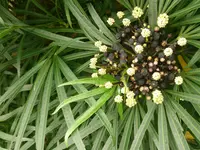
This species has unusually narrow, linear leaf segments arranged in a palmate pattern, giving each leaf a starburst look that is distinctive within the Araliaceae family.

Shrub of tropical edges

It naturally occurs as a multi-stemmed shrub along forest edges and in coastal lowland habitats in Southeast Asia, where it benefits from bright light but partial shelter from dense canopy shade.

Relatively recent introduction

Although native to tropical Asia, it entered ornamental horticulture only in recent decades and is now grown mainly as a foliage accent in warm-climate landscapes and specialized collections.

FAQs about miagos bush

Yellowing leaves usually result from overwatering, poor drainage, or sudden temperature changes. Check that the root zone is not waterlogged, improve drainage, and remove affected leaves. Adjust watering gradually rather than making abrupt changes.

Grow Healthy Plants with Botan Care

Keep your plants happy and healthy with plant identification, disease detection, and easy care guidance.

Botan plant care app — identify plants on mobile

Explore More Plants