Host Tree Assessment
Inspect poplar and other host trees for existing structural weakness or decay before allowing the fungus to establish, since this bracket accelerates wood rot and should not be encouraged on trees that need to remain sound.

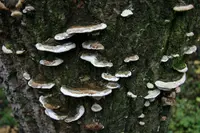
Poplar bracket, Oxyporus populinus, is a wood-decay fungus that forms thick, shelf-like brackets on living or dead poplar and other hardwood trees. It is not a houseplant but a specialist decomposer in forest, park, and urban tree settings.
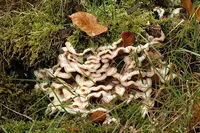
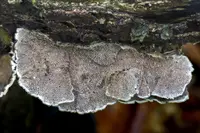
The brackets are usually pale to creamy white, corky to woody in texture, and can persist for a long time on trunks or large branches. They indicate internal wood decay, which can weaken trees and increase the risk of branch or trunk failure.
Gardeners mainly encounter this species outdoors when assessing tree health rather than learning how to care for Poplar Bracket. It prefers moist wood and shaded to semi-shaded conditions typical of mature tree canopies.

Care Difficulty
Moderate Care

Light Preference
Partial Shade

Water Requirements
Moderate Water

Temperature Preference
Cool Climate

Hardiness Zone
Unknown

Soil Texture
Loamy, Silty, Organic-rich

Soil pH
Slightly acidic (6.5–7.0)

Soil Drainage
Moist but well-drained

Fertilization
Minimal (feed rarely)
Scan your plant to receive care tips personalized for your specific plant
Available on iOS and Android
This wood-decaying fungus develops most reliably where light and moisture conditions are stable rather than intense.
Moisture levels in the host wood matter more than surface watering for this bracket fungus.
This species favors cool to mild conditions but can persist across a relatively wide outdoor temperature range.
Humidity does not significantly affect Oxyporus populinus, which naturally develops on outdoor wood in typical ambient conditions.
Oxyporus populinus is a wood-decay fungus that colonizes standing or fallen poplar and similar hardwoods rather than typical potting soil.
This species is not suitable for conventional container growing, as it requires host wood rather than a potting medium.
This wood-decay fungus grows on host trees and generally does not need fertilization in managed landscapes.
Pruning focuses on managing infected host wood rather than shaping Oxyporus populinus itself.
Transplanting relates to affected host trees, since this fungus is not maintained as a potted specimen.
Propagation of this bracket fungus is rarely a goal in home or landscape management and is generally discouraged.
This perennial decay fungus is naturally cold hardy, so no specific winter care is required for the organism itself.

Plant Health Check
Not sure what's wrong with your plant? Check your plant's health inside the app.
This bracket fungus is a wood-decay pathogen that primarily attacks living and dead poplar and related trees, causing a characteristic white rot that selectively removes lignin and leaves the wood pale and fibrous.
In infected trunks, the fungus produces a distinctive internal decay pattern, with brown cubical cracking and lighter pockets of stringy white rot, which arborists use as a diagnostic sign during tree inspections.
Its fruiting bodies are thick, corky to woody brackets that start pale and can weather to a darker color while remaining rigid and persistent on the trunk for several years, even after they stop producing spores.

Oxyporus populinus is considered a wound parasite, meaning it usually colonizes poplar trees through existing injuries in the bark or wood, and those entry points often determine how quickly structural decay develops inside the trunk.
This wood-decaying fungus is not suited to decorative container culture. It normally colonizes dead or stressed hardwood, especially poplar and aspen. In pots it lacks the large woody substrate it needs and will not establish reliably.
Keep your plants happy and healthy with plant identification, disease detection, and easy care guidance.