Targeted habitat placement
Place substrate trays or colonized wood chips near compost heaps, mulched beds, or decaying wood where flies and other insects are already active, since these insects are the primary spore dispersers for Phallus rugulosus.

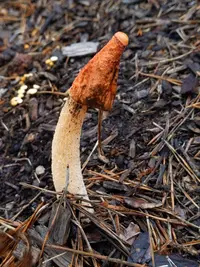
Wrinkly stinkhorn, Phallus rugulosus, is a saprophytic fungus, not a traditional green plant. It feeds on decaying wood and leaf litter, helping break down organic matter in forests and gardens.
The fruiting body is tall and slender with a wrinkled, sponge-like stem and a slimy, olive-brown cap that produces a strong odor. This smell attracts flies, which spread its spores.
Phallus rugulosus is found in warm to temperate regions, often in mulch, woodland edges, and rich organic soils. It tends to appear suddenly after rain, then collapses within a day or two.
Gardeners do not usually try to care for Wrinkly Stinkhorn, but it generally favors moist, shaded sites with abundant organic debris.

Care Difficulty
Moderate Care

Light Preference
Partial Shade

Water Requirements
Keep Soil Moist

Temperature Preference
Warm Climate

Hardiness Zone
Unknown

Soil Texture
Loamy, Organic-rich

Soil pH
Acidic (5.5–6.5)

Soil Drainage
Moist but well-drained

Fertilization
Minimal (feed rarely)
Scan your plant to receive care tips personalized for your specific plant
Available on iOS and Android
This saprophytic fungus develops fruiting bodies best under shaded forest or garden conditions rather than open sun.
This fungus needs consistently moist, organic-rich ground rather than direct watering of the fruiting bodies.
This species fruits reliably in mild to warm conditions and declines in prolonged cold or extreme heat.
Humidity is not a key factor for Phallus rugulosus, which focuses more on moisture in the substrate than in the air.
Phallus rugulosus develops best in loose, moisture-retentive yet free-draining, organic-rich substrate.
This fungus is not well suited to typical container growing, since it depends on decomposing organic material in the ground.
Phallus rugulosus is a saprophytic fungus that usually obtains enough nutrients from rich, decaying organic matter and rarely benefits from targeted fertilization.
Phallus rugulosus does not require pruning, since its fruiting bodies are temporary fungal structures rather than persistent stems or foliage.
This fungus is not suited to typical pot culture, so management focuses on establishing and refreshing an outdoor substrate rather than classic repotting.
Propagation of Phallus rugulosus is usually left to natural spore dispersal, which is highly effective where suitable decaying organic matter is present.
In suitable climates this saprophytic fungus typically overwinters in the soil without need for special attention, as only the underground mycelium persists between fruiting periods associated with caring for Wrinkly Stinkhorn.

Plant Health Check
Not sure what's wrong with your plant? Check your plant's health inside the app.
The fruiting body has a distinctly wrinkled, net-like stem surface that helps distinguish it from other stinkhorn species with smoother stems. This rugose texture is reflected in its species name rugulosus, meaning finely wrinkled.
Its olive-brown spore slime (gleba) produces a strong odor that specifically attracts carrion- and dung-loving flies, which then transport the sticky spores on their feet and bodies to new sites.
This species is usually found in disturbed soils, mulch, or rich organic debris rather than deep forest, indicating a strong adaptation to human-modified and nutrient-rich environments.

The egg stage of this fungus, a whitish underground structure, can persist unnoticed in soil or mulch until conditions are suitable, then rapidly expand and emerge as a full fruiting body in a matter of hours.
This fungus spreads by releasing spores carried by insects attracted to its odor. It can appear in clusters where wood chips, mulch, or rich organic debris are present, but it rarely becomes a serious garden management problem.
Keep your plants happy and healthy with plant identification, disease detection, and easy care guidance.