Baja elephant tree Care (Pachycormus discolor)

Also known as: Baja Elephant Tree
Baja elephant tree

About Baja elephant tree

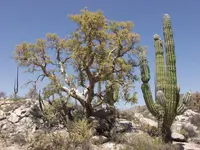
The Baja elephant tree, Pachycormus discolor, is a slow-growing succulent shrub or small tree with a thick, swollen trunk used for water storage. Its branching canopy carries small, leathery leaves and often develops a striking, sculptural silhouette with age.

This species is native to the arid regions of Baja California, where it thrives in rocky, well-drained slopes under strong sun. It is drought tolerant but sensitive to cold and excess moisture, which influences how easy it is to keep healthy.

For most growers, it is considered a specialty plant that rewards patience and careful attention. Understanding how to care for Baja elephant tree mainly involves managing bright light, fast-draining soil, and restrained watering.


Main Plant Requirements

Care Difficulty

Moderate Care

Light Preference

Full Sun

Water Requirements

Low Water

Temperature Preference

Warm Climate

Hardiness Zone

9–11

Soil Texture

Sandy, Loamy, Rocky

Soil pH

Slightly acidic (6.5–7.0), Slightly alkaline (7.0–7.5)

Soil Drainage

Well-drained

Fertilization

Minimal (feed rarely)

Get Personalized Care Plan

Scan your plant to receive care tips personalized for your specific plant

Available on iOS and Android

How to Care for the Baja elephant tree

This desert shrub thrives in bright, intense light that mimics its native Baja habitat.

  • Provide 6–10 hours of direct sun daily; full sun is best, especially morning to mid-afternoon exposure.
  • It tolerates light afternoon shade in very hot regions, but prolonged shade causes weak, stretched growth and sparse branching in Baja elephant tree.
  • In winter or coastal climates, choose the sunniest, most open spot; avoid locations shaded by buildings or trees for more than 4–5 hours.

Watering should be infrequent and guided by soil dryness rather than a fixed schedule.

  • Allow the top 5–10 cm of soil to dry completely before watering; in hot, dry seasons this may mean deep watering every 2–4 weeks outdoors.
  • Use very fast-draining, gritty soil so water runs through within seconds; standing water or heavy clay strongly increases root-rot risk for Pachycormus discolor.
  • In cool seasons or dormancy, reduce or stop watering until the trunk slightly softens or fine roots start to shrivel, then give a modest drink.

This species prefers warm, arid conditions and is sensitive to prolonged cold and frost.

  • Ideal growing temperatures are 70–90°F (21–32°C), with brief peaks to 95–100°F (35–38°C) tolerated if soil is dry and roots are established.
  • Protect from frost; damage often occurs below 28–30°F (-2 to -1°C), and extended freezes can kill young or potted plants.
  • In winter, keep as close to 50–60°F (10–16°C) as local climate allows, and avoid sudden swings between cool, damp nights and hot daytime sun.

This desert caudiciform prefers dry air and does not have special humidity requirements.

  • Target 30–50% humidity, similar to typical heated or air-conditioned indoor air.
  • The Baja elephant tree tolerates much drier conditions than many houseplants, so avoid humidifiers nearby.
  • If new growth becomes soft, spots appear on the caudex, or leaves blacken, reduce ambient humidity and improve air movement.

This species needs a very fast-draining, mineral-heavy mix to protect its caudex from rot.

  • Use a sandy, gritty soil with coarse structure, such as 60–70% inorganic material (pumice, lava rock, coarse perlite, or grit) blended with 30–40% cactus mix or lean loam.
  • Aim for slightly acidic to neutral pH, around 6.0–7.0, which suits Pachycormus discolor without encouraging nutrient lockout.
  • Increase aeration by using large-grain particles (3–6 mm) and avoiding fine peat that compacts and stays wet too long.
  • Avoid dense garden soil, water-retentive potting mixes, and any medium that stays wet for more than 24 hours after thorough watering.

This species is well suited to container growing due to its slow growth and sculptural caudex.

  • Choose a wide, shallow pot to accommodate the spreading caudex and keep the plant stable as the top growth extends.
  • Use unglazed terracotta or other porous materials so moisture evaporates faster and the caudex dries promptly after watering.
  • Elevate the pot and ensure drain holes remain fully open so excess water exits quickly and does not pool under the container.

Pachycormus discolor is adapted to very poor soils, so use fertilizer sparingly to avoid soft, weak growth.

  • During active growth in spring–summer, apply a balanced, low-nitrogen NPK cactus or succulent fertilizer at 1/4–1/2 strength.
  • Feed once every 4–6 weeks at most; many established plants can skip feeding entirely outdoors.
  • Stop feeding in fall and winter dormancy to prevent etiolated, out-of-season growth.
  • In containers, use a gritty mix and, if needed, a light top-dressing of compost rather than frequent liquid feeding when caring for Baja elephant tree.

Pruning Pachycormus discolor is mainly for health and light shaping, not for heavy size control.

  • Best time is late winter to early spring, before vigorous new growth begins.
  • Use clean, sharp bypass pruners to remove dead, diseased, or crossing branches at their origin.
  • Thin crowded inner shoots lightly to reveal the trunk and maintain a balanced canopy outline.
  • Avoid hard cuts into the main caudex or large structural branches to reduce infection risk and scarring.

This species dislikes frequent disturbance, so repot or transplant Pachycormus discolor only when clearly necessary.

  • Check for roots circling the pot, pushing through drainage holes, or very slow growth despite good care.
  • Plan repotting or transplanting for late spring to early summer, once temperatures are consistently warm.
  • Repot no more often than every 3–5 years, stepping up only 1 pot size in a very fast-draining, mineral-rich mix.
  • Minimize root stress by keeping the root ball as intact as possible, watering lightly afterward, and shading from intense sun for 1–2 weeks.

Propagation of Pachycormus discolor is possible but slow and better suited to patient growers.

  • Sow fresh seeds in late spring in a warm (70–80°F), bright, lightly shaded spot using a gritty, free-draining mix.
  • Keep the seed medium just barely moist, never wet, to limit damping-off and root rot.
  • Use semi-hardwood stem cuttings in late spring–summer, allowing cut ends to callus for several days before potting.
  • Place cuttings in a very coarse mix with bottom warmth and high light, and expect rooting to take many weeks or months.

Winter care for Pachycormus discolor focuses on avoiding prolonged frost and excess moisture around the roots.

  • Mature plants tolerate brief light frost but are safest above 28–30°F, especially in containers.
  • In-ground plants in marginal climates benefit from a 5–8 cm layer of coarse gravel mulch over the root zone.
  • Move potted specimens under cover or indoors to a bright, cool, dry area before hard freezes.
  • Water sparingly in winter, keeping the soil mostly dry to prevent rot in the swollen caudex and roots.

Care Tips

Root zone protection

Top-dress the pot or planting area with a 1–2 in layer of coarse mineral grit (pumice, small gravel, or decomposed granite) to protect surface roots, keep the caudex dry at the base, and reduce splash that can encourage rot or fungal spots.

Controlled caudex shaping

If you want a more exposed, sculptural caudex, repot slightly higher every 2–3 years, brushing away some old mix and adding fresh gritty substrate while keeping at least 1–2 in of roots fully buried for stability and water uptake.

Branch training technique

While stems are still flexible, use soft ties and a small stake or bonsai wire wrapped over protective tape to gently angle branches, checking and adjusting monthly to avoid wire marks and to create a balanced canopy over the swollen trunk.

Summer growth push

During the active warm season, cluster the plant with other drought-tolerant succulents in the brightest, breeziest spot and rotate the container 90° every 2–3 weeks to encourage even branching and compact, sun-hardened growth when growing Baja elephant tree.

Dormancy management

If the plant drops most leaves in late fall or winter, reduce water sharply and move it to a slightly cooler, very bright and dry position, resuming normal watering only when new bud swell and fresh leaves appear.

Common Pests and Diseases

Mealybugs

This pest often hides in branch crotches and along the fissured caudex, sucking sap and causing slow decline, yellowing, and sooty mold from honeydew. Infestations are favored by warm, dry indoor conditions and excess nitrogen fertilizer.

Solution

Isolate the plant, then dab visible insects with cotton swabs dipped in 70% isopropyl alcohol and gently scrub the corky bark and joints. Follow with 2–3 applications of a light horticultural oil or insecticidal soap at 7–10 day intervals, and reduce soft, nitrogen‑rich feeding to make the plant less attractive.

Scale insects

These insects form hard or soft bumps on stems and older branches, especially on rough, corky bark, leading to yellowing leaves and weak new growth from chronic sap loss. Honeydew may attract ants and support sooty mold on nearby surfaces.

Solution

Manually remove scales by gently scraping with a fingernail or soft brush, then treat the bark and stems with horticultural oil to smother remaining juveniles. For persistent problems, repeat oil sprays every 10–14 days and control nearby ant activity to reduce insect protection and spread.

Red spider mites

This pest thrives on pachycaul species kept very dry and warm, feeding on tender foliage and causing stippling, dull gray patches, and fine webbing on leaves. Damage is most common in heated, low‑humidity indoor settings or very sheltered patios.

Solution

Rinse foliage thoroughly under a gentle stream of water, including leaf undersides, and slightly raise humidity around the canopy without wetting the caudex for long periods. Apply insecticidal soap or a labeled miticide every 5–7 days for several cycles, and avoid placing the plant in hot, stagnant air to reduce reinfestation risk.

Fungal stem canker

This disease affects stressed or mechanically damaged stems and branches, producing sunken, discolored patches that may crack or ooze and can eventually girdle sections of the plant. Symptoms include dieback of tips above the lesion, especially after cold or overwatering stress.

Solution

Prune out affected stems well below visible damage with sterile tools and allow cut surfaces to dry quickly in good airflow. Keep the caudex and stems dry between waterings, avoid overhead watering, protect the plant from cold, and use a fast‑draining mineral substrate to limit future infections as part of Pachycormus discolor care.

Interesting Facts

Elephantine caudex trunk

This species develops a swollen woody base and trunk, called a caudex, that stores water and allows the plant to survive long rainless periods on arid Baja California slopes.

Seasonally shifting foliage

In its native climate it often drops leaves during hot, dry conditions and re-leafs quickly after rainfall, showing a drought-deciduous strategy that reduces water loss when moisture is scarce.

Specialist Baja endemic

The species is naturally restricted to the Baja California Peninsula and nearby islands, where it grows on rocky hillsides and coastal mesas, often rooted in very shallow, mineral soils.

Botan icon

Did you know?

In its natural habitat, older specimens can form thick, sculptural trunks and limbs that are shaped over decades by wind and sparse growth, making wild trees visually comparable to large, naturally styled bonsai in the landscape.

FAQs about Baja elephant tree

Yellowing leaves usually come from overwatering, poor drainage, or sudden temperature changes. Check that the pot drains freely, let the soil dry more between waterings, and avoid cold drafts or abrupt moves between very different environments.

Grow Healthy Plants with Botan Care

Keep your plants happy and healthy with plant identification, disease detection, and easy care guidance.

Botan plant care app — identify plants on mobile

Explore More Plants