Mark Dormant Spots
After foliage dies back in late summer or fall, place small labels or stones where each crown sits so you avoid damaging the dormant rhizomes when digging or planting nearby.

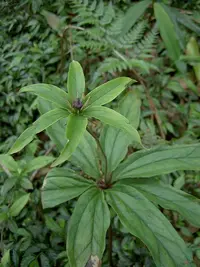
Multi-leaf paris (Paris polyphylla) is a shade-loving woodland perennial valued for its unusual, architectural form. It grows from a rhizome and emerges each spring. A typical plant carries a whorl of several narrow leaves around a single upright stem, crowned by a star-like green to yellow-green flower with long, threadlike segments. This gives it a distinctive, almost sculptural appearance in shaded borders.
Paris polyphylla is native to forested and mountainous regions of East and South Asia, where it grows in cool, moist, humus-rich soils. It can be slow to establish and resents disturbance, so patience is important when learning how to care for multi-leaf paris. Consistent moisture, shade, and well-drained, organic soil help maintain healthy growth.

Care Difficulty
Hard Care

Light Preference
Partial Shade

Water Requirements
Keep Soil Moist

Temperature Preference
Cool Climate

Hardiness Zone
5–8

Soil Texture
Loamy, Silty, Organic-rich

Soil pH
Acidic (5.5–6.5)

Soil Drainage
Moist but well-drained

Fertilization
Minimal (feed rarely)
Scan your plant to receive care tips personalized for your specific plant
Available on iOS and Android
This woodland perennial prefers soft, filtered light rather than direct, intense sun.
This plant prefers consistently moist but not waterlogged soil, especially during active growth.
This species is adapted to cool, temperate woodland climates with distinct seasons.
This species benefits from moderately moist air that mimics cool woodland conditions.
This woodland perennial prefers loose, humus-rich soil that stays evenly moist but never stagnant.
This species is suitable for container growing when the pot mimics a cool, deep woodland soil profile.
Paris polyphylla benefits from light, steady feeding rather than heavy fertilization.
Paris polyphylla needs only light, corrective pruning to stay healthy.
This woodland perennial is usually grown in the ground, with transplanting done infrequently and carefully.
Paris polyphylla is most practically propagated by careful division, with seed used mainly by patient growers.
Paris polyphylla is hardy in many temperate gardens but benefits from modest winter root protection.

Plant Health Check
Not sure what's wrong with your plant? Check your plant's health inside the app.
This shade-loving species is a long-lived woodland perennial that can take several years from seed to reach flowering size, reflecting a very slow growth strategy typical of undisturbed forest understories.
Its characteristic structure combines a ring (whorl) of broad leaves topped by a separate whorl of narrow, threadlike petals and sepals, an arrangement that helps distinguish it from other members of the Melanthiaceae family.
In the wild, it is native mainly to cool, humid mountain forests and forest edges across parts of the Himalayas and East Asia, where it often grows in rich, humus-heavy soils on shaded slopes.

Genetic and morphological studies place this species as one of the more derived members of the genus Paris, meaning it represents a relatively advanced stage in the group’s evolutionary history rather than a primitive form.
Lack of flowering usually comes from insufficient plant age, low light during spring, or depleted soil nutrients. Crowding and recent division can also delay blooms. Allow several seasons, maintain steady moisture, and avoid disturbing established clumps unnecessarily.
Keep your plants happy and healthy with plant identification, disease detection, and easy care guidance.