Establish deep roots
During the first 1–2 growing seasons, apply long, infrequent soakings rather than light sprinklings to encourage a deep taproot that will improve drought tolerance and wind stability later.

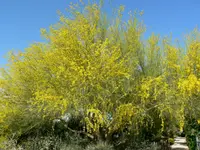
Blue paloverde (Parkinsonia florida) is a small desert tree known for its blue-green bark and airy canopy of tiny leaflets. It stays relatively open and light, casting filtered shade rather than deep darkness. In spring it produces many small yellow flowers along its branches, giving strong seasonal interest in dry landscapes.
This species is native to the Sonoran Desert of the southwestern United States and northern Mexico, where it has adapted to intense sun, heat, and drought. Because of this, it is generally easy to grow in arid and semi-arid climates, provided soil drains well and irrigation is not excessive. Understanding how to care for blue paloverde starts with respecting its desert origins and avoiding consistently wet conditions.

Care Difficulty
Easy Care

Light Preference
Full Sun

Water Requirements
Low Water

Temperature Preference
Warm Climate

Hardiness Zone
8–11

Soil Texture
Sandy, Loamy, Rocky

Soil pH
Neutral (7.0), Slightly alkaline (7.0–7.5)

Soil Drainage
Well-drained

Fertilization
Minimal (feed rarely)
Scan your plant to receive care tips personalized for your specific plant
Available on iOS and Android
This desert tree thrives in intense sun but can adapt to slightly softer light in very hot regions.
This drought-adapted tree prefers deep, infrequent watering rather than frequent light irrigation.
This species is adapted to hot, arid climates and handles a wide temperature range once established.
Humidity is not a significant factor for Parkinsonia florida, which is adapted to very dry desert air.
Parkinsonia florida needs lean, very well-drained, often sandy soil to prevent root rot.
This desert tree can be grown in containers only on a temporary or dwarfing basis, with careful attention to stability and drainage.
Parkinsonia florida is adapted to nutrient-poor desert soils and needs only light, occasional feeding in cultivation.
Pruning of Parkinsonia florida is mainly for structure, safety, and to maintain a balanced canopy.
Transplanting is more relevant than repotting for Parkinsonia florida, which is usually grown as a landscape tree.
Parkinsonia florida is most often propagated from seed, which suits its natural desert adaptation.
This desert tree is quite cold hardy in much of its range and usually needs minimal winter care once established.

Plant Health Check
Not sure what's wrong with your plant? Check your plant's health inside the app.
The blue-green bark of this desert tree contains abundant chlorophyll, allowing it to photosynthesize efficiently through stems and branches, especially during drought when many leaves are shed.
Parkinsonia florida is considered a relatively short-lived desert tree, often persisting for only a few decades in the wild compared with long-lived desert conifers or oaks, which influences how desert plant communities change over time.
This species is strongly associated with desert washes and ephemeral stream channels, where its deep roots and flexible stems help it survive periodic flash floods and shifting sediments in arid landscapes.

Parkinsonia florida is one of the dominant trees forming the classic Sonoran Desert palo verde–saguaro community, where its canopy helps create protected microhabitats that are essential for the establishment and survival of young Carnegiea gigantea (saguaro) cacti.
This species is semi-evergreen. It keeps green bark year-round for photosynthesis but may drop many or all leaves during drought or cold. Leaf loss is usually a normal water-conserving response rather than a health problem.
Keep your plants happy and healthy with plant identification, disease detection, and easy care guidance.