


Passiflora citrina Care

Passiflora citrina

About Passiflora citrina

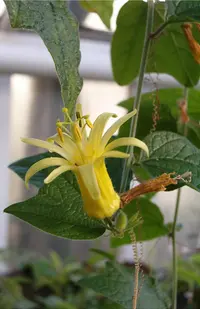
Passiflora citrina is a tropical, evergreen vine known for its bright yellow, star-like flowers and attractive, glossy green foliage. It belongs to the passionflower group but has a more compact, delicate look than many relatives.

This species is native to cloud forests of Central America, where it grows in cool, humid, and partially shaded habitats. In cultivation it tends to flower freely when given enough light and consistent moisture, but dislikes extreme heat or drought.

With support, it climbs readily and suits containers, hanging baskets, or small trellises in mild climates or protected spaces. Understanding how to care for Passiflora citrina mainly involves matching its need for bright, filtered light, airy soil, and even moisture without waterlogging.

Main Plant Requirements

Care Difficulty

Moderate Care

Light Preference

Partial Sun

Water Requirements

Regular Water

Temperature Preference

Tropical / Frost Sensitive

Hardiness Zone

10–11

Soil Texture

Sandy, Loamy, Organic-rich

Soil pH

Acidic (5.5–6.5), Slightly acidic (6.5–7.0)

Soil Drainage

Moist but well-drained

Fertilization

Moderate (every 2–4 weeks)

Get Personalized Care Plan

Scan your plant to receive care tips personalized for your specific plant

Available on iOS and Android

How to Care for the Passiflora citrina

This tropical climber needs bright, mostly indirect light for reliable flowering.

  • Provide 4–6 hours of morning sun with light afternoon shade; eastern or lightly filtered southern exposure suits Passiflora citrina in most climates.
  • Allow bright, dappled shade in hotter regions, since harsh afternoon sun can scorch leaves and fade flowers, especially in summer.
  • If vine growth becomes leggy or flowering declines, increase light exposure; in winter, avoid deep shade and prune nearby plants that block low-angle sun.

This vine prefers steadily moist but not saturated soil throughout the growing season.

  • Water when the top 3–5 cm of soil feels dry, soaking the root zone thoroughly, then let excess drain to avoid root rot.
  • Increase watering in warm, active growth periods when leaves feel slightly soft or start to curl, and reduce frequency in cooler months as growth slows.
  • Watch for yellowing, limp leaves as a sign of overwatering and for crisp, browning leaf edges or leaf drop as signs the plant stayed dry too long.

This species thrives in warm, frost-free conditions with only modest temperature swings.

  • Aim for 65–80°F (18–27°C) during active growth for best flowering and vine extension.
  • Protect the plant whenever temperatures approach 40°F (4°C); brief dips may be tolerated, but hard frost can kill stems to the ground or the whole plant.
  • In hot spells above 90°F (32°C), provide afternoon shade and consistent moisture to limit heat stress and leaf scorch, especially for young plants.

This species appreciates moderately humid air but adapts if basic moisture needs are met.

  • Aim for 50–60% humidity, especially in warm rooms or during active growth.
  • In very dry air, leaf edges may brown and buds may fail to open fully, indicating humidity stress.
  • Increase humidity with a nearby humidifier or grouped plants rather than misting, which offers only brief moisture.

Passiflora citrina prefers a light, free-draining mix that still retains some moisture and organic matter.

  • Use a loamy, organic-rich base such as all-purpose potting mix blended with 30–40% perlite or coarse bark for structure and aeration.
  • Ensure rapid drainage so water runs through within seconds; avoid compacted or clay-heavy soil that stays wet for many hours.
  • Aim for slightly acidic to neutral pH around 6.0–7.0, which supports nutrient uptake and root health.
  • Improve drainage and oxygen around roots by avoiding fine sand or heavy peat-only mixes that collapse and exclude air over time.

This vine is suitable for container growing when the pot supports its climbing and root needs.

  • Choose a deep, relatively wide pot that allows a substantial root mass to support heavy top growth without tipping.
  • Select a heavier material such as ceramic if the vine climbs a trellis, to improve stability in wind and when the plant is wet.
  • Position the container so excess water can run off freely after watering, avoiding saucers that hold standing water around the base.

Passiflora citrina responds well to moderate feeding during its active growing season.

  • Use a balanced liquid fertilizer (such as 10-10-10 or 20-20-20) diluted to 1/2 strength for container plants.
  • Apply every 2–3 weeks from spring through late summer when growth and flowering are strongest.
  • Incorporate a light layer of compost or a slow-release fertilizer pellet into the topsoil in spring.
  • Stop feeding or reduce to monthly at 1/4 strength in fall and winter when growth slows.

Passiflora citrina benefits from controlled pruning to manage vigor and encourage flowering wood.

  • Prune in late winter or very early spring before strong new growth begins.
  • Remove dead, damaged, or congested stems first, cutting back to healthy tissue with clean, sharp secateurs.
  • Shorten overly long vines to maintain size and improve light penetration, which supports better flowering.
  • Disinfect tools between plants and avoid cutting into very thick, older stems unless reshaping is essential.

Container-grown Passiflora citrina needs periodic repotting to support its fast root growth.

  • Check for roots circling the pot base, emerging from drainage holes, or reduced vigor as signs it needs a larger container.
  • Plan to repot every 1–2 years in early spring, just before vigorous new growth starts.
  • Move to a pot 2–5 cm wider, using a free-draining mix and keeping the root ball at the same depth.
  • Handle roots gently, water thoroughly after potting, and shade from strong sun for 3–5 days to limit transplant stress.

Passiflora citrina is commonly propagated from semi-ripe cuttings or seeds under warm, bright conditions.

  • Take 8–12 cm semi-ripe stem cuttings in late spring to summer, keeping 2–3 nodes per cutting.
  • Remove lower leaves, dip the cut base in rooting hormone, and insert into a moist, well-aerated medium like perlite and peat.
  • Maintain 70–80°F, high humidity, and bright, indirect light until roots form in several weeks.
  • Sow fresh seeds in spring in a warm propagator and keep evenly moist; germination may be slow and uneven.

Passiflora citrina is frost-sensitive and needs protection in regions with cold winters.

  • Keep temperatures above 45–50°F; in USDA zones colder than 10, grow in containers and overwinter indoors.
  • Before first frost, move pots to a bright, cool room or greenhouse and reduce watering so the soil stays just lightly moist.
  • Outdoors in mild climates, mulch the root zone with 5–8 cm of organic material to buffer temperature swings.

Care Tips

Provide climbing support

Install a sturdy trellis or mesh at planting time and gently tie new shoots with soft ties, guiding 1–3 main stems horizontally to encourage dense flowering along the framework.

Pinch to branch

Regularly pinch out the soft tips of overly long, green shoots during active growth to promote side-branching and more flower-producing wood rather than a few long vines.

Root zone mulching

Apply a 3–5 cm layer of fine bark or composted wood mulch around the root zone, keeping it 3–5 cm away from the stem, to buffer soil temperature and reduce moisture swings.

Prevent stem girdling

Check ties and wires every 1–2 months and loosen or replace them before they cut into thickening stems, which helps maintain uninterrupted sap flow and plant vigor when growing Passiflora citrina.

Routine pest scouting

Inspect leaf undersides and soft shoot tips weekly for aphids, spider mites, and whiteflies, and if found, wash them off with a firm water spray before populations build up enough to stunt flowering.

Common Pests and Diseases

Passionflower mite

This pest is a tiny eriophyid mite that distorts young leaves, stunts shoots, and can reduce flowering. Symptoms include curled, hardened foliage and slow, weakened growth on new vines.

Solution

Prune and discard the most distorted shoot tips, then spray all foliage with a fine horticultural oil or sulfur-based miticide, repeating every 7–10 days until new growth appears normal. Improve air movement, avoid overhead watering, and isolate affected plants to limit spread when growing Passiflora citrina indoors or in greenhouses.

Heliconius caterpillars

These insects are butterfly larvae that feed selectively on passionflower foliage, often skeletonizing leaves and chewing soft shoot tips. Damage is usually most severe on young, tender growth during warm months.

Solution

Handpick caterpillars and egg clusters from leaves and stems and dispose of them away from the plant. If defoliation is heavy, use a targeted biological control such as Bacillus thuringiensis (Bt) on the foliage, and encourage natural predators by avoiding broad-spectrum insecticides in the garden around Passiflora citrina.

Scale insects

This pest forms small, rounded or oval bumps on stems and leaf veins and excretes sticky honeydew. Symptoms include sticky leaves, sooty mold growth on the honeydew, and gradual decline in vigor.

Solution

Wipe or gently scrape off visible scales with a cotton pad dipped in alcohol, then follow with an application of insecticidal soap or horticultural oil, making sure to coat stems and leaf undersides. Repeat treatments every 7–14 days, improve light and airflow, and quarantine heavily infested plants to prevent spread to other passionflowers.

Passionflower leaf spot

This disease is usually fungal and causes small tan, brown, or purple-edged spots that may merge into larger dead patches on leaves. Symptoms include premature yellowing and drop of older foliage, especially in warm, humid, poorly ventilated conditions.

Solution

Remove and discard spotted or fallen leaves and avoid overhead watering to keep foliage dry. Improve spacing and airflow, water at the base in the morning, and if spotting continues, apply a copper or chlorothalonil fungicide labeled for ornamental vines, treating both upper and lower leaf surfaces.

Cucumber mosaic virus

This disease causes mottled, mosaic-patterned leaves, distorted growth, and reduced flowering, and can spread between passionflowers and other hosts via aphids. Symptoms include light and dark green patches on leaves, stunted shoots, and general loss of vigor.

Solution

Promptly remove and destroy infected plants, since viral infections cannot be cured. Control aphids with insecticidal soap or horticultural oil, keep tools clean, and avoid propagating from any plant that shows mosaic or distortion, as this is essential for careful Passiflora citrina plant care.

Interesting Facts

Naturally compact climber

This species is a relatively small, fine-stemmed vine compared with many other passionflowers, typically forming a dense, manageable climber rather than long, rampant shoots, which makes it suitable for smaller trellises and pots.

Distinctive yellow corona

Its flowers have a bright yellow corolla and a contrasting darker yellow corona (the filamentous ring inside the petals), creating a two-tone effect that is unusual among commonly grown passionflowers, which are often purple, blue, or white.

Limited natural range

P. citrina is native to cloud forests of Central America, especially in Guatemala and nearby regions, where it grows in cool, humid mountain habitats rather than hot lowland tropics.

Botan icon

Did you know?

This species was only formally described in the late 20th century, and its striking yellow flowers quickly led to its adoption by collectors, so most plants in cultivation today descend from relatively few original wild-collected individuals.

FAQs about Passiflora citrina

This species is a twining climber that uses tendrils to attach to nearby structures. It does not run along the ground. Provide a trellis, wires, or another support so stems can secure themselves and grow upward.

Grow Healthy Plants with Botan Care

Keep your plants happy and healthy with plant identification, disease detection, and easy care guidance.

Botan plant care app — identify plants on mobile









