Staggered Age Planting
Plant a mix of 1st- and 2nd-year plants in the same bed so flowering and visual coverage remain consistent as older plants decline after 3–4 years.

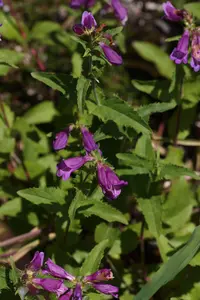
Serrulate penstemon (Penstemon serrulatus) is a perennial flowering plant native to moist lowlands, stream edges, and open woods of the Pacific Northwest. It forms upright clumps with square stems, narrow serrated leaves, and showy tubular flowers in shades of blue to purple.
Plants usually bloom in late spring to early summer and attract many pollinators, especially bees and hummingbirds. Once established, it is moderately easy to maintain, provided the soil does not dry out completely.
It prefers cool to mild climates, regular moisture, and well-drained, humus-rich soil, which helps guide how to care for serrulate penstemon in garden settings.

Care Difficulty
Moderate Care

Light Preference
Full Sun

Water Requirements
Moderate Water

Temperature Preference
Cold Hardy

Hardiness Zone
5–9

Soil Texture
Sandy, Loamy, Rocky

Soil pH
Acidic (5.5–6.5), Slightly acidic (6.5–7.0)

Soil Drainage
Well-drained

Fertilization
Minimal (feed rarely)
Scan your plant to receive care tips personalized for your specific plant
Available on iOS and Android
This species prefers bright, open conditions similar to its native Pacific Northwest riverbanks and meadows.
This plant prefers evenly moist but fast-draining soil, especially in its first growing seasons.
This perennial is adapted to cool, maritime climates but handles a broad outdoor temperature range when established.
This species tolerates typical outdoor humidity and rarely needs special humidity management.
This perennial prefers loose, well-aerated, fast-draining soil to prevent root and crown rot.
This species can be grown in containers if the pot is set up to drain quickly and stay aerated.
This native perennial needs modest feeding, especially in poor soils, to support steady growth and flowering in serrulate penstemon.
Thoughtful pruning of Penstemon serrulatus maintains a compact habit and encourages extended blooming.
This species is usually grown in the ground, so focus on careful transplanting rather than frequent repotting.
Penstemon serrulatus is commonly propagated by seeds, softwood cuttings, or careful division of established clumps.
This penstemon is generally cold hardy in much of its native and cultivated range and needs only modest winter care.

Plant Health Check
Not sure what's wrong with your plant? Check your plant's health inside the app.
This species is native to the moist lowlands and river valleys of the Pacific Northwest, where it often forms colonies along streambanks, wet meadows, and coastal thickets from sea level up to low montane zones.
The species name serrulatus refers to the finely toothed margins of its leaves, which are noticeably more serrated than those of many related penstemons and help distinguish it in the field.
Its tubular, bluish-purple flowers are sized and shaped to fit bumblebees and other large native bees, which push into the corolla to reach nectar and, in doing so, transfer pollen efficiently between plants.

In coastal parts of its range, this species can tolerate periodic flooding and winter storm exposure, yet still persist for many years in the same clumps, making it a stable component of long-lived riparian and coastal plant communities.
Lack of flowers usually comes from too much shade, rich or heavily fertilized soil, or overcrowding. Cold damage to buds and very dry soil in late spring also reduce flowering. Light pruning after bloom encourages better performance next year.
Keep your plants happy and healthy with plant identification, disease detection, and easy care guidance.