Giant butterbur Care (Petasites japonicus)

Also known as: Japanese sweet coltsfoot, Bog rhubarb, Fuki, Japanese Butterbur
Giant butterbur

About Giant butterbur

Giant butterbur, Petasites japonicus, is a vigorous, cold-hardy perennial grown mainly for its huge, umbrella-like leaves and bold, architectural look. It forms dense colonies from creeping rhizomes, quickly covering moist ground and creating a dramatic foliage canopy in summer. Native to stream banks and damp woodland edges in East Asia, it prefers cool, consistently moist soil and protection from strong, direct sun. The plant is best suited to larger gardens or contained spaces, as its spreading habit can become invasive in ideal conditions. Understanding how to care for Giant butterbur starts with giving it enough moisture and room to spread while managing its growth boundaries.

Main Plant Requirements

Care Difficulty

Moderate Care

Light Preference

Partial Shade

Water Requirements

Keep Soil Moist

Temperature Preference

Cold Hardy

Hardiness Zone

5–8

Soil Texture

Loamy, Silty, Organic-rich

Soil pH

Acidic (5.5–6.5), Slightly acidic (6.5–7.0)

Soil Drainage

Waterlogged tolerant

Fertilization

Minimal (feed rarely)

Get Personalized Care Plan

Scan your plant to receive care tips personalized for your specific plant

Available on iOS and Android

How to Care for the Giant butterbur

This moisture-loving perennial prefers cool, bright shade rather than strong direct sun.

  • Provide dappled or filtered light under trees or beside buildings, with at most 2–3 hours of gentle morning sun per day.
  • Avoid strong midday or afternoon sun, which can scorch the large leaves of Giant butterbur, causing bleaching and crispy edges.
  • In hotter summers, increase shade using taller plants or shade cloth; in cooler climates, slightly more morning sun can improve vigor without stressing foliage.

This plant is adapted to stream banks and marshy spots, so it thrives in consistently moist soil.

  • Maintain soil that is evenly moist to slightly wet, allowing only the top 1–2 cm to dry lightly between waterings in drier sites.
  • Use deep watering so moisture penetrates 15–20 cm, and ensure soil is rich and not compacted, to reduce waterlogging around the rhizomes.
  • In hot, dry spells, increase frequency if leaves droop or edges crisp; reduce watering slightly in cool, rainy seasons to prevent sour, foul-smelling soil.

This hardy perennial tolerates cold winters but grows best in cool to mild conditions.

  • Optimal growth occurs around 55–75°F (13–24°C), with rapid leaf expansion in cool, moist spring weather.
  • Dormant rhizomes usually survive down to about -20°F (-29°C) under mulch or snow, though new shoots can be damaged by late hard frosts.
  • In hot climates above 85°F (29°C), growth may slow and leaves may wilt; provide extra shade and moisture to prevent heat stress and leaf scorch.

This species prefers consistently moist air but usually adapts to typical outdoor humidity in temperate climates.

  • Aim for 50–80% humidity, which often occurs naturally near ponds, streams, or other damp areas.
  • Dry, hot winds can crisp leaf edges and cause wilting, signaling humidity and moisture stress.
  • Increase local humidity by mulching heavily, grouping plants near water features, or using windbreaks around Giant butterbur stands.

Petasites japonicus thrives in deep, moist, humus-rich soils that stay damp but not stagnant.

  • Use a loamy mix with high organic matter, such as 50–70% composted leaf mold or garden compost blended with native soil.
  • Ensure slow but steady drainage; soil should feel spongy and moist yet not squelching or foul-smelling after watering or rain.
  • Target a slightly acidic to neutral pH of about 6.0–7.0, amending very alkaline soil with organic material over time.
  • Avoid compacted clay, thin sandy ground, or spots that dry out quickly; add coarse sand or fine bark to improve aeration where needed.

This vigorous, spreading perennial is generally unsuitable for long-term container growing but can be contained short term with careful management.

  • Choose a very large, wide, and heavy container to counter spreading rhizomes and prevent the pot from tipping under tall foliage.
  • Line the interior sides with a tough root barrier fabric to slow rhizome escape and reduce risk of cracking the container.
  • Use a moisture-retentive yet draining mix and raise the pot on feet so heavy watering does not trap water under the base.

Petasites japonicus benefits from modest feeding in rich, moist soil but does not need heavy fertilization.

  • Use a balanced, slow-release fertilizer (for example 10-10-10) or a thin layer of garden compost in early spring as shoots emerge.
  • Feed established clumps 1–2 times during the growing season, focusing on spring and early summer for leaf development.
  • Dilute liquid fertilizer to half strength if used, applying only to moist soil to avoid root burn.
  • Stop feeding Giant butterbur in late summer and avoid fertilizing during winter dormancy.

Pruning Petasites japonicus is mainly about tidiness and controlling spread rather than shaping a woody structure.

  • Cut back dead or damaged leaves at ground level in late fall or very early spring using clean, sharp shears.
  • Remove crowded or overlapping leaves during the season to improve air flow and reduce fungal issues in dense clumps.
  • Trim back unwanted runners or peripheral shoots to limit spreading and keep the patch within its allotted area.
  • Collect and dispose of diseased foliage rather than composting to reduce reinfection in damp sites.

This species is usually grown in the ground; transplanting mature clumps is more common than repotting container plants.

  • Plan to lift and divide crowded clumps every 3–5 years, or when growth slows and leaves emerge smaller than usual.
  • Transplant in early spring or early fall, when temperatures are mild and soil is consistently moist but not waterlogged.
  • Dig a wide root ball, keeping rhizomes as intact as possible, and replant at the same depth in enriched, damp soil.
  • Water thoroughly after transplanting, shade temporarily if exposed, and keep soil evenly moist for several weeks to limit root stress.

Petasites japonicus is most often propagated by division of its rhizomes rather than from seed.

  • Divide established clumps in early spring just as new buds appear, or in early fall while soil is still warm.
  • Lift a section of the rhizome, ensuring each piece has several buds and healthy roots attached.
  • Replant divisions at the same depth in consistently moist, organic-rich soil, spacing widely due to future spread.
  • Water divisions well, maintain even moisture, and provide partial shade to encourage quick establishment.

This plant is generally cold hardy in temperate climates and needs only modest winter care.

  • Tolerates frost once established, with foliage naturally dying back to ground level in late fall.
  • Apply a 5–8 cm layer of organic mulch over the root zone in cold regions to buffer freeze–thaw cycles.
  • For container plants, move pots into a sheltered, unheated area to prevent roots from freezing solid in prolonged cold.

Care Tips

Rhizome Containment

Install a buried root barrier 30–40 cm deep around planting areas to keep spreading rhizomes confined and make future clump division easier.

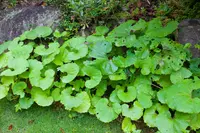
Managed Groundcover

Use the plant as a living mulch under trees but thin out outer shoots annually so it does not overwhelm neighboring shade perennials or encroach on paths.

Early Spring Grooming

Remove last year’s tattered leaves and any winter-damaged stalks before new shoots elongate, which improves air movement and reduces habitat for slugs and fungal spores.

Slug And Snail Control

Place slug traps and rough copper or gravel bands at the edges of the colony in early spring when new leaves emerge, since young foliage is especially vulnerable to chewing damage.

Controlled Division Timing

Divide and replant rhizomes just as new buds swell in early spring, keeping each piece with at least 1–2 healthy buds, to rejuvenate overgrown clumps and maintain manageable patches when growing Giant butterbur.

Common Pests and Diseases

Slugs and snails

This pest is strongly attracted to the large, tender leaves and can rapidly shred foliage, especially in damp, shaded sites where the plant is usually grown.

Solution

Hand-pick at dusk or after rain, use iron phosphate slug pellets around but not touching the crowns, and place beer traps or copper barriers along bed edges. Reduce hiding spots by clearing debris, and avoid overhead watering late in the day to keep the soil surface slightly drier at night.

Leaf spot

This disease causes tan to brown spotting on leaves that may merge into larger blotches, often appearing in humid, crowded plantings.

Solution

Remove and dispose of affected leaves to reduce fungal spores, and avoid wetting foliage by watering at soil level. Improve airflow by thinning dense clumps, and if the problem persists in the same location each year, rotate to a less humid site or use a labeled copper-based fungicide during extended wet periods as part of broader Petasites japonicus care.

Powdery mildew

This disease produces a white to gray powdery coating on the upper leaf surface, which can lead to yellowing and reduced vigor in late summer.

Solution

Improve air circulation by dividing and spacing clumps, and water at the base rather than overhead to keep leaves dry. Remove the worst-affected leaves and dispose of them, and in persistent cases apply a sulfur or potassium bicarbonate product labeled for ornamental plants at the first sign of infection.

Aphids

These insects cluster on young shoots and leaf undersides, sucking sap and causing curled, distorted growth and sticky honeydew on the foliage.

Solution

Spray colonies off with a strong stream of water, then follow with insecticidal soap or horticultural oil, coating leaf undersides thoroughly. Encourage natural predators such as lady beetles by avoiding broad-spectrum insecticides, and cut back heavily infested shoots if populations stay high.

Leaf miners

This pest creates pale, winding tunnels inside the large leaves, which can reduce the ornamental quality but rarely kill the plant.

Solution

Remove and destroy leaves showing extensive fresh mines to break the life cycle, and avoid composting them in open piles. For recurring problems, use floating row covers over emerging spring foliage in areas with known infestations, or apply a systemic insecticide labeled for ornamental leaf miners according to local regulations if damage is severe.

Interesting Facts

Edible spring shoots

The young flower buds and leaf stalks, known as fuki in Japan, are traditionally eaten as a seasonal vegetable after careful preparation to reduce bitterness and remove natural pyrrolizidine alkaloids, which are toxic compounds.

Massive leaf canopies

Mature plants can develop leaves 60–100 cm across on thick petioles, forming dense canopies that quickly shade out smaller plants along streams and damp ground.

Natural streambank colonizer

This species spreads aggressively by long, creeping rhizomes, allowing it to stabilize moist riverbanks and ditches but also making it potentially invasive in temperate gardens outside its native East Asian range.

Botan icon

Did you know?

In traditional Japanese village landscapes, fuki patches were often deliberately maintained near houses and irrigation channels as a long-lived perennial vegetable, and some documented clonal stands have been harvested from the same site for many decades.

FAQs about Giant butterbur

This rhizomatous species spreads vigorously through underground stems and can quickly form large colonies. Use root barriers or large, contained beds, and remove unwanted shoots regularly to prevent it from overtaking smaller or slower-growing plants.

Grow Healthy Plants with Botan Care

Keep your plants happy and healthy with plant identification, disease detection, and easy care guidance.

Botan plant care app — identify plants on mobile

Explore More Plants