Encourage Compact Mats
Pinch or lightly shear back lanky stems in early summer to promote dense, low growth and prevent the plant from opening in the center as it matures.

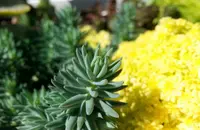
Jenny's stonecrop, Petrosedum rupestre subsp. rupestre 'Blue Spruce', is a low-growing succulent perennial often used as a groundcover or in rock gardens. It forms dense, spreading mats of blue-green, needle-like leaves that resemble a miniature conifer.
This species is native to rocky, sunny sites in parts of Europe, so it naturally tolerates poor, shallow soils and periods of drought. Its resilience, fast growth, and low nutrient needs make it suitable for beginners who want to care for Jenny's Stonecrop with minimal effort.
It generally prefers bright light, sharp drainage, and infrequent watering, and it adapts well to containers, troughs, and green roofs.

Care Difficulty
Easy Care

Light Preference
Full Sun

Water Requirements
Low Water

Temperature Preference
Cold Hardy

Hardiness Zone
3–9

Soil Texture
Sandy, Loamy, Rocky

Soil pH
Slightly acidic (6.5–7.0), Neutral (7.0)

Soil Drainage
Well-drained

Fertilization
Minimal (feed rarely)
Scan your plant to receive care tips personalized for your specific plant
Available on iOS and Android
This sun-loving succulent thrives in bright outdoor conditions with several hours of direct light daily.
This drought-tolerant succulent prefers infrequent, thorough watering and fast-drying soil.
This hardy stonecrop tolerates a wide temperature range but grows best in mild, temperate conditions.
This succulent tolerates a wide humidity range and rarely needs special adjustment in homes.
This plant prefers very fast-draining, mineral-rich soil that dries quickly between waterings.
This species is very suitable for container growing outdoors on balconies, patios, or rock-style planters.
This drought-tolerant succulent needs only light feeding to maintain compact, healthy growth when grown in containers.
Pruning is mainly used to keep Petrosedum rupestre subsp. rupestre 'Blue Spruce' dense and tidy.
This succulent is often grown in rock gardens or shallow containers and dislikes frequent disturbance.
Petrosedum rupestre subsp. rupestre 'Blue Spruce' is commonly increased by short stem cuttings and division.
This species is generally cold hardy in much of the US and needs only modest winter attention in the ground.

Plant Health Check
Not sure what's wrong with your plant? Check your plant's health inside the app.
This stonecrop forms dense, needle-like leaves that closely mimic conifer foliage, an adaptation that reduces water loss and helps the plant tolerate full sun and windy sites better than many other small sedums.
In its native European range, it often grows in thin soils on rocky slopes, walls, and crevices, anchoring into tiny fissures where many other species cannot survive, which explains its strong performance in rock gardens and dry stone walls.
Stems root readily wherever they touch suitable substrate, allowing the plant to spread clonally into low, mat-forming colonies that can stabilize shallow, gritty soils and small embankments.

This subspecies has been widely adopted in some European and North American green roof systems because its shallow roots, high drought tolerance, and low biomass production reduce roof load while maintaining living cover under highly exposed, low-water conditions.
This species spreads by low, trailing stems and can form a dense mat over time, but it is usually not considered aggressive. It is easy to control by lifting or trimming unwanted sections along bed edges.
Keep your plants happy and healthy with plant identification, disease detection, and easy care guidance.