Spore management
If fruiting bodies appear in unwanted areas, cover them with a breathable bag before removal to trap spores and reduce future random colonies nearby.

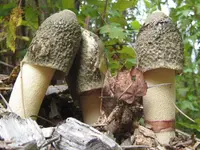
Ravenel's stinkhorn, Phallus ravenelii, is a fungi species rather than a traditional leafy plant. It is known for its slender, often white to pinkish stalk and a slimy, foul-smelling cap that attracts flies. The fruiting body appears quickly from an underground egg-like structure, then collapses within a short time.
This species is native to North America and commonly appears in wood chips, mulch, rich soil, and decaying organic matter in gardens and lawns. It can be easy to care for Ravenel's stinkhorn outdoors where there is consistent moisture, organic debris, and partial shade, but it is not typically grown as a deliberate ornamental organism.

Care Difficulty
Moderate Care

Light Preference
Partial Shade

Water Requirements
Keep Soil Moist

Temperature Preference
Warm Climate

Hardiness Zone
Unknown

Soil Texture
Loamy, Organic-rich

Soil pH
Acidic (5.5–6.5)

Soil Drainage
Moist but well-drained

Fertilization
Minimal (feed rarely)
Scan your plant to receive care tips personalized for your specific plant
Available on iOS and Android
This ground-dwelling fungus prefers sheltered, moderately bright woodland light rather than full, open sun.
Moist, airy soil is essential for reliable fruiting of this stinkhorn fungus.
This species fruits best in warm, humid conditions typical of late spring to early fall.
Humidity plays little role in the development of Phallus ravenelii, which relies more on substrate moisture than air moisture.
Phallus ravenelii develops best in consistently moist, loose, organic-rich substrates that allow air to reach the mycelium.
This species is not well suited to ornamental container growing and is usually managed where it appears in outdoor beds or mulch.
This saprophytic fungus feeds on decaying organic matter and usually needs no additional fertilizer in garden or woodland settings, even when caring for Ravenel's stinkhorn.
Phallus ravenelii does not require true pruning, but spent fruiting bodies can be removed for hygiene and appearance.
This stinkhorn is rarely kept in containers, so management focuses on transplanting or relocating colonized substrate rather than classic repotting.
Phallus ravenelii is usually left to spread naturally, since its spores disperse readily and deliberate propagation can be hard to control.
This species forms resilient underground structures and is generally cold hardy in its suitable climate, so it needs no special winter care outdoors.

Plant Health Check
Not sure what's wrong with your plant? Check your plant's health inside the app.
The olive-brown slime on the cap (gleba) chemically mimics the odor profile of decaying organic matter, which strongly attracts flies that then pick up and transport its spores on their bodies and in their gut.
The fruiting body emerges from a white, rubbery “egg” and can expand rapidly to full height within a few hours, driven mainly by water uptake into pre-formed tissues rather than by new cell division.
This species is especially common in urban and suburban landscapes where wood chips and mulch provide an ideal substrate, so it often appears suddenly in newly mulched beds, lawns, and garden borders.

Ravenel's stinkhorn is named after the 19th-century American botanist Henry William Ravenel, who made major contributions to the study of North American fungi and first documented this distinctive species in the southeastern United States.
This fungus spreads efficiently by spores carried on insects attracted to its odor. In garden beds with rich organic matter, it can appear in clusters and recur annually, but it does not damage surrounding plants or roots.
Keep your plants happy and healthy with plant identification, disease detection, and easy care guidance.