Encourage Upright Growth
Install a moss pole or textured stake close to the main stem early on, then gently tie new petioles with soft garden tape so aerial roots can grip and the plant develops thicker, more stable stems.

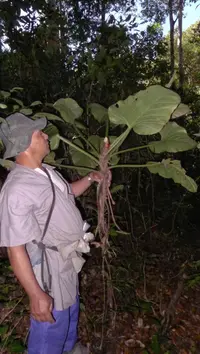
Shortstem philodendron, Philodendron fragrantissimum, is a tropical aroid grown mainly for its bold, glossy foliage and compact climbing habit. It typically produces thick, short internodes and medium to large leaves that give the plant a dense, structural look indoors.
In nature it occurs in humid tropical forests of Central and South America, where it grows as an understory climber on trees. Its preference for stable warmth, moderate humidity, and airy, rich substrate makes it manageable for indoor growers who can provide consistent conditions.
Understanding how to care for shortstem philodendron starts with providing bright, filtered light, evenly moist but not soggy soil, and good support for its climbing growth.

Care Difficulty
Moderate Care

Light Preference
Bright Indirect Light

Water Requirements
Moderate Water

Temperature Preference
Tropical / Frost Sensitive

Hardiness Zone
10–11

Soil Texture
Loamy, Peaty, Organic-rich

Soil pH
Acidic (5.5–6.5), Slightly acidic (6.5–7.0)

Soil Drainage
Moist but well-drained

Fertilization
Light (every 4–6 weeks)
Scan your plant to receive care tips personalized for your specific plant
Available on iOS and Android
Philodendron fragrantissimum prefers bright, indirect light that mimics a forest understory.
Philodendron fragrantissimum prefers evenly moist but not waterlogged soil.
This species prefers warm, stable conditions with no exposure to frost.
This aroid prefers moderately humid air but usually adapts to typical household levels.
This species grows best in a loose, airy mix that balances moisture retention with rapid drainage.
This climbing species is very suitable for container growing.
Philodendron fragrantissimum responds well to modest, consistent feeding in active growth.
Pruning Philodendron fragrantissimum is mainly done to manage size and remove unhealthy growth.
This species appreciates occasional repotting to refresh soil and give roots room to expand.
Philodendron fragrantissimum is commonly propagated from stem cuttings taken during active growth.
This tropical philodendron is frost-sensitive and needs indoor or warm-sheltered conditions in winter.

Plant Health Check
Not sure what's wrong with your plant? Check your plant's health inside the app.
When the leaves are gently rubbed or bruised, this species releases a subtle spicy, anise-like scent, which is unusual among philodendrons and inspired its name fragrantissimum, meaning very fragrant.
In its native Central and South American habitats, this plant starts life on the forest floor and later climbs trees as a hemiepiphyte, anchoring with aerial roots that help it reach brighter canopy light.
The plant develops notably thick, sometimes slightly flattened petioles that store water and support its heavy, elongated leaves, an adaptation that helps it tolerate short dry spells in tropical forests.

Mature plants in the wild can develop impressive inflorescences typical of the Araceae family, with a central spadix partly enclosed by a pale spathe, which attract specific beetle pollinators through heat production in a process known as thermogenesis.
Leaf curling usually comes from moisture stress, excess fertilizer, or low humidity. Check the root ball for dryness or sogginess, flush built-up salts from the pot, and increase ambient humidity while keeping temperatures stable and drafts minimal.
Keep your plants happy and healthy with plant identification, disease detection, and easy care guidance.