Silver Sword Care (Philodendron hastatum)

Silver Sword

About Silver Sword

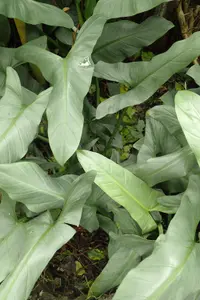
Philodendron hastatum, commonly called silver sword, is a tropical climbing aroid grown mainly for its striking metallic blue-gray foliage. Its long, narrow, arrow-shaped leaves develop a stronger silvery sheen as the plant matures and starts to vine. In nature it occurs in tropical forests of Brazil, where it climbs trees and receives bright, filtered light with high humidity. As a houseplant it is generally considered moderate in difficulty, mainly because it prefers stable warmth, consistent moisture, and support to climb. Owners who learn how to care for Silver Sword usually find it a reliable, long-lived foliage plant for bright indoor spaces.

Main Plant Requirements

Care Difficulty

Easy Care

Light Preference

Bright Indirect Light

Water Requirements

Moderate Water

Temperature Preference

Tropical / Frost Sensitive

Hardiness Zone

10–12

Soil Texture

Loamy, Peaty, Organic-rich

Soil pH

Acidic (5.5–6.5), Slightly acidic (6.5–7.0)

Soil Drainage

Moist but well-drained

Fertilization

Light (every 4–6 weeks)

Get Personalized Care Plan

Scan your plant to receive care tips personalized for your specific plant

Available on iOS and Android

How to Care for the Silver Sword

Philodendron hastatum needs bright, indirect light to keep its foliage firm and evenly colored.

  • Provide 6–8 hours of bright, filtered light each day, such as near an east- or north-facing window or under light tree shade outdoors.
  • Tolerates partial shade, but if stems stretch, leaves shrink, or the Silver Sword color dulls, move it slightly closer to the light source.
  • Avoid harsh midday or afternoon sun; direct sun through glass or outdoors between 11 a.m.–3 p.m. can scorch leaves, especially in summer.

Philodendron hastatum prefers evenly moist, well-drained soil rather than constant wetness.

  • Water when the top 2–4 cm of soil feels dry; frequency may range from every 5–10 days in warm seasons to every 10–20 days in cooler months.
  • Use a free-draining mix and a pot or site where excess water can escape, reducing the risk of root rot and sour, anaerobic soil.
  • Watch the plant: yellowing, mushy stems and a sour smell suggest overwatering, while drooping, thin leaves and dry, pulling soil indicate underwatering.

This species grows best in stable, warm conditions without sudden temperature swings.

  • Aim for 65–80°F (18–27°C) for steady growth; short periods up to 85°F (29°C) are usually tolerated if humidity and watering are appropriate.
  • Protect from cold: growth slows below about 60°F (16°C), and damage can occur near 50°F (10°C) or lower, especially with wind or damp soil.
  • Never expose Philodendron hastatum to frost; move plants away from drafty doors, uninsulated windows, or outdoor spots that drop rapidly at night in fall and early spring.

This philodendron prefers moderate to high humidity for best foliage health.

  • Aim for 50–70% humidity; below 40% the plant may develop dry, brown leaf edges.
  • Silver Sword tolerates short dry-air periods but benefits from a pebble tray or humidifier near heating vents.
  • Watch for curling leaves, crispy tips, and stalled growth as signs of humidity stress.
  • Increase local humidity by grouping plants, using a room humidifier, or placing the pot on a water-filled pebble tray without submerging the base.

Use a loose, airy, organic-rich substrate that drains quickly yet holds some moisture.

  • Choose a mix built around peat or coco coir with added chunky material so roots receive both moisture and air.
  • Combine roughly 40% peat or coco, 30% fine bark, 20% perlite, and 10% compost to create a stable, nutrient-holding structure.
  • Keep pH slightly acidic to neutral, around 6.0–7.0, which supports nutrient uptake for Philodendron hastatum.
  • Avoid dense garden soil, heavy clay, or mixes that stay wet for more than 2–3 days, which encourage root rot and poor aeration.

This species adapts very well to container growing.

  • Select a pot wide and heavy enough to counterbalance the climbing vines so it does not tip when the plant gains height.
  • Use a container material that matches your watering style, such as terracotta to release moisture faster in humid homes.
  • Provide a sturdy support like a moss pole anchored deep in the pot so the roots and container share the structural load.

Philodendron hastatum benefits from moderate, consistent feeding during active growth for steady foliage production.

  • Use a balanced liquid fertilizer (e.g., 10-10-10 or 20-20-20) at 1/4–1/2 strength for caring for Silver Sword indoors.
  • Feed every 4–6 weeks in spring and summer, applying to moist soil to reduce root burn risk.
  • Skip compost-heavy mixes in small pots; instead, use a well-draining potting mix and light, water-soluble feeding.
  • Reduce feeding to 1 light application in fall and stop during winter when growth slows.

Philodendron hastatum responds well to controlled pruning that manages size and encourages bushier growth.

  • Best time is late winter to early spring, just before new growth begins.
  • Remove yellowing, dead, or damaged leaves and any thin, weak stems to maintain plant health.
  • Shorten overly long vines above a node to encourage branching and a fuller shape.
  • Use clean, sharp scissors or pruners; disinfect blades before and after to limit disease spread.

This species prefers slightly snug pots but benefits from periodic repotting to refresh soil and support healthy roots.

  • Check for roots circling the pot, emerging from drainage holes, or slowed growth as signs it needs a larger container.
  • Repot every 2–3 years in spring, moving to a pot 2–5 cm wider with fresh, airy aroid or peat-free mix.
  • Water lightly 1–2 days before repotting, then gently loosen the root ball and trim dead or mushy roots only.
  • After repotting, water thoroughly once, keep in bright indirect light, and avoid fertilizing for 3–4 weeks to reduce stress.

Philodendron hastatum is commonly propagated from stem cuttings taken from healthy, actively growing vines.

  • Take 1–2 node tip or mid-stem cuttings in late spring or summer, each with at least one leaf and visible node.
  • Root cuttings in water or moist, well-drained mix at 70–80°F with bright, indirect light and high humidity (50–70%).
  • Ensure the node is submerged in water or buried in the medium while leaves stay above the surface.
  • Transplant to soil once roots reach 3–5 cm, then keep evenly moist but not waterlogged for the first few weeks.

This tropical climber is not frost tolerant and needs warm, stable indoor conditions in winter.

  • Move outdoor containers indoors before temperatures drop below 55°F, choosing a bright, draft-free spot.
  • Avoid temperatures below 50°F, which can cause leaf damage and root stress.
  • Water less often, allowing the top 2–3 cm of soil to dry, since growth is slower in low light.
  • Keep foliage away from cold window glass and heating vents; maintain 40–60% humidity if possible.

Care Tips

Provide climbing support

Install a sturdy moss pole or coco pole early and gently tie stems with soft ties so the plant can climb, which encourages larger, thicker leaves and a more stable structure over time.

Rotate for even growth

Turn the pot 90° every 2–3 weeks so all sides receive similar light, which helps prevent lopsided vines and keeps internodes (spaces between leaves) shorter and more compact.

Clean foliage regularly

Wipe leaves every 3–4 weeks with a barely damp, soft cloth to remove dust, which improves light absorption and makes it easier to spot early signs of pests when caring for Silver Sword.

Airflow for pest control

Position the plant where there is gentle, consistent air movement and avoid crowding it among many other plants, which reduces the likelihood of spider mites and fungal issues on the foliage.

Planned repot timing

Schedule repotting in late spring, moving only 1 pot size up and handling roots carefully, to reduce transplant shock and support steady growth during the active season.

Common Pests and Diseases

Spider mites

This pest causes fine stippling on leaves, dull or dusty-looking foliage, and fine webbing on undersides, especially in warm, dry indoor air. Symptoms include slow decline and premature leaf drop if populations build up.

Solution

Rinse both sides of the leaves thoroughly with lukewarm water, repeating every few days, and increase humidity to 50–60%. For persistent infestations, apply insecticidal soap or a neem oil spray to all leaf surfaces and stems, keeping the plant isolated until no new damage appears.

Mealybugs

These insects appear as white, cottony clusters in leaf axils, along petioles, and on aerial roots, often causing sticky honeydew and distorted new growth. Symptoms include gradual yellowing and reduced vigor as they feed on plant sap.

Solution

Remove visible mealybugs with a cotton swab dipped in isopropyl alcohol and wipe down affected areas. Follow up with 2–3 treatments of insecticidal soap or neem oil at 7–10 day intervals, and inspect new leaves and nodes regularly as part of Philodendron hastatum care.

Bacterial leaf spot

This disease causes water-soaked, translucent or dark, irregular spots on leaves that may enlarge and turn tan or brown with yellow halos. Symptoms include rapid spread in warm, humid, poorly ventilated conditions.

Solution

Remove and discard all affected leaves and avoid wetting the foliage, especially at night. Improve air circulation, reduce crowding with other plants, and water at the soil level; in severe cases, discard heavily affected plants to protect nearby philodendrons.

Erwinia stem rot

This disease leads to soft, mushy, foul-smelling stems at nodes and the base of cuttings, often starting after mechanical injury or excessive moisture. Symptoms include sudden collapse of affected stems and rapid spread through connected tissue.

Solution

Immediately cut out and discard all soft, rotting sections using sterilized tools, and do not compost infected material. Allow remaining healthy tissue and potting mix to dry slightly, improve drainage and airflow, and avoid overhead watering or wounding stems; severely affected plants are best discarded.

Thrips

These insects scrape leaf surfaces, causing silvery or bronze streaks, speckling, and deformed new leaves, which are especially noticeable on the smooth, metallic foliage of Silver Sword. Symptoms include dark, rice-shaped specks of frass and highly damaged young growth at the vine tips.

Solution

Shower the plant to dislodge adults and larvae, then use sticky traps near the foliage to monitor and reduce flying adults. Treat new growth and leaf undersides with repeated applications of insecticidal soap or a horticultural oil, and consider isolating the plant and pruning heavily damaged leaves to break the life cycle.

Interesting Facts

Natural Brazilian climber

This species is native to the Atlantic Forest region of Brazil, where it grows as a climbing hemiepiphyte, starting life on the ground and then attaching to tree trunks as it matures.

Silvery leaf coating

The characteristic metallic silver tone on its juvenile leaves comes from a dense layer of microscopic leaf surface cells that scatter light, rather than from true metallic pigments.

Shape-shifting foliage

Young plants have narrow, lance-shaped leaves, but as the vine climbs and reaches brighter, more stable light, the leaves become larger, thicker, and more arrow-shaped, a common adult transition in many climbing aroids.

Botan icon

Did you know?

In the wild, Philodendron hastatum can climb several meters up host trees, and the leaves produced high in the canopy can be several times larger than those seen on typical indoor plants, reflecting its adaptation to bright but filtered forest light.

FAQs about Silver Sword

Brown leaf edges usually come from low humidity, underwatering, or fertilizer burn. Entire brown, mushy areas indicate root rot from excess moisture. Check the root system, adjust watering, increase humidity to 50–60%, and trim damaged tissue.

Grow Healthy Plants with Botan Care

Keep your plants happy and healthy with plant identification, disease detection, and easy care guidance.

Botan plant care app — identify plants on mobile

Explore More Plants