Spring gravel mulch
After the soil has warmed in spring, top-dress around clumps with a thin 1–2 cm layer of fine gravel to keep stems dry at the base, suppress splashing soil, and mimic the plant’s natural rocky habitat.

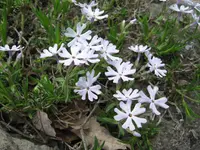
Cleft phlox (Phlox bifida) is a low, mat-forming perennial often used as a rock garden or edging plant. It creates dense, soft mounds that spill gently over stones or borders. Its narrow, needle-like leaves stay low to the ground, while spring flowers rise just above in shades of pale blue, lavender, or white, each petal distinctly notched or “cleft.” Native to dry, rocky areas of the Midwest United States, it is naturally adapted to well-drained, lean soils. This plant is generally easy to maintain once established, provided it has good drainage and plenty of sun. Understanding how to care for cleft phlox starts with avoiding heavy, wet soils and deep shade.

Care Difficulty
Easy Care

Light Preference
Full Sun

Water Requirements
Low Water

Temperature Preference
Cold Hardy

Hardiness Zone
4–8

Soil Texture
Sandy, Loamy, Rocky

Soil pH
Acidic (5.5–6.5), Slightly acidic (6.5–7.0)

Soil Drainage
Well-drained

Fertilization
Minimal (feed rarely)
Scan your plant to receive care tips personalized for your specific plant
Available on iOS and Android
Phlox bifida prefers bright conditions that support compact, floriferous growth outdoors.
Phlox bifida needs careful watering that matches its preference for dry, well-drained conditions.
This species is a cold-hardy perennial adapted to temperate outdoor climates with seasonal temperature swings.
Humidity is rarely a concern for Phlox bifida, which is adapted to dry, open sites.
Phlox bifida performs best in lean, sharply drained mineral soil that never stays waterlogged.
This species can be grown in containers if given a very fast-draining, sun-exposed setup similar to a rock garden.
Phlox bifida benefits from light, targeted feeding but grows acceptably in lean soils.
Phlox bifida needs only modest pruning to maintain a compact, floriferous mat.
This mat-forming perennial is usually grown in the ground, with transplanting more relevant than repotting.
Phlox bifida is commonly propagated by division, stem cuttings, and seeds under suitable conditions.
Phlox bifida is generally cold hardy in much of the US and needs minimal winter care in the ground.

Plant Health Check
Not sure what's wrong with your plant? Check your plant's health inside the app.
Each flower has five deeply notched petals that look like ten, which increases the apparent size of the floral display and helps attract early-season pollinators in sparse spring habitats.
This species is naturally restricted to dry, sandy, or rocky sites in the Midwestern U.S., often on dunes, glades, or open pine–oak woods where many other perennials struggle to survive.
The plant forms low, dense, semi-evergreen mats that can persist through mild winters, helping stabilize thin soils and creating small microhabitats for invertebrates and other ground-dwelling organisms.

Phlox bifida is considered regionally uncommon and is tied to specialized, often declining habitats such as sand prairies and glades, so wild populations can be sensitive to habitat fragmentation and development, making responsible sourcing from nurseries important if you want to grow Phlox bifida in gardens.
This species spreads slowly by short stems and gentle self-seeding, forming low mats over time. It does not usually behave aggressively in garden settings and is easy to keep within defined borders with light edging.
Keep your plants happy and healthy with plant identification, disease detection, and easy care guidance.