New Zealand flax Care (Phormium tenax)

Also known as: Lowland flax, Swamp flax
New Zealand flax

About New Zealand flax

New Zealand flax (Phormium tenax) is an evergreen perennial grown for its strong, sword-like leaves that form dense, upright clumps. Mature plants can become architectural focal points in gardens and landscapes. Native to New Zealand’s coastal and lowland areas, it is adapted to wind, salt spray, and variable moisture, which makes it relatively tough and long-lived in cultivation. Its bold foliage and tall flower spikes also provide structure and movement in planting schemes. This species is generally straightforward to grow if given full sun, reasonably well-drained soil, and protection from extreme cold, and these traits influence how to care for New Zealand flax in most home gardens.

Main Plant Requirements

Care Difficulty

Moderate Care

Light Preference

Full Sun

Water Requirements

Moderate Water

Temperature Preference

Warm Climate

Hardiness Zone

8–11

Soil Texture

Sandy, Loamy, Organic-rich

Soil pH

Acidic (5.5–6.5), Slightly acidic (6.5–7.0)

Soil Drainage

Moist but well-drained

Fertilization

Minimal (feed rarely)

Get Personalized Care Plan

Scan your plant to receive care tips personalized for your specific plant

Available on iOS and Android

How to Care for the New Zealand flax

Phormium tenax grows best in bright, open conditions with strong but not extreme sun exposure.

  • Provide 6–8 hours of direct sun daily; in hot inland summers, prioritize morning sun with light afternoon shade to reduce leaf scorch.
  • Tolerates light or dappled shade, but New Zealand flax may develop looser growth and less intense leaf color if light drops below about 4 hours.
  • In cooler or coastal climates it can handle full sun all day; in very bright, reflective sites monitor for bleaching and tip burn and add light shade if needed.

Phormium tenax prefers evenly moist but not saturated soil, especially during its establishment phase.

  • Water when the top 3–5 cm of soil feels dry, applying a slow, deep soak so moisture reaches the full root zone rather than frequent light splashes.
  • Reduce watering in cool or rainy seasons, ensuring soil drains freely; avoid standing water or heavy clay that stays wet for more than 1–2 days.
  • Watch foliage for cues: browning, crisp tips often indicate underwatering, while yellowing leaves and a sour soil smell suggest overwatering and poor drainage.

This species handles a broad temperature range but performs best with moderate, stable conditions.

  • Optimal growth occurs around 60–75°F (16–24°C), where foliage development and color are most consistent.
  • Mature plants can survive brief drops to about 15–20°F (-9 to -6°C), but repeated hard freezes can damage leaves and young crowns.
  • Tolerates summer heat up to 90–100°F (32–38°C) if soil moisture is adequate; in heatwaves, mulch the root zone and protect from hot, drying winds when possible.

This species tolerates a wide humidity range and rarely needs special humidity management indoors or outdoors.

  • Target 30–60% humidity; the plant handles drier air better than many ornamentals due to its tough, fibrous leaves.
  • In centrally heated homes, New Zealand flax usually adapts without extra humidity, provided roots are not water-stressed.
  • Watch for browning leaf tips combined with very dry soil, a sign of combined drought and low humidity, and correct mainly by improving watering.

Phormium tenax prefers free-draining, moderately fertile soil that does not stay waterlogged.

  • Use a sandy or loamy mix with 30–40% coarse material such as sharp sand, fine gravel, or perlite to keep pore spaces open.
  • Aim for slightly acidic to neutral pH, roughly 6.0–7.0, which supports root function and nutrient uptake without additional amendments.
  • Blend in a modest amount of stable organic matter, such as mature compost, to improve moisture retention without turning the soil heavy.
  • Avoid compacted clay, peat-heavy mixes, or sites where water pools after rain, as prolonged saturation increases root and crown rot risk.

This species can grow successfully in containers when given a stable, well-drained setup.

  • Choose a wide, heavy container to counterbalance tall, wind-catching foliage and reduce the risk of tipping.
  • Select a pot deeper than the visible root mass to allow the strong, fibrous roots to anchor and stabilize the plant.
  • Raise the container slightly on feet or spacers so drainage holes clear quickly after watering or heavy rain.

Phormium tenax benefits from moderate feeding to support foliage color and steady growth.

  • Use a balanced slow-release fertilizer (around 10-10-10) or well-rotted compost at the start of spring.
  • Feed container-grown New Zealand flax every 6–8 weeks in spring–summer with a half-strength balanced liquid fertilizer.
  • Avoid high-nitrogen lawn products near the root zone, which can cause weak, floppy leaves.
  • Stop feeding in late summer so new growth hardens before winter and to prevent soft, frost-prone foliage.

Phormium tenax needs light, periodic pruning to keep clumps clean and well-shaped.

  • Best time is late winter to early spring before strong new growth starts.
  • Cut out dead, damaged, or heavily spotted leaves at the base using sharp, clean pruners.
  • Thin a few crowded inner leaves to improve air flow and maintain a neat, fan-like outline.
  • Avoid cutting across healthy leaves; remove whole leaves at ground level to prevent frayed tips.

Phormium tenax is most often transplanted in the ground but can be shifted or potted on when crowded.

  • Plan transplanting or repotting for early spring or early fall when temperatures are mild.
  • Look for roots circling the pot, water running straight through, or slowed growth as cues to move it up 1 pot size.
  • Lift with as much root ball as possible, handle roots gently, and set at the same soil depth in well-drained soil.
  • Water deeply after moving, then keep soil just moist for 2–3 weeks to limit shock, avoiding heavy fertilization until growth resumes.

Phormium tenax is usually propagated by division, which preserves the parent plant’s color and form.

  • Divide clumps in early spring when new shoots are just emerging.
  • Lift the plant or a section, then separate fans with a sharp knife, ensuring each division has roots attached.
  • Trim excessively long leaves by one-third to reduce moisture loss while new roots establish.
  • Replant divisions into well-drained soil or pots, keep evenly moist, and provide bright, indirect light until growth strengthens.

Phormium tenax is moderately cold hardy but benefits from simple winter precautions in colder regions.

  • Mature plants tolerate brief drops to about 15–20°F, but young or potted plants are more vulnerable.
  • Apply a 5–8 cm mulch around the base, keeping it slightly away from the crown to insulate roots.
  • In zones colder than 8, move containers to a sheltered, frost-free spot with bright light.
  • In very windy or exposed sites, loosely tie leaves into a bundle to reduce leaf damage and snow accumulation.

Care Tips

Wind conditioning

In windy sites, allow young plants to flex naturally in moderate wind rather than staking immediately, as this helps build stronger root anchorage and reduces the risk of plants snapping once supports are removed.

Clump renewal

Every 5–7 years, lift and divide congested clumps in late winter, replanting only the youngest, healthiest fans from the outer edge to maintain strong color and upright form.

Sharp leaf management

When leaves encroach on paths or play areas, trim them back to a V-shape rather than cutting straight across, which reduces fraying and keeps the plant looking neater while still avoiding sharp edges at eye or hand level.

Snow and ice relief

In regions with occasional snow or ice, loosely gather the leaves with soft twine before storms and gently shake off heavy accumulation to prevent fans from splaying or snapping at the base.

Mulch ring control

Maintain a 5–10 cm deep, weed-free mulch ring around the plant, but keep mulch pulled back 5–8 cm from the crown to discourage crown rot and make routine inspections for pests easier when growing New Zealand flax.

Common Pests and Diseases

Mealybugs

This pest feeds on leaf bases and in the crown, sucking sap and excreting sticky honeydew that can lead to sooty mold. Symptoms include white, cottony clusters in tight leaf axils and general loss of vigor.

Solution

Isolate affected plants, then use a strong stream of water to dislodge visible insects from leaf bases. Follow with repeated applications of a ready-to-use insecticidal soap or horticultural oil, making sure the spray penetrates into the crown and between tightly packed leaves.

Scale insects

These insects attach firmly to leaves, often along midribs, appearing as small, raised brown or gray bumps that cause yellowing and weakening of foliage. Honeydew may encourage black sooty mold on the stiff leaves.

Solution

Physically scrape off accessible scale with a soft brush or cloth, then treat remaining insects with horticultural oil, coating both upper and lower leaf surfaces and the leaf bases. Repeat treatments every 7–10 days until new growth appears clean and populations are suppressed.

Soft rot

This disease typically begins in the crown, causing a foul smell, softening of the leaf bases, and sudden collapse of central fans. Symptoms include water-soaked tissue at the base and easy leaf pull-out.

Solution

Remove and discard the entire affected plant if the crown is badly rotted, as recovery is unlikely. For early, localized cases, cut out all soft tissue, improve soil drainage and reduce overhead watering, keeping water away from the crown, and avoid high-nitrogen fertilization that encourages lush, weak growth.

Leaf spot

This disease causes elongated brown or purple-brown lesions on leaves, often with yellow halos, which can merge and make foliage look tatty and discolored. Symptoms include premature leaf dieback from the tips inward, especially in humid or overcrowded plantings.

Solution

Prune and dispose of affected leaves to reduce inoculum, avoiding overhead watering that keeps foliage wet for long periods. Improve air circulation around clumps, water at soil level, and, if spotting is severe and recurring, apply a labeled broad-spectrum fungicide to new and existing leaves during warm, humid periods as part of broader Phormium tenax care instructions.

Interesting Facts

Fiber uniquely structured

The leaves contain long, strong fibres arranged in bundles within the leaf tissue, giving the plant high tensile strength that made it historically valuable for ropes, fishing lines, and woven materials.

Important wetland stabilizer

In its native New Zealand, this species commonly grows in coastal and wetland areas, where its dense root system helps bind and stabilize soil, reducing erosion in windy and flood-prone sites.

Specialist bird pollination

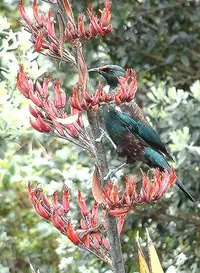
The tubular, nectar-rich flowers are adapted for pollination by native New Zealand birds such as tūī and bellbird, which have curved beaks that fit the flowers and transfer pollen as they feed.

Botan icon

Did you know?

Traditional Māori cultivation of this plant involved selecting and naming distinct leaf forms, with certain named varieties grown specifically for high-quality weaving of items such as cloaks, mats, and kete (baskets), a practice that created a rich horticultural and cultural classification system around the species.

FAQs about New Zealand flax

Leaf tips often brown from low humidity, salt buildup, or excess fertilizer. Wind scorch, intense reflected heat, or drought stress also cause browning. Remove damaged leaves, flush the soil occasionally, and adjust environmental stressors to stabilize growth.

Grow Healthy Plants with Botan Care

Keep your plants happy and healthy with plant identification, disease detection, and easy care guidance.

Botan plant care app — identify plants on mobile

Explore More Plants