Select natural substrates
Mount this lichen on rough, untreated bark or stone rather than smooth or coated surfaces, as a textured, slightly porous substrate helps the holdfasts anchor securely and promotes stable, long-term growth.

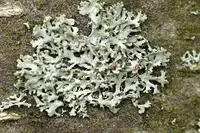
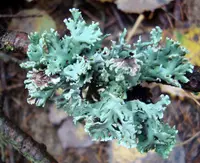
Rosette lichen (Physcia tenella) is a foliose lichen, not a true plant, formed by a partnership between a fungus and photosynthetic algae. It typically grows as small, flat rosettes with pale gray to bluish lobes and fine, hairlike edges.
This species commonly colonizes tree bark, fence posts, rocks, and old roofs across much of Europe and other temperate regions with clean or moderately clean air. It is generally slow-growing and sensitive to heavy air pollution, which makes it less suitable for polluted urban sites.
In suitable locations, it is relatively easy to keep stable, though it dislikes frequent handling, heavy shading, or waterlogged surfaces. Those conditions guide how to care for rosette lichen in outdoor or specialized display setups.

Care Difficulty
Moderate Care

Light Preference
Partial Shade

Water Requirements
Low Water

Temperature Preference
Cold Hardy

Hardiness Zone
3–9

Soil Texture
Rocky, Sandy, Loamy

Soil pH
Acidic (5.5–6.5)

Soil Drainage
Well-drained

Fertilization
Minimal (feed rarely)
Scan your plant to receive care tips personalized for your specific plant
Available on iOS and Android
Physcia tenella prefers bright, indirect light with moderate daily sun exposure.
Physcia tenella absorbs water from rain, mist, and ambient humidity rather than from soil like a typical plant.
This lichen tolerates a wide temperature range but grows best in cool to mild conditions.
This lichen prefers cool, consistently moist air and reacts quickly to very dry conditions.
In cultivation, Physcia tenella anchors to stable, mineral-rich surfaces rather than traditional soil.
This species can be grown in containers only as a mounted lichen display rather than a rooted potted plant.
Physcia tenella, a common rosette lichen, gains most nutrients from rain, dust, and its substrate, so extra fertilization is usually unnecessary.
Pruning Physcia tenella is rarely required and is mainly done to manage appearance or remove unhealthy sections.
This lichen is usually left on its natural host, but limited transplanting is possible for display or study purposes.
Propagation of Physcia tenella is done mainly by relocating small thalli rather than using seeds or cuttings.
This lichen is naturally cold hardy and needs no special winter care in typical outdoor conditions across most temperate regions.

Plant Health Check
Not sure what's wrong with your plant? Check your plant's health inside the app.
This species is highly tolerant of air pollution and is one of the first foliose lichens to colonize tree bark and man‑made substrates in towns and cities, so its presence often marks areas with at least moderately improved air quality compared to zones where only crustose lichens or no lichens occur.
It often forms pale gray rosettes on branches below bird perches and near road edges, where nitrogen-rich droplets and dust accumulate, reflecting its adaptation to slightly enriched, mildly eutrophicated bark surfaces.
Although most abundant on the bark of deciduous trees such as ash, willow, and hawthorn, it also occurs on conifers, fence posts, concrete, and roofing materials, showing a wide ecological amplitude for pH and surface texture.

This lichen frequently hosts specialized parasitic fungi, such as members of the genus Lichenoconium, which grow only on living lichen thalli and use its tissues as a substrate, making it part of a complex, multi-level micro-ecosystem on tree bark.
Growth is very slow. In good conditions it usually extends only a few millimeters per year. Growth rate depends strongly on clean air, stable moisture, and low physical disturbance, so urban or polluted sites often show almost no visible expansion.
Keep your plants happy and healthy with plant identification, disease detection, and easy care guidance.