Basal rejuvenation
Every 3–4 years, remove 1–3 of the oldest stems at ground level in late winter to keep the shrub vigorous, reduce congestion, and maintain strong new colored growth.

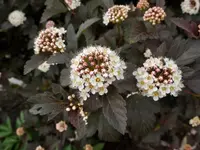
Eastern ninebark (Physocarpus opulifolius Diabolo) is a hardy, deciduous shrub valued for its deep burgundy foliage and peeling, layered bark. It forms a rounded, upright plant with clusters of small white to pinkish spring flowers followed by decorative seed capsules.
This shrub is native to eastern North America, where it typically grows along stream banks and rocky slopes. Its tolerance of cold, wind, and urban conditions makes it suitable for low-maintenance landscapes.
It is generally easy to grow, adapting to a wide range of soils as long as drainage is good. Full sun to light shade and moderate moisture support healthy growth, so learning how to care for Eastern Ninebark focuses mostly on placement and occasional pruning.

Care Difficulty
Easy Care

Light Preference
Full Sun

Water Requirements
Moderate Water

Temperature Preference
Cold Hardy

Hardiness Zone
3–7

Soil Texture
Sandy, Loamy, Clay

Soil pH
Acidic (5.5–6.5), Slightly acidic (6.5–7.0)

Soil Drainage
Moist but well-drained

Fertilization
Minimal (feed rarely)
Scan your plant to receive care tips personalized for your specific plant
Available on iOS and Android
This shrub colors and flowers best with strong outdoor light exposure throughout the growing season.
This shrub prefers evenly moist but not saturated soil, especially during its first 1–2 years.
This hardy shrub tolerates a wide range of outdoor temperatures once established.
This shrub tolerates typical outdoor humidity and rarely needs special humidity management.
Physocarpus opulifolius Diabolo prefers moderately fertile, well-structured mineral soil with reliable drainage.
This shrub can be grown in containers if the pot is large and stable enough for its vigorous root system.
This shrub is low maintenance, but moderate feeding supports strong growth and foliage color when growing Eastern Ninebark in lean soils.
Physocarpus opulifolius Diabolo responds well to thoughtful pruning that maintains size, health, and flowering.
This shrub is usually grown in the ground, so focus on correct transplanting rather than frequent repotting.
Physocarpus opulifolius Diabolo is commonly propagated vegetatively to maintain the exact foliage color and habit.
This shrub is cold hardy in most temperate climates and usually needs little special winter care once established.

Plant Health Check
Not sure what's wrong with your plant? Check your plant's health inside the app.
The deep purple foliage color comes from high concentrations of anthocyanins, which can partially mask chlorophyll and give the leaves a nearly black appearance in full sun while still allowing efficient photosynthesis.
As the shrub ages, its bark naturally peels in thin, curling layers that reveal lighter inner bark, creating a textured, multi-toned effect that is especially visible in winter after leaf drop.
The dense, arching branches and persistent multi-stem framework provide good nesting cover and shelter for small birds, while the nectar-rich white-pink spring flowers support pollinating insects.

This cultivar was selected from the North American species Physocarpus opulifolius specifically for its unusually dark foliage that holds its color through summer without the leaf scorch that affects many other purple-leaved shrubs, which has made it a reference standard for Physocarpus opulifolius Diabolo plant care trials and comparisons in public gardens.
This shrub forms a broad, multi-stemmed clump but usually stays where it is planted. It can widen slowly at the base, yet it is not considered invasive in typical North American garden settings.
Keep your plants happy and healthy with plant identification, disease detection, and easy care guidance.