Use sturdy staking
Install strong stakes or a low wire fence early in the season to keep the tall, heavy flowering stems upright and to prevent wind damage or lodging in wet soil.

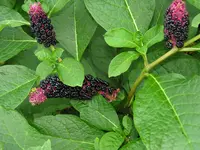
Indian pokeweed, Phytolacca acinosa, is a fast-growing perennial herb that forms leafy clumps with thick, fleshy stems and elongated clusters of white to pink flowers. These are followed by showy dark purple berries that often attract attention in late summer and autumn.
The species is native to parts of Asia but is grown ornamentally in gardens elsewhere, sometimes spreading by self-seeding. It tolerates a range of soils and can be vigorous, which makes it easy to establish but occasionally hard to control.
Gardeners who want to care for Indian Pokeweed should note that it generally prefers sun to light shade and consistently moist, well-drained soil, especially during its main growing season.

Care Difficulty
Easy Care

Light Preference
Partial Shade

Water Requirements
Moderate Water

Temperature Preference
Cold Hardy

Hardiness Zone
5–9

Soil Texture
Loamy, Silty, Organic-rich

Soil pH
Acidic (5.5–6.5), Slightly acidic (6.5–7.0)

Soil Drainage
Moist but well-drained

Fertilization
Minimal (feed rarely)
Scan your plant to receive care tips personalized for your specific plant
Available on iOS and Android
Phytolacca acinosa prefers bright outdoor conditions with moderate direct sun and some daily shade.
This species prefers consistently moist, well-drained soil rather than very dry or waterlogged conditions.
This hardy perennial tolerates a wide outdoor temperature range but responds best to mild, stable conditions during active growth.
Humidity is rarely a limiting factor for Phytolacca acinosa grown outdoors.
Phytolacca acinosa prefers deep, moist, well-aerated soil with steady drainage.
This species can be grown in containers, but the plant’s strong root system needs careful management.
Phytolacca acinosa generally needs minimal feeding in average garden soil but responds to light nutrition in poorer sites.
Phytolacca acinosa benefits from light, targeted pruning to manage size and maintain plant health.
This species is usually grown in the ground, so focus on careful transplanting rather than frequent repotting.
Phytolacca acinosa is most often propagated from seed, which establishes new plants reliably under the right conditions.
This hardy perennial generally tolerates typical winters in temperate regions with little intervention once established.

Plant Health Check
Not sure what's wrong with your plant? Check your plant's health inside the app.
This species develops long, upright racemes where green berries ripen to a deep purplish-black, a feature that helps distinguish it from the drooping clusters of the related American pokeweed Phytolacca americana.
It is native to montane and submontane regions of East and South Asia, often occurring along forest margins, roadsides, and disturbed slopes from the eastern Himalayas through parts of China and Japan.
Introduced as an ornamental and sometimes as a dye plant, it has naturalized in several parts of central and southern Europe, where it can behave as an invasive species by forming dense stands in light-rich woodland and shrub habitats.

Mature individuals often develop a thick, fleshy taproot that can reach notable size relative to the above-ground stems, enabling the plant to resprout vigorously after cutting and to persist for years in the same site even where aerial shoots are removed regularly.
This species self-seeds freely and can form dense clumps if not managed. Birds disperse the berries, spreading seedlings. Regular deadheading, prompt removal of unwanted seedlings, and root removal when young help keep it contained.
Keep your plants happy and healthy with plant identification, disease detection, and easy care guidance.