

Red Spruce Identification (Picea rubens)

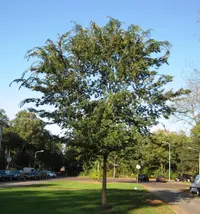
Recognize Red Spruce by its short, four-sided needles borne singly all around the twig, rough twigs with tiny peg-like leaf bases, and narrow, conical form.

Mature trees usually keep a straight trunk and a dense crown, while the reddish-brown bark breaks into thin, irregular scales.

Picea rubens Identification

Check Your Plant ID

Upload a plant photo and check the identification in seconds.

Clear images work best. Avoid photos taken too close or too far away

Check the overall form, needles, and cones of Red Spruce.

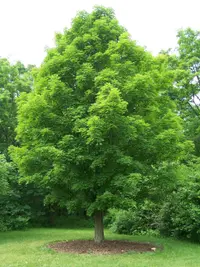
  • A narrow, spire-like evergreen with a straight trunk and dense, layered branches.
  • Needles are single, stiff, and attached all around the twig, not in flat sprays.
  • Each needle is short, about 1/2 to 5/8 inch (1.3 to 1.6 cm) long, and four-sided in cross-section.
  • Twigs often look rough after needles drop because short woody pegs remain.
  • Cones are hanging, light brown, and relatively small, usually about 1 1/2 to 2 inches (4 to 5 cm) long.

Look at several twigs and a cone together for the most reliable visual check.

Picea rubens shows clear age-related changes in form, branching, bark, and cone production.

  • Seedling: Seedlings carry a thin upright stem with short, crowded needles; the first branches are sparse, leaving a narrow, simple outline.
  • Young plant: Young plants form a dense, sharply conical crown. Whorled branches become regular, and needles typically reach about 1/2 to 5/8 inch (1.3-1.6 cm).
  • Mature plant: Mature trees develop a tall, narrow spire with slightly drooping upper branchlets. Bark breaks into thin, flaky gray-brown scales on the trunk.
  • Fruiting stage: Cone-bearing branches show many hanging, cylindrical cones, usually 1 1/2 to 2 inches (4-5 cm) long, adding a textured, pendulous look.

Picea rubens stays needled year-round, so seasonal clues are subtle but useful. In spring, new shoots appear at twig tips as soft, lighter green growth that contrasts with the older, darker needles. By late summer into fall, hanging cones are easier to spot as they mature from reddish or greenish young cones to light brown. In winter, the dense conical outline and persistent needles remain visible.

A few northeastern conifers are regularly mistaken for Red Spruce.

black spruce(Picea mariana)

Often confused because both have short, dark green needles and small cones. Black spruce usually has stiffer, more crowded needles and rounder cones, often under 1 inch (2.5 cm), while Picea rubens has slightly longer needles and more elongated cones.

Norway spruce(Picea abies)

Young trees can look similar at a glance. Norway spruce is best separated by much larger cones, commonly 4 to 7 inches (10 to 18 cm), and strongly drooping branchlets; Picea rubens has smaller cones and a less pendulous outline.

Picea rubens is native to eastern North America, centered in the Appalachian Mountains from Pennsylvania south to North Carolina and Tennessee, with a broader range into New England and southeastern Canada. It is most often found in cool, moist high-elevation forests and mountain coves, commonly with fir and northern hardwoods. In the southern Appalachians, seeing a spruce in upper montane habitat helps narrow identification, because red spruce is one of the characteristic native conifers there.

Confirm It from a Photo

Use Botan to identify or verify the plant from an image, which helps avoid mix-ups before you label or buy it.

FAQ

Yes. This species is usually identified by its short, four-sided needles, rough twigs with tiny peg-like bases, reddish-brown scaly bark, and narrow cones. Flowers are brief and not usually needed for how to identify Red Spruce.

More Plant Identification Guides

Find the Plant. Get the Details.

Identify a plant from a photo with Botan, then view its profile, care information, and common problems.

Botan app identifying a plant from a photo
12 Most Wanted Rare Houseplants to Grow at Home

6 min read · 21 Sept 2026

12 Most Wanted Rare Houseplants to Grow at Home

Rare houseplants can turn an ordinary corner in your apartment into a living botanical collection. This guide covers 12 most admired picks, what makes them special, and how to grow them successfully at home.

Plant Recommendations

12 Most Wanted Rare Houseplants to Grow at Home
How Fast Does Bamboo Grow Per Day, Month, and Year

10 min read · 7 Jul 2026

How Fast Does Bamboo Grow Per Day, Month, and Year

Bamboo grows extremely fast: some species can reach 5-6 m in just 3-4 months under the right conditions. This guide explains how much bamboo can grow per day, week, and year, and what affects its growth rate.

Plant Recommendations
How Fast Does Bamboo Grow Per Day, Month, and Year
Top 5 Best Indoor Plants for Air Quality

5 min read · 11 Sept 2026

Top 5 Best Indoor Plants for Air Quality

Indoor plants can make a room feel fresher thanks to their air-purifying qualities. Here are 5 of the most suitable choices for your routine and living space.

Plant Recommendations
Top 5 Best Indoor Plants for Air Quality