
Whitebark Pine Identification (Pinus albicaulis)

To recognize Whitebark Pine, look for needles in bundles of five, each about 1.5 to 3 inches (4 to 8 cm) long, plus egg-shaped cones 2 to 3 inches (5 to 8 cm) long with no opening scales.

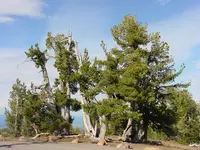
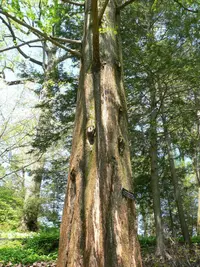
It often grows as a small, irregular tree with pale gray to whitish bark on mature trunks.

Pinus albicaulis Identification

Check Your Plant ID

Use a clear photo to confirm what plant you have.

Clear images work best. Avoid photos taken too close or too far away

Check the needles, crown, and cones first.

  • Needles grow in bundles of five, stiff and crowded near branch tips, usually 1.5-3 inches (4-8 cm) long.
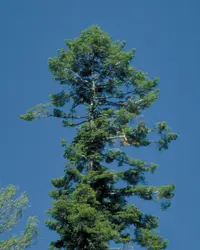
  • The crown is often broad, irregular, and windswept-looking rather than evenly conical.
  • Branches are thick and widely spaced, giving the tree a coarse, open structure.
  • Cones are short, egg-shaped, about 2-3 inches (5-8 cm) long, and sit near branch ends.

Older trunks often look pale gray to whitish and broken into small, scaly plates.

Pinus albicaulis shows useful age-related shifts in form, branching, bark, and cone display.

  • Seedling: A small upright stem carries soft juvenile needles in bundles of five, with sparse branching and a narrow, simple outline.
  • Young plant: Plants begin forming a compact, irregular crown; branches thicken and spread, while smooth gray bark still covers the main stem.
  • Mature plant: Older trees often become broad-crowned or wind-shaped, with stout limbs, pale scaly bark, and a height of 20-60 feet (6-18 m).
  • Fruiting stage: Cones become a strong clue: stout, purplish to brown, egg-shaped, and 2-3 inches (5-8 cm) long, clustered near branch ends.

Pinus albicaulis stays needled year-round, so the clearest seasonal clue is its cones. By late summer into fall, mature cones become visible near branch tips, remaining purple to dark brown and often breaking apart on the tree rather than dropping whole. In spring to early summer, new pale shoots and fresh needle growth can briefly soften the crown’s color and texture, but this change is subtler than the cone display.

Several high-elevation five-needle pines can be mistaken for Whitebark Pine.

limber pine(Pinus flexilis)

Both have needles in bundles of five and can grow in exposed mountain sites. Limber pine usually has longer needles, often 2 to 3 inches (5 to 8 cm), and its cones are longer and hang more clearly; Whitebark Pine has shorter, stiffer needles and more egg-shaped cones.

Swiss stone pine(Pinus cembra)

This species also has dense bundles of five short needles and a compact crown. It is usually more symmetrical, with a tidier, conical outline, while Pinus albicaulis often appears more irregular and wind-shaped. Its cones are also more cylindrical than broadly egg-shaped.

Pinus albicaulis is native to high mountains of western North America, from British Columbia and Alberta south through the Cascade and Sierra Nevada ranges to the Rocky Mountains of Wyoming and nearby states. It typically grows near treeline in subalpine and alpine habitat, often on exposed ridges, rocky slopes, and cold, windy sites, commonly around 4,900 to 12,000 feet (1,500 to 3,700 m). Finding a pine in these harsh upper-mountain settings helps narrow identification.

Does Your Plant Match?

Use Botan to compare a photo and confirm the plant, which helps avoid mix-ups with similar species.

FAQ

The quickest clue is its needles in bundles of five, paired with egg-shaped cones that stay mostly closed and a pale, chalky bark on older trunks. This combination is central to Whitebark Pine identification.

More Plant Identification Guides

Scan Your Plant. Get the Details.

Use Botan to identify a plant from a photo, then see plant details, care information, and common problems.

Botan app identifying a plant from a photo
12 Best Plants That Repel Spiders For Your Home and Garden

8 min read · 24 Jul 2026

12 Best Plants That Repel Spiders For Your Home and Garden

Spiders constantly appear in places you don't want them. A few common plants can help repel them using scent alone. Here are 12 options suitable for both indoors and outdoors, plus care tips for each.

Plant Recommendations

12 Best Plants That Repel Spiders For Your Home and Garden
When to Plant Hydrangeas: Best Time by Season and Type

6 min read · 30 Oct 2026

When to Plant Hydrangeas: Best Time by Season and Type

Hydrangeas grow best when you plant them in cool weather. This guide explains when to plant hydrangeas in your area, compares fall and spring planting seasons, and shows the right steps for each type.

Beginner Guides
When to Plant Hydrangeas: Best Time by Season and Type
How to Winterize Your Garden in 6 Steps

5 min read · 28 Sept 2026

How to Winterize Your Garden in 6 Steps

Learn how to prepare your garden for winter with a practical six-step checklist covering cleanup, tender plant care, watering, mulching, winter protection, and winterizing equipment and containers.

Plant Care
How to Winterize Your Garden in 6 Steps