Wind-firm training
In the first 3–5 years, lightly stake the young tree on the windward side and gradually loosen ties each season so the trunk flexes and develops strong taper rather than remaining weak and top-heavy.

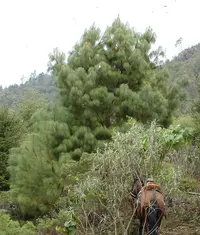
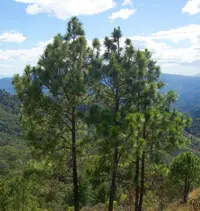
Smooth-bark Mexican pine, Pinus pseudostrobus, is a fast-growing evergreen conifer native to highland regions of Mexico and parts of Central America. It typically forms a tall, straight trunk with smooth grayish bark when young and long, soft needles in clusters, giving the crown a fine, airy appearance.
In its natural habitat, it often grows in mixed pine-oak forests and can adapt to a range of cool to warm climates. It prefers sun, well-drained soil, and moderate moisture, which makes it easier to manage in suitable outdoor spaces. Understanding how to care for Smooth-bark Mexican Pine starts with providing enough light and avoiding waterlogged conditions.

Care Difficulty
Moderate Care

Light Preference
Full Sun

Water Requirements
Low Water

Temperature Preference
Warm Climate

Hardiness Zone
9–11

Soil Texture
Sandy, Loamy, Rocky

Soil pH
Acidic (5.5–6.5), Slightly acidic (6.5–7.0)

Soil Drainage
Well-drained

Fertilization
Minimal (feed rarely)
Scan your plant to receive care tips personalized for your specific plant
Available on iOS and Android
This highland pine prefers abundant sun from an early age for strong, balanced growth.
This species prefers well-drained soil and moderate moisture, especially while establishing roots.
This pine is adapted to mild, highland climates with cool, dry seasons and moderate summer warmth.
This species handles a wide humidity range and rarely needs special humidity management outdoors.
This pine prefers sharply drained, mineral soils that mimic a rocky mountain habitat.
This fast-growing, large pine is only moderately suitable for temporary container cultivation when young.
This pine grows well in modest soils and usually needs only light, targeted feeding when young or container-grown.
Pruning needs for Pinus pseudostrobus are minimal and focus on safety and structure rather than shaping.
This species is usually grown in the ground, with container culture limited to young plants or bonsai.
Pinus pseudostrobus is mainly propagated from seed; vegetative methods are uncommon and technically demanding.
Mature trees are moderately cold tolerant and usually need little winter care in suitable climates.

Plant Health Check
Not sure what's wrong with your plant? Check your plant's health inside the app.
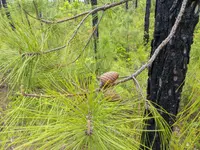
Its seed cones have distinctive cone scales with a small notch at the tip, a key trait used by botanists to separate it from closely related Mexican pines in the field.
This species is naturally found in montane zones of Mexico and parts of Central America, often forming pure or nearly pure stands on cool, moist slopes above roughly 1,800 m where many other pines do not compete as well.
In its native range it is widely planted in forest restoration and timber programs because it grows relatively fast, produces straight trunks, and shows good adaptation to degraded volcanic and montane soils.

Its long, flexible needles, usually grouped in 5s, can reach around 20–30 cm and hang in loose tufted bundles, giving mature trees a notably soft, drooping crown silhouette compared with many other Mexican pines.
This species is relatively fast-growing for a pine, often adding 30–90 cm of height per year in good conditions. Growth is quicker in deep, well-drained soils and mild climates, slower in compacted or dry sites.
Keep your plants happy and healthy with plant identification, disease detection, and easy care guidance.