Wind-hardening young trees
Stake only the first 1–2 years and allow some trunk movement so the tree develops strong taper and anchoring roots, then remove stakes completely to avoid girdling and wind damage later.


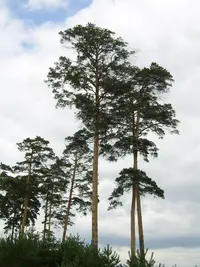
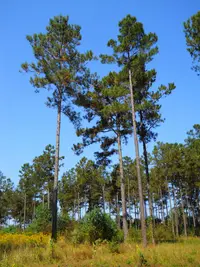
Blue pine, Pinus wallichiana, is a long-lived evergreen conifer known for its soft, bluish-green needles and gracefully pendulous branches. It typically grows as a tall, narrow to broadly conical tree with a strong central trunk.
This species is native to the Himalayas, where it forms forests on cool, mountainous slopes. In cultivation, it is valued as an ornamental tree for larger gardens and parks.
Its relatively fast growth, tolerance of cold, and general disease resistance make it moderately easy to care for Blue Pine if it has enough space. It prefers full sun, well-drained soil, and steady but not waterlogged moisture.

Care Difficulty
Moderate Care

Light Preference
Full Sun

Water Requirements
Moderate Water

Temperature Preference
Cold Hardy

Hardiness Zone
5–7

Soil Texture
Sandy, Loamy, Rocky

Soil pH
Strongly acidic (4.5–5.5), Acidic (5.5–6.5)

Soil Drainage
Well-drained

Fertilization
Minimal (feed rarely)
Scan your plant to receive care tips personalized for your specific plant
Available on iOS and Android
Pinus wallichiana prefers bright outdoor conditions with consistent sun exposure for strong, balanced growth.
Pinus wallichiana prefers evenly moist, well-drained soil, especially during its first few growing seasons.
This species is a cold-hardy mountain pine that prefers cool to moderate climates with distinct seasons.
This high-altitude pine tolerates a wide humidity range but prefers moderately moist air.
This species prefers cool, well-aerated, free-draining soil that does not stay waterlogged.
This pine can be grown in containers for some years, but it remains a long-term tree and may outgrow pots.
Pinus wallichiana grows reasonably well in average soil, but light feeding improves vigor in managed landscapes.
Pruning needs for Pinus wallichiana are moderate and focus mainly on safety, structure, and health.
This pine is usually grown in the ground, and transplanting young trees correctly is more important than container repotting.
Propagation of Pinus wallichiana is most reliable from seed and is generally done by nurseries rather than home growers.
Mature Blue Pine trees are cold hardy and usually need little special winter care in most temperate climates.

Plant Health Check
Not sure what's wrong with your plant? Check your plant's health inside the app.
This Himalayan pine forms long, soft needles in bundles of five that hang in a graceful, pendulous way, giving mature trees a notably weeping crown compared with most other pines.
In its native range of the western Himalayas, this species naturally grows on steep, rocky slopes at elevations roughly between 1,800–3,700 m, where it tolerates cold, wind, and relatively poor soils.
The species often forms mixed forests with deodar cedar (Cedrus deodara) and other montane conifers, providing important habitat and food resources for local wildlife through its dense canopy and seed-bearing cones.

In traditional Himalayan communities, the long, flexible needles and resin of this species have been widely used as fire-starting material and for thatching, bedding, and simple handicrafts, making the tree both an ecological and a practical cultural resource.
This species grows moderately fast for a conifer, typically adding 30–60 cm per year once established. Growth is slower in the first few years while roots develop, then increases under good light, moisture, and soil conditions.
Keep your plants happy and healthy with plant identification, disease detection, and easy care guidance.