Harvest Leaf Rotation
Rotate harvesting among several plants or clumps and take only the outer, mature leaves so each rosette can keep a strong center for continuous regrowth when growing Chinese Plantain.

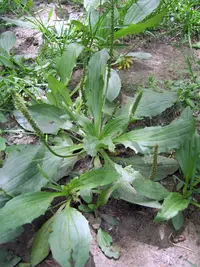
Chinese plantain, Plantago asiatica, is a small, low-growing perennial herb often forming flat rosettes of broad, glossy green leaves. It sends up short flower spikes with tiny, inconspicuous flowers that later produce small seeds.
This species is native to East Asia and commonly grows in lawns, paths, and open ground, showing good tolerance to foot traffic and compacted soils. It tends to be resilient and straightforward to grow, which makes it useful when learning how to care for Chinese Plantain.
Chinese plantain prefers consistent moisture, reasonably fertile soil, and light ranging from full sun to light shade, but it adapts well to many garden or container conditions.

Care Difficulty
Easy Care

Light Preference
Partial Sun

Water Requirements
Regular Water

Temperature Preference
Cold Hardy

Hardiness Zone
4–9

Soil Texture
Sandy, Loamy, Silty

Soil pH
Acidic (5.5–6.5), Slightly acidic (6.5–7.0)

Soil Drainage
Moist but well-drained

Fertilization
Minimal (feed rarely)
Scan your plant to receive care tips personalized for your specific plant
Available on iOS and Android
This species grows best with moderate sun and protection from harsh extremes.
Plantago asiatica prefers evenly moist soil that never stays saturated.
This plant handles a broad climate range but grows best in mild conditions.
Humidity is rarely critical for Plantago asiatica, which adapts well across typical home and outdoor ranges of 30–60%.
Plantago asiatica prefers loose, moisture-retentive but free-draining soil that does not stay waterlogged.
This species is suitable for container growing when moisture and root space are managed carefully.
Plantago asiatica grows in relatively poor soils and only needs light, targeted feeding in containers or depleted beds.
Pruning needs for Plantago asiatica are minimal and mainly focus on hygiene and appearance.
Plantago asiatica is more often grown in beds than in pots, so care focuses on transplanting rather than frequent repotting.
Plantago asiatica is commonly propagated by seed and by dividing established clumps.
Plantago asiatica is cold hardy in much of the US and generally needs little winter care.

Plant Health Check
Not sure what's wrong with your plant? Check your plant's health inside the app.
This species forms a low, flat rosette of leaves that hugs the soil surface, which helps it resist mowing and trampling in lawns and pathways.
Its seeds have specialized surface hairs that swell and become sticky when wet, anchoring the seeds to the soil and improving germination in disturbed ground.
In many East Asian cities it commonly colonizes cracks in pavement, compacted roadsides, and worn footpaths, showing high tolerance to soil compaction and moderate pollution.

In traditional East Asian agriculture, this species has long been used as a minor leafy vegetable and grain additive, and modern studies document its seeds and leaves as common ingredients in rural food practices rather than only as a weed.
This species spreads by seed and short rhizomes, forming low clumps or patches over time. In a garden bed it can self-seed, but it is usually not aggressively invasive if excess seedlings are removed.
Keep your plants happy and healthy with plant identification, disease detection, and easy care guidance.