Select mounting base
Use a rot-resistant, textured surface such as hardwood board, cork slab, or tree fern plaque so the roots can anchor firmly and the mount will not decay quickly under constant moisture.

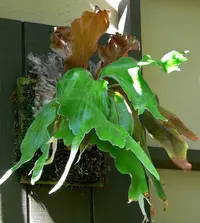
Platycerium stemaria is an epiphytic fern known as a staghorn fern, valued for its sculptural, forked fronds that resemble antlers. It naturally grows on tree trunks in tropical African forests, where it collects moisture and nutrients from rain, debris, and air rather than soil. The plant forms a layered shield of sterile fronds against its mounting surface, anchoring the plant and creating a pocket that traps organic material. Its need for bright, indirect light, steady warmth, and consistent but not excessive moisture makes it moderately demanding, but understanding how to care for Platycerium stemaria makes long-term success more reliable.

Care Difficulty
Moderate Care

Light Preference
Bright Indirect Light

Water Requirements
Moderate Water

Temperature Preference
Tropical / Frost Sensitive

Hardiness Zone
11–12

Soil Texture
Peaty, Organic-rich

Soil pH
Acidic (5.5–6.5)

Soil Drainage
Moist but well-drained

Fertilization
Light (every 4–6 weeks)
Scan your plant to receive care tips personalized for your specific plant
Available on iOS and Android
This epiphytic fern prefers bright, filtered light similar to bright forest shade.
This fern stores moisture in its shield fronds and needs careful, not constant, watering.
This species prefers warm, frost-free conditions similar to a tropical understory.
This fern prefers fairly humid air to keep fronds healthy and resistant to stress.
This epiphytic fern thrives in a loose, airy, fast-draining mount or mix rather than dense potting soil.
This species adapts well to container or mounted growing when stability and aeration are prioritized.
Nutrient needs are modest, but light feeding supports steady frond growth in Platycerium stemaria.
Pruning focuses on hygiene rather than shaping, as this fern naturally forms an architectural clump.
This species is usually mounted rather than potted, so transplanting focuses on refreshing the mount when growth outgrows its support.
Propagation is possible but slow, typically done by division of offsets rather than by spores for home growers.
This tropical fern is frost sensitive and needs mild, stable conditions through winter.

Plant Health Check
Not sure what's wrong with your plant? Check your plant's health inside the app.
This species develops large, deeply lobed sterile shield fronds that can overlap and stack in tiers, forming a pronounced funnel that traps water, leaf litter, and dust against the host tree.
It is naturally native to tropical Africa, especially in moist lowland and mid‑elevation forests, unlike many other commonly grown staghorn ferns that originate from Southeast Asia or Australia.
Its fertile fronds carry extensive, often continuous brown spore patches on the underside of the broad lobe tips, creating a solid felt-like surface rather than the more discrete clusters seen in some related species.

Mature individuals in suitable rainforest habitat can form such large, layered colonies on a single tree trunk that they create miniature composting pockets, where decomposing organic matter accumulates and supports a tiny, soil-like microhabitat for invertebrates and microbes high above the ground.
This species grows best mounted on wood or in slatted baskets with coarse, fast-draining media. Containers are possible but risk staying too wet. Ensure excellent airflow, secure mounting, and space for shield fronds to expand over time.
Keep your plants happy and healthy with plant identification, disease detection, and easy care guidance.